How to Remove the InShot Watermark From Your Videos (2026)
Mark Ma
Last updated: November 2026
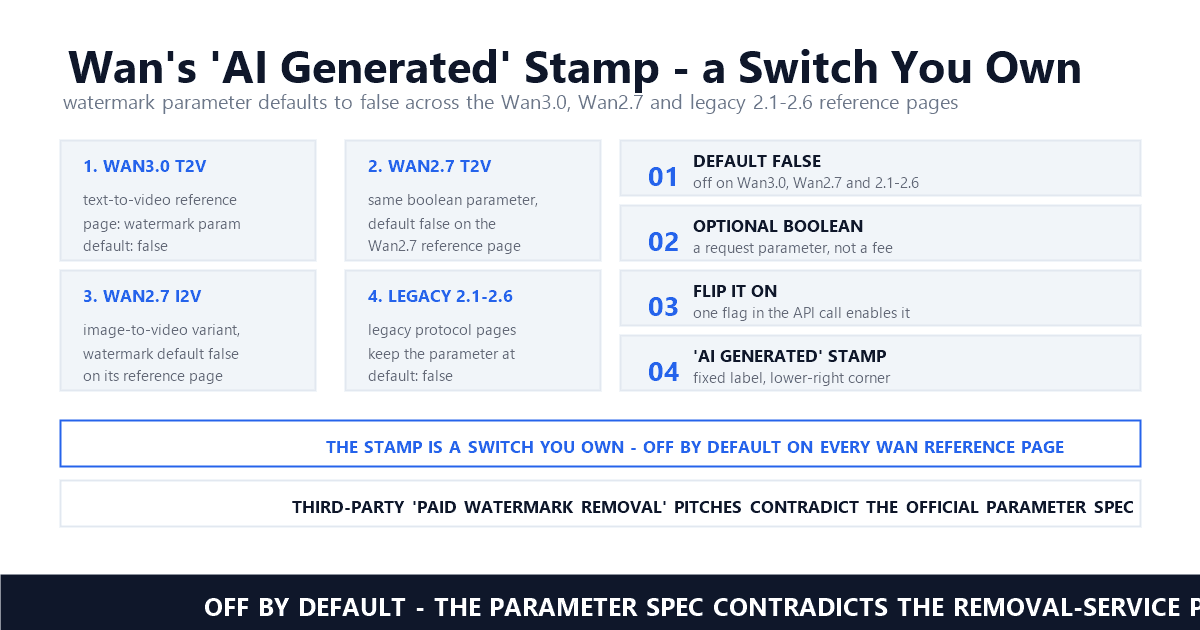
Type "Wan video watermark removal" into a search bar and paid tools line up for a stamp that Alibaba Cloud's API adds only on request. The Model Studio reference pages covering Wan3.0, Wan2.7, and the legacy 2.1 through 2.6 models describe the watermark parameter in the same words: optional, boolean, false by default. That one fact reframes most of the removal market built around this model family.
Removing watermarks is what our team does all day — UnMark, the cleanup product we run, exists for stamped footage, and Wan-named jobs reach our queue almost exclusively as wrapper-site exports, where the mark in frame belongs to a reseller's overlay rather than to Alibaba's model. Our analysis below reads only primary sources: four Model Studio API reference pages plus the official Wan2.2 model card on Hugging Face, fetched in November 2026.
Provenance is the verifiable record of where a piece of media came from, and it is precisely what the removal listings obscure here. Sort the actual objects apart — an API switch you control, a corner stamp you may have opted into, a wrapper brand you never agreed to — and the right action for each becomes obvious: request-level, region-level, or source-avoidance. Everything else is paying for problems your file does not have.
No — not unless you ask for it. On every Wan video endpoint in Alibaba Cloud Model Studio, the watermark parameter is optional and defaults to false. The Wan3.0 reference states it plainly: false means no watermark is added, true means one is. The stamp is a request option, not a baked-in fate.
The clearest wording sits in the Wan3.0 Video Generation API Reference, whose parameter table reads: "Whether to add a watermark. false: Default value, no watermark is added." — Alibaba Cloud documentation. Wan3.0 is the family's current flagship, "an All-in-One reference-based video generation model that supports Text-to-Video, Image-to-Video (first frame/first-last frame), and Reference-based Video Generation" — Alibaba Cloud documentation — shipping in preview as wan3.0-video, with a faster wan3.0-video-prime sibling beside it. Neither variant changes the watermark story: the switch is the same boolean on both.
Mechanically, "video generation tasks take a relatively long time (typically 1-5 minutes), the API uses asynchronous calls" — Alibaba Cloud documentation — so you submit a request, receive a task ID, and poll until the finished URL appears. Duration spans 2 to 30 seconds, with input video counting against that ceiling, and resolution tiers run 1080P, 720P, 480P. The watermark switch sits alongside these as a peer parameter, off unless someone flips it. We compared the four reference pages side by side, and the default never moves.
Pricing follows usage rather than marking: "Cost = Unit price (based on resolution) × Duration (in seconds)." — Alibaba Cloud documentation — so a watermarked request bills identically to a clean one. No surcharge applies for the stamp, no discount for skipping it — the option is free in both directions, which is as close to a policy statement as an API table ever gets. A model whose flag carries no price signal is a model whose vendor has no stake in your choosing it.
That default-off stance separates Wan from most models we cover. Kling's free tier burns its mark into every export and Seedance behaves similarly — the mechanics are documented in our Kling guide and our Seedance guide, and those always-on stamps are exactly why removal tooling exists for those platforms. Wan inverts the premise: the erasure question only arises after an opt-in, so the working question becomes who flipped the switch, not how to fight the model.
A small fixed label reading "AI Generated", placed in the lower-right corner of the frame. The Wan2.7 references describe the same stamp for text-to-video and image-to-video, and the legacy 2.1-2.6 page calls the text fixed. Position never varies, so a corner-aware cleanup handles it in one region.
Each page contributes a slightly different sentence, and together they pin the object down. The Wan 2.7 image-to-video reference: "Whether to add an \"AI Generated\" watermark in the lower-right corner of the video." — Alibaba Cloud documentation. The Wan2.7 text-to-video reference: "Adds a watermark in the lower-right corner with the text \"AI Generated\"." — Alibaba Cloud documentation. The legacy page for the older protocol is the most explicit of all: "The watermark is placed in the lower-right corner of the video with the fixed text \"AI Generated\"." — Alibaba Cloud documentation. Same corner, same wording, four documents spanning three generations of the model line.
Watermarking is the practice of burning a visible mark into the pixels themselves, which is why position matters for cleanup: a mark that never moves occupies one predictable region of the frame, and inpainting that region does not require tracking across shots. Our methods breakdown compares the trade-offs in our inpainting comparison — reconstruction keeps the framing, cropping changes the aspect ratio, blurring leaves a smear. For a static corner label, reconstruction wins on every axis that matters to a finished export.
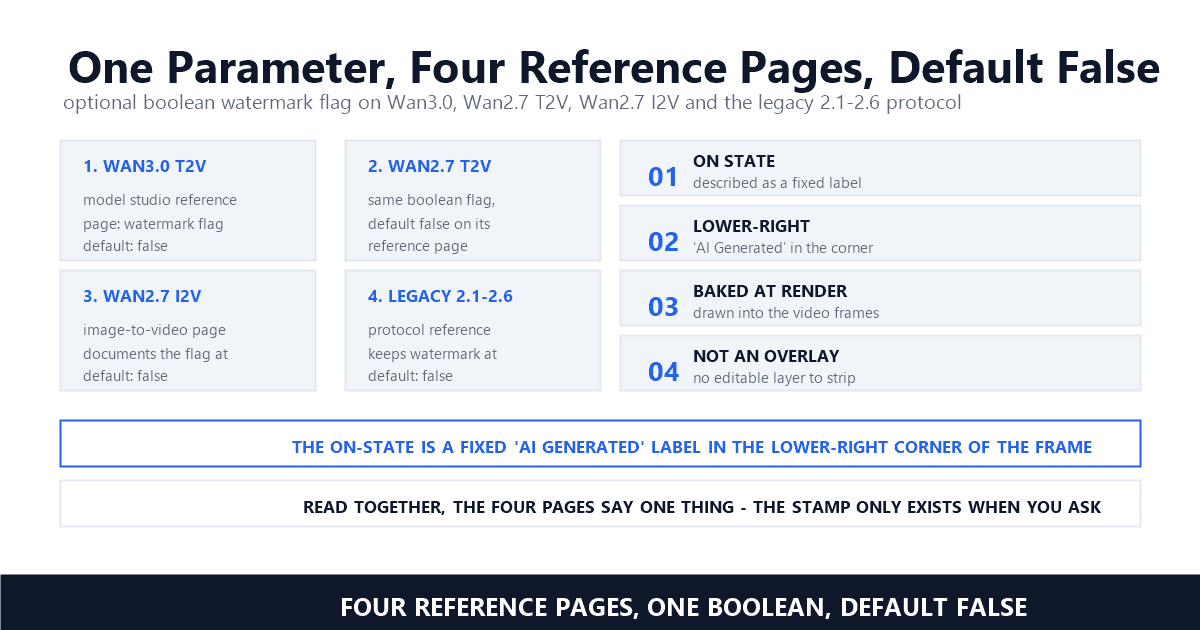
All of them that Model Studio documents. The current lineup runs from wan2.1 through wan3.0, and each API reference lists watermark as optional with false as the default. Wan3.0, in preview, generates up to 30 seconds at 30fps; Wan2.7 spans 2 to 15 seconds. One default governs the whole family.
The lineage is unusually well labeled. The legacy reference page announces its coverage outright: "This API uses the legacy protocol and supports wan2.6 and earlier models (wan2.5/wan2.2/wan2.1)." — Alibaba Cloud documentation — and its model table names wan2.6-t2v, wan2.5-t2v-preview, wan2.2-t2v-plus, wan2.1-t2v-turbo, and wan2.1-t2v-plus, each with its own resolution tiers from 480P up to 1080P defaults of 1920*1080. The current-generation pages then carry the identical watermark clause forward. Wan3.0 is described as able to "generate videos up to 30 seconds long at 30fps" while "currently in preview" — Alibaba Cloud documentation; Wan2.7 accepts durations from 2 to 15 seconds with 5 seconds as the default. Preview is the staging label Alibaba Cloud gives models whose behavior can still change, and even so, the watermark default has stayed false across every generation so far.
We observed one more consistency worth noting for pipeline builders: prompts accept up to 20,000 characters on Wan3.0 versus 1,500 on the wan2.6 and wan2.5 series and 800 on wan2.2 and wan2.1, and reference media is capped at 20 MB per image with clips up to 100 MB — every one of those limits is version-specific, while the watermark clause alone reads word-for-word alike. Version drift touches capacity, not marking. A request written for wan2.6 keeps its watermark semantics when retargeted to wan3.0-video, which is rarer in this industry than it should be.
Because the demand is keyword-shaped. Wrapper sites and local resellers stamp their own branding on Wan output, searchers meet that stamp, and tool listings answer with removal pages. The SERP for the phrase holds generic listicles and one academic paper — nothing from Alibaba, nothing grounded in the API reference.
Run the search yourself and the front page is the tell: a Chinese software-recommendation blog, Filmora's remove-watermark listicle replicated across its English, Spanish, and Indonesian properties, and an academic paper on visible watermark removal as a computer-vision problem. No page from Alibaba Cloud. No Help Center hit. Nothing that quotes the API reference — because quoting it would deflate the pitch. In our testing, files that arrive billed as "watermarked Wan output" split cleanly into two piles: exports whose single corner mark matches the documented "AI Generated" label, and wrapper exports carrying a reseller's logo, URL, or account stamp that no Alibaba document describes at all.
Wrapper is the loose industry name for a third-party site that resells model access behind its own interface and its own branding, and it explains nearly every stamp users report. The wrapper pays for API calls, adds its logo to the render, and the customer walks away believing the model itself stamped the video. The contrast with platforms whose free tiers genuinely mark every export — Hailuo, Pika, Vidu, each covered in our Hailuo guide, our Pika guide, and our Vidu guide — could not be sharper: there the mark is a pricing mechanism, here it is mostly an intermediary's brand riding on a model that ships clean by default.
There is a second path that skips the stamp entirely. Alibaba's Tongyi Lab has released parts of this family as open weights: the Wan2.2 model card states "The models in this repository are licensed under the Apache 2.0 License." — Hugging Face — meaning anyone can download the weights and generate locally under permissive commercial terms. A locally generated Wan2.2 clip never transits any watermarking endpoint, so there is nothing to remove by construction. The removal market cannot survive contact with either fact: the API default or the open checkpoint.
Read the listings closely and a pattern repeats across every default-clean platform: tool pages enumerate formats — MP4, MOV, AVI, WebM — and promise one-click erasure, yet never name the model version whose output they supposedly repair. Genericism is the tell. A page grounded in Wan's actual documentation would open with the parameter table, because the table is the entire story; a page grounded in tool sales opens with urgency instead. When the underlying artifact is opt-in by design, the honest product decision is to say so — and the honest reader decision is to close the tab.
For output you generated, the question rarely bites: the default export carries no stamp at all. If you switched watermark on, the mark is cosmetic on your own file. Red lines appear elsewhere — China's labeling rules protect mandated marks, Section 1202 targets fraudulent removal, and laundering AI clips as camera footage is deception.
Start with the jurisdiction that hosts the model. China's content-labeling measures, in force since September 2025, require explicit and implicit labels on AI-generated content and penalize malicious deletion or alteration of them; our China labeling guide maps the articles. The optional "AI Generated" stamp is Alibaba's service-level mark rather than the mandated implicit label, but re-publishing Wan output through domestic channels puts the statutory labeling regime on your file regardless of what the API did.
In the United States, Section 1202 reaches removal of copyright management information carried in or on a work with intent to enable infringement — our 1202 explainer unpacks the fraud requirement. A visible corner stamp is not copyright management information unless copyright records ride along with it, so the ordinary case stays ordinary. Europe adds a disclosure layer: Article 50 of the AI Act expects machine-readable marking on synthetic media, the clauses detailed in our EU AI Act explainer, and stripping provenance signals before distribution is the fact pattern those duties anticipate.
The settled framing holds across regimes: cleaning cosmetic marks from your own generations is normal asset hygiene, the position argued in our ownership pillar and our 2026 legality guide. The conduct to refuse is relabeling synthetic output as camera footage — that compounds platform penalties with deepfake exposure, and no cleanup tool absolves it. Wrapper marks deserve their own caution: someone else's branding is someone else's property, and scrubbing it does not make the underlying usage yours.
Set watermark=false at request time and you never need removal. Keep the original export because Alibaba purges result URLs after 24 hours. If you do enable the stamp on your own video, a single lower-right region cleans up; batch jobs and API pipelines stay routine either way.
The storage warning is not cosmetic. "Video URLs are valid for only 24 hours and then automatically purged." — Alibaba Cloud documentation — so a finished render that you do not download within a day ceases to exist on their side; the file lands as MP4 with H.264 encoding, which every editor accepts without transcode. Polling is the pattern of asking a task endpoint for status on a fixed interval until a job completes, and Wan's 1-5 minute window rewards a 5 to 10 second poll cadence rather than hammering the endpoint. Pull the file down, archive it, and treat the cloud copy as disposable. We have watched the alternative end badly enough times to keep this rule pinned in our own queue: a finished render left past the 24-hour mark simply stops resolving, and the only copy that survives is whichever stamped re-export someone grabbed from a wrapper site instead.
If a Wan-named clip does show up stamped — because a wrapper added branding or someone flipped the switch — the fix is the same one we run for every platform: verify the mark's region, reconstruct it, ship. Our batch pipeline in our batch-cleanup guide processes corner-labeled files identically whether the label says "AI Generated" or a reseller's name, and the source-first principle in our source-first guide applies with unusual force here: when the source platform offers a no-watermark export by default, the correct removal step is zero. For provenance-aware teams deciding what signals to keep or strip, our SynthID versus C2PA breakdown covers the invisible side.
One habit closes most of this topic: generate, download, and archive within the same hour. The 24-hour purge is generous for iteration and hostile for procrastination, and every nightmare story about lost renders traces back to treating a temporary URL as storage. Archive the clean default export, note in your project whether watermark was ever enabled, and keep the request payload alongside the file — future you will not remember which flag produced which artifact, and provenance documentation costs one JSON snippet today versus one forensic session next quarter.
Does Wan AI video have a watermark?
Not by default. Every Model Studio API reference for Wan documents the watermark parameter as optional with false as the default, and the Wan3.0 page states plainly that no watermark is added unless a request sets it. The "AI Generated" corner stamp is an opt-in: whoever wrote the request chose it, which makes the honest removal route re-rendering without the parameter rather than editing pixels afterward.
How do I remove the Wan "AI Generated" watermark?
Rerun the generation if you control the original request — watermark defaults to false, so the cleanest export is the default one. When re-rendering is off the table, the stamp's fixed lower-right position means single-region reconstruction handles it without touching the rest of the frame; our inpainting comparison covers why reconstruction beats cropping or blurring for a static corner label.
Why does my Wan video have a watermark I never asked for?
Almost always because the clip arrived through a wrapper site that stamps its own branding before delivery — the model itself ships clean by default and its open Wan2.2 weights generate locally with no marking endpoint in the path at all. Check the mark: fixed "AI Generated" text in the lower-right corner matches the documented stamp; a logo, URL, or username is the reseller's overlay.
Last updated: November 2026
Alibaba Cloud Model Studio documentation — Wan3.0 Video Generation API Reference (accessed November 2026)
Alibaba Cloud Model Studio documentation — Wan 2.7 image-to-video API (accessed November 2026)
Alibaba Cloud Model Studio documentation — Wan2.7 text-to-video API reference (accessed November 2026)
Alibaba Cloud Model Studio documentation — Wan text-to-video API reference (2.1-2.6) (accessed November 2026)
Hugging Face — Wan-AI/Wan2.2-T2V-A14B model card (License: apache-2.0) (accessed November 2026)
Mark Ma is the founder and lead engineer at UnMark, where he leads the development of AI-powered video watermark removal technology. With over a decade of experience in computer vision, deep learning, and video processing, he has built production systems that process millions of frames per month across TikTok, Instagram Reels, and Google Veo content. His technical work focuses on motion-compensated watermark detection, spatial-temporal inpainting, and quality-preserving reconstruction for short-form vertical video. Before UnMark, Mark shipped computer vision infrastructure at scale for content moderation and ad compliance platforms. He writes this blog to document the real engineering, testing, and regulatory reasoning behind UnMark's processing pipeline — every test result, frame analysis, and benchmark published here is reproduced from actual production data, not synthetic examples. His goal is to give creators, brands, and regulators a verifiable technical reference for AI video watermark removal in 2026.