COPIED Act vs Watermark Removal: What's Actually Illegal (2026)
Mark Ma
Last updated: October 2026
The searches for seedance video watermark removal have a peculiar shape: half the results promise that Seedance never watermarks anything, and the other half sell tools to remove a watermark that the first half insists does not exist. Both sides cannot be right, and people using ByteDance's video model are paying for the confusion in wasted credits, broken client deliverables, and upgrade decisions based on advice that contradicts the vendor's own documentation.
My day job is building UnMark, a watermark removal product, and we treat platform-protected marks as out of scope — so when a model this popular sits at the center of contradictory advice, I read the primary sources the way I would read a contract. For Seedance that meant the ByteDance Seed launch blog, the Volcengine and BytePlus API references, Dreamina's official pricing pages, and the paid-service agreement that governs 即梦 (Jimeng), the Chinese consumer app on the same model family. Those documents settle the question, and they do so more precisely than any of the posts currently ranking for it.
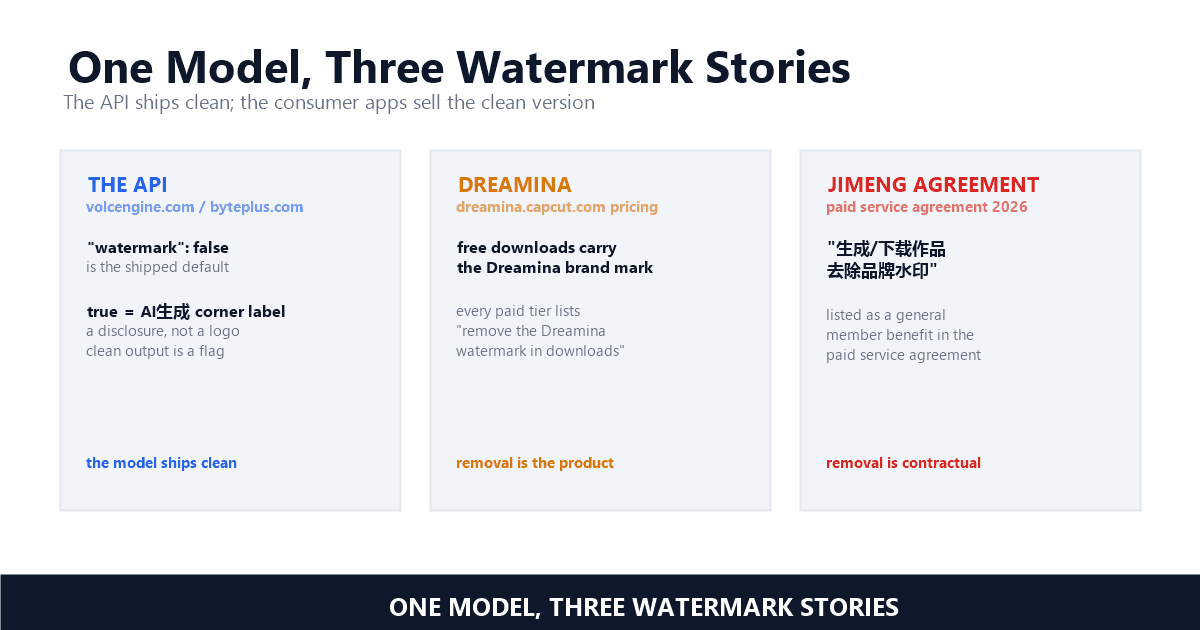
The short version: the model's API ships with no watermark and can add only an opt-in AI-generated disclosure label; the consumer platforms stamp free downloads with a brand mark and sell the removal as a paid benefit. Everything else — the rumors, the tool landing pages, the comparison tables — is noise around those two facts.
No — not by default. The Seedance video generation API exposes a watermark switch that ships set to false, and the only mark it can add when you flip it on is a small AI-generated disclosure in the corner, not a brand logo. The brand stamps come from the platforms around the model, not the model itself.
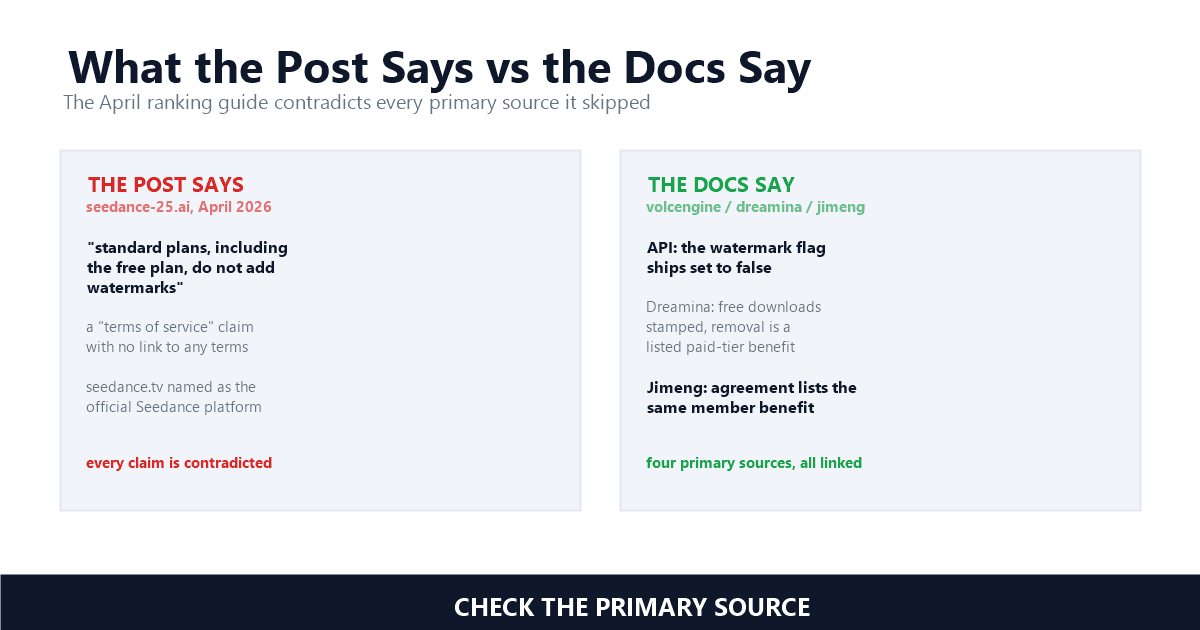
Volcengine, ByteDance's cloud platform that hosts the Seedance family for developers, documents the parameter in its Seedance 2.0 API reference: "生成视频是否包含水印。枚举值:false:生成视频不含水印。true:生成视频右下角会展示 AI生成 水印。" — Seedance 2.0 API Reference, Volcengine. Translated: whether the generated video contains a watermark — false means no watermark, true means the bottom-right corner displays an AI-generated mark. The default is false. The official code samples for the same endpoint — curl, Python, and Java — all set watermark to false explicitly, and a companion note in the reference adds that the last-frame preview image returned by a separate parameter ships 无水印 — watermark-free — as well.
BytePlus, the international edition of the same stack, carries the identical switch in its video generation operator: optional, false, no watermark unless you ask. One detail on that sheet accidentally explains a lot of the public confusion — the model IDs themselves are strings like dreamina-seedance-2-0-260128, fusing the consumer brand and the model name into one identifier. When the API's own naming blurs model and platform, a thousand blog posts were always going to blur them too. And that matters legally: when the flag is turned on, the corner mark is a disclosure under China's AI content labeling regime — the labeling rules we covered in depth — not decoration, and deleting it is a different offense than tidying a logo.
Because Dreamina, the official consumer home for Seedance, applies its own brand mark to what free accounts download — and then lists the removal of that mark as a selling point on every paid tier. The mark is not the model's; it is the storefront's. That distinction is the whole game, and the platform's own pages state it plainly.
Dreamina's official Seedance 2.0 generator page lays out its subscription ladder — Basic, Standard, Advanced, Ultra — and each tier's benefit list includes the same line: remove the Dreamina watermark in downloads. The pricing guide, refreshed in September 2026, frames the free entry the same way: "Free-credit amounts, watermarks, model access, and plan terms may vary, so check the current Dreamina product and subscription pages before generating." — Seedance 2.0 Pricing Guide, Dreamina. Watermarks listed right there between credits and model access — as a plan variable, on the vendor's own page. An official creator-guide page adds the free tier's texture: 225 daily tokens for all users, enough for a few high-end generations per day, all of them carrying the stamp unless you upgrade.
If you have read the Kling guide, the Pika breakdown, or the Runway export notes, none of this will surprise you. Brand watermarking is the freemium lever — the mark exists to be removed, and the removal is what the subscription sells. Hailuo runs the same play. Seedance's consumer layer is simply ByteDance's version of the industry-standard conversion mechanism, which is precisely why the claim that Seedance never watermarks anything — the claim in the next section — deserved a full audit.
The same dual-track structure, written out contractually. 即梦AI (Jimeng), the domestic consumer app on the Seedance model family operated by ByteDance affiliate Shenzhen Lianmeng Technology, states in its paid-service agreement that removing the brand watermark from generated and downloaded works is a member benefit — meaning free-tier downloads carry the mark by design.
The agreement, updated September 20, 2026 and effective September 27, defines the membership ladder — Basic, Standard, Advanced, and Super tiers for individuals, plus a team edition — and lists the general benefits every subscription grants: "会员专属生成通道、生成/下载作品去除品牌水印、以及其他为提升会员用户体验不时更新的会员通用权益" — Paid Service Agreement, Jimeng AI. In plain terms: a members-only generation channel, removal of the brand watermark from generated and downloaded works, and whatever else updates over time. When watermark removal appears in the general benefits clause of a binding agreement, it is not a rumor or a promotional trick — it is the product's documented architecture.
Independent material describes the free side the same way. A university lab tutorial updated in March 2026 walks students through Jimeng's video workflow and instructs them to expect a watermarked download on the free path, with membership as the route to a clean file. Between the agreement and that documented behavior, the domestic picture matches the international one mark for mark: free means stamped, paid means clean. The only real difference is the language of the paywall and the payment rails behind it.
Mostly from one ranking guide that merged the model with the platforms. An April 2026 post asserts that Seedance's standard plans, free plan included, do not add watermarks, cites unlinked terms of service, and points readers to seedance.tv as the official platform — not a ByteDance domain. The official consumer home is Dreamina; the developer home is Volcengine and BytePlus.
The same post states that "Seedance's standard plans, including the free plan, do not add watermarks to generated videos" and calls the policy "stated in Seedance's terms of service" without linking any terms. Its comparison table extends the error, awarding Seedance's free tier a clean pass while marking every competitor watermarked — Pika, Runway, Kling, Hailuo — and waving away Google's Veo in the same breath. The competitors' cells are roughly right; the Seedance cell is the problem. A reader who trusts the table generates on Dreamina's free tier, downloads a stamped file, and concludes their account must be broken — then searches for a remover and lands on a tool page. The misinformation and the tool listings feed each other, which is why the correction has commercial value and not just factual value.
To be fair, the confusion has an innocent-looking root. Seedance 2.0 launched officially on February 12, 2026, and within months its model IDs, its consumer storefront, and its API operator pages all interleave the words Dreamina and Seedance — dreamina-seedance-2-0-fast-260128 and friends — so a writer skimming documentation could reasonably conclude that Dreamina's watermark rules were Seedance's. But model-level facts and platform-level facts live in different documents, and the platform documents are unambiguous. The ranking post read the first document and wrote about the second.
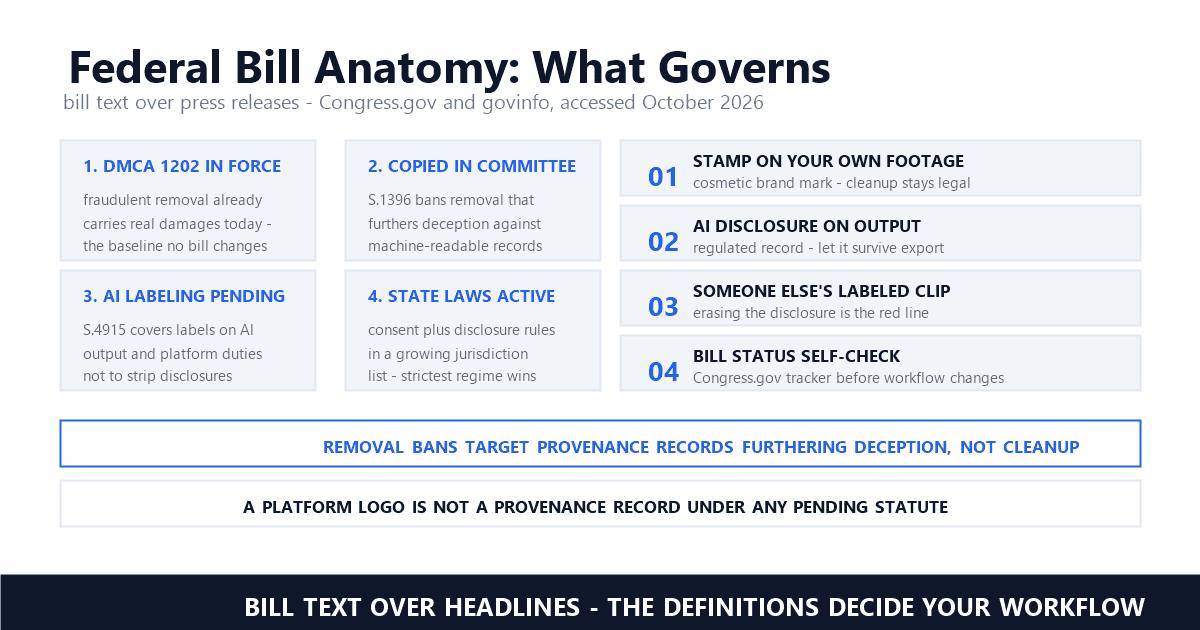
Run the four-question legality check and the answer arrives in layers: stripping the free tier's brand mark breaches the contract, and if the mark in play is the AI-generated disclosure rather than the brand stamp, Chinese law adds a statutory layer. The brand mark itself is usually not copyright management information, but that federal layer deserves its own look.
The contract layer first. The watermark on a free Dreamina or Jimeng download is the paywall — the agreement quotes above make removal a member benefit, which makes free-tier removal an end-run around the membership terms. Consequences live at the account level: terms across ByteDance's consumer properties allow limiting or suspending accounts that game the paywall, and DMCA §1202 enters only when the mark carries copyright management information, which a platform logo typically does not. The cleaner framing is the one the platforms themselves use: the removal is a product feature, and using the feature means paying for the product.
The statutory layer is sharper. On the API, the opt-in corner mark is a machine-readable-plus-visible disclosure under China's labeling regime, where Article 10 of the labeling measures penalizes malicious deletion and even distributing deletion tools. In Europe, the AI Act's Article 50 machine-readable marking obligations attach to providers and deployers regardless of what any visible logo says — so even a legitimately clean-looking export can carry obligations in its metadata. And when a mark does qualify as copyright management information, the federal text is blunt: "No person shall, without the authority of the copyright owner or the law—(1) intentionally remove or alter any copyright management information" — Legal Information Institute. Three regimes, three different triggers, one conclusion: identify which mark you are looking at before you touch it.
Inpainting, mostly — the same technology our own product applies to footage the user has the right to clean, redirected at marks the platforms gate. The ranking results are a wall of tool landing pages, and beneath their different packaging they all run one thing: a vision model that detects the mark region and rebuilds those pixels across frames.
The current SERP for seedance watermark removal illustrates the pattern: one page promises clean removal for ByteDance marks at transparent pricing, another pairs its remover with an AI upscale, a third tells you to skip removal and generate on its platform instead. The technique itself is legitimate — we analyzed its mechanics honestly in earlier breakdowns — the tradeoffs against cropping and blurring, and how mask size drives repair economics when a mark sits in a corner. A static bottom-right stamp is the easy case. What the tool pages skip is that on the Seedance ecosystem the removal they are selling is available from the vendor itself for the price of a plan — so the tool's only honest edge is for footage that predates your subscription or came from a source you cannot re-generate.
The open-source corner adds a second, quieter product: a Python toolkit surfaced by KitPloit that strips invisible signals — SynthID-style watermarks, C2PA manifests, EXIF and AIGC metadata — from images and video. Provenance is the trail a piece of media leaves about its own origin, and it lives below the frame where no logo ever renders. Removing provenance metadata is a different act from erasing a visible badge, with different legal weight — and on European-distributed content, it can run straight into the Article 50 obligations described above. Tool pages that conflate the two are not simplifying; they are hiding the riskier half.
Pick your track before you pick any tool — each has a legitimate clean path: developers set the API's watermark flag; consumer creators subscribe and download clean files as a plan benefit; and for footage you already have the rights to clean, dedicated removal exists. What no track includes is stripping the free tier's mark to dodge the paywall.
The developer track is the most direct. Grok Imagine hard-codes its mark with no setting and prohibits interference — Seedance is the friendlier vendor by contrast: the Volcengine and BytePlus references hand you a flag, default off, and the platform bills by the second. BytePlus's operator sheet lists unit prices of $0.242 per second on the basic tier and $0.303 on enhanced, scaled by resolution factors that run from ×0.4651 at 480p to ×5.0761 at 4K — so a team generating at volume buys clean output as a line item, not a workaround. Model output runs 4 to 15 seconds per clip at up to 4K, with returned links valid for 24 hours.
The consumer track is the simplest: subscribe on Dreamina or Jimeng and the brand watermark comes off your downloads as a listed benefit — promotional monthly pricing on Dreamina has ranged from $5 to $42 across the Standard, Pro, and Max tiers, and Jimeng mirrors the structure in its own four-tier ladder. Compared with the vendors whose marks are permanent — Sora's moving logo among them — ByteDance's consumer layer is refreshingly transactional about it. And if your queue holds watermarked footage you already have the rights to clean, batch removal over our documented pipeline exists for precisely that footage — based on our processing data, UGC handoffs and ad-platform compliance are the two cases we see most. The mark's origin decides the tool; the rights decide whether any tool should run at all.
Does Seedance 2.0 add a watermark on the free plan?
The model's API defaults to no watermark — the flag exists but ships off, and the optional mark is an AI-generated disclosure rather than a logo. Consumer platforms differ: Dreamina and Jimeng stamp free downloads with a brand mark and document removal as a paid benefit. Ask which layer you are on before asking whether a mark will appear.
Can you remove the Dreamina watermark without paying?
Not legitimately. The removal is a documented benefit of the paid tiers, so free-tier stripping breaches the membership terms, and tools that do it inherit that position. If the mark in play is the AI-generated disclosure rather than the brand stamp, China's labeling rules add statutory penalties for deletion on top of the contract layer.
Does the Seedance API output have a watermark?
By default, no. The Volcengine and BytePlus references document a watermark parameter that defaults to false, and official code samples leave it off; setting it to true places an AI-generated mark in the bottom-right corner as a compliance disclosure. ByteDance bills per second with resolution-based factors, so clean output is a pricing decision, not a workaround.
Last updated: October 2026
Mark Ma is the founder and lead engineer at UnMark, where he leads the development of AI-powered video watermark removal technology. With over a decade of experience in computer vision, deep learning, and video processing, he has built production systems that process millions of frames per month across TikTok, Instagram Reels, and Google Veo content. His technical work focuses on motion-compensated watermark detection, spatial-temporal inpainting, and quality-preserving reconstruction for short-form vertical video. Before UnMark, Mark shipped computer vision infrastructure at scale for content moderation and ad compliance platforms. He writes this blog to document the real engineering, testing, and regulatory reasoning behind UnMark's processing pipeline — every test result, frame analysis, and benchmark published here is reproduced from actual production data, not synthetic examples. His goal is to give creators, brands, and regulators a verifiable technical reference for AI video watermark removal in 2026.