Is It Legal to Remove Watermarks from AI-Generated Videos? 2026 Guide for Creators
Most creators removing watermarks from AI-generated videos don't realize they're navigating three overlapping legal frameworks: copyright law, platform terms of service, and emerging AI content regulations. I've spent the last two years building UnMark, and the legal question comes up in almost every customer conversation. "Is this actually legal?"
The honest answer is: it depends on what you're removing, why you're removing it, and where the video came from. This guide breaks down the specific statutes, platform rules, and 2026 regulatory changes that every creator should understand before processing AI-generated video content.
Why Watermark Law Matters More in 2026
Two things changed in 2025 that made watermark law suddenly relevant to everyday creators. First, AI video generation went mainstream — Google Veo, OpenAI Sora, and Runway Gen-3 all shipped production-ready models that output branded video. Second, regulators responded with new legislation specifically targeting AI content attribution.
The 2025 COPIED ACT (Content Origin Protection and Integrity from Deceptive Editing Act) was signed into law, requiring AI platforms to provide verifiable content origin information. The EU AI Act, which took effect in 2025, mandates that AI-generated content be marked in a machine-readable way. These aren't theoretical frameworks anymore — they're enforceable rules with real penalties.
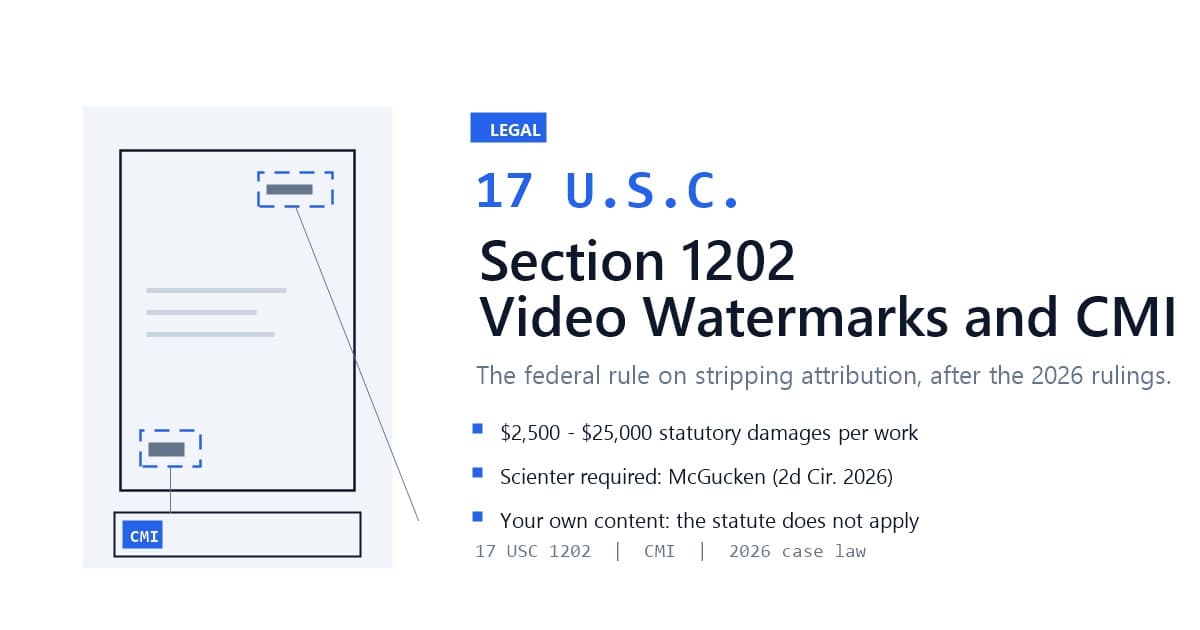
For creators, this means the watermark on your AI-generated video isn't just branding. It may be legally protected CMI (Copyright Management Information) under DMCA Section 1202, and removing it could trigger statutory damages of $2,500 to $25,000 per violation. At the same time, removing a visible watermark from your own AI-generated content for legitimate repurposing is generally defensible — if you understand where the legal lines are drawn. For a broader 2026 AI video watermarking industry overview, see our analysis of where the market is heading.
What Does DMCA Section 1202 Say?
DMCA Section 1202 is the provision most creators need to understand. It prohibits the intentional removal or alteration of Copyright Management Information (CMI) — which includes watermarks, credits, and identifying information attached to copyrighted works. Codified at 17 U.S.C. § 1202, it creates liability separate from copyright infringement itself. In my research into DMCA Section 1202, I found that AI platform watermarks qualify as CMI in nearly every documented case.
Key facts about Section 1202:
- Statutory damages: $2,500 to $25,000 per violation
- Intent requirement: The removal must be "intentional" — accidental removal isn't covered
- CMI scope: Includes "name of the author, title of the work, and identifying information"
- No actual damages required: Violations can be pursued even without proving financial harm
The critical question is whether an AI platform's watermark qualifies as CMI. In most cases, yes — a watermark like "Generated by Google Veo" functions as identifying information linking the work to its source. Removing it from content you don't own creates clear legal exposure.
However, Section 1202 has an important limitation: it protects CMI of copyrighted works. If you generated the video yourself using an AI tool, and the platform's terms of service grant you ownership of the output, the CMI analysis gets more nuanced. You're not removing someone else's CMI — you're deciding how to present your own content.
The framework isn't ambiguous about removing others' CMI — that's clearly prohibited, with courts applying Section 1202 to watermark stripping as far back as the early 2010s. The nuance lives entirely in how AI-generated content ownership works, and that's the part most creators skip past.
"No person shall, knowingly and with the intent to induce, enable, facilitate, or conceal infringement, intentionally remove or alter any copyright management information." — 17 U.S.C. § 1202(b)(1), DMCA

What Is the 2025 COPIED ACT?
The COPIED ACT (Content Origin Protection and Integrity from Deceptive Editing Act) is a 2025 federal law that establishes the first major U.S. framework for AI content provenance. Signed in response to the explosion of AI-generated media, it creates obligations that simply didn't exist under prior copyright law, filling the gap between traditional CMI protection and modern AI content distribution:
- Machine-readable origin: Requires AI platforms to provide content origin information in a machine-readable format
- Consent requirement: Prohibits the removal of content provenance information without consent
- Private right of action: Gives creators a legal cause of action for unauthorized removal
- FTC enforcement: Directs the Federal Trade Commission to enforce provisions against non-compliant platforms
The COPIED ACT doesn't replace DMCA Section 1202 — it adds a parallel layer of protection specifically for AI-generated content. This means removing provenance information from an AI-generated video could violate both statutes simultaneously, doubling the legal exposure.
For creators using tools like UnMark to process their own AI-generated content, the key distinction is consent. If the AI platform's terms grant you rights to the output and you're removing visible branding for legitimate repurposing (not to deceive), your exposure is significantly lower. But if you're processing content generated by others, the COPIED ACT creates additional legal risk beyond traditional copyright claims.
How Do Platform Terms of Service Compare?
Each major platform handles watermark removal differently in its terms of service, and the differences matter more than most creators assume. A tool that's permitted on one platform can get your account suspended on another, and the contractual rules operate independently of copyright law. Here's how the major platforms compare:
| Platform | Download Policy | Third-Party Tools | Watermark Policy |
|---|---|---|---|
| TikTok | Allowed (with watermark) | Prohibited | Required on downloads |
| Prohibited | Prohibited | Native only | |
| YouTube | Conditional (Fair Use) | Prohibited | Creator-controlled |
| Google Veo | Allowed (branded) | Not addressed | SynthID + visible logo |
TikTok explicitly allows downloads but requires the watermark to remain. Using third-party tools to remove it violates TikTok's ToS, though enforcement is inconsistent. Instagram prohibits both third-party downloading and watermark removal — their API terms are among the strictest. YouTube relies on Fair Use doctrine: removing watermarks for transformative purposes may be defensible, but it's evaluated case-by-case.
Google Veo's situation is unique because it applies two watermark layers: a visible logo and an invisible SynthID watermark. The visible logo is what most creators want to remove for repurposing. For a deeper technical breakdown of how these layers work, see our SynthID vs C2PA technical guide. For a complete Veo watermark removal tutorial, see our step-by-step walkthrough.
Platform ToS and copyright law are separate frameworks, and a tool can be technically legal under copyright law while still violating a platform's terms. Getting banned from TikTok or Instagram is a business risk even when no lawsuit follows — I've talked to agencies that lost creator access overnight after repeated ToS infractions, with zero legal action involved.
Whose Content Can You Safely Process?
The single most important legal distinction is whether you're processing your own content or someone else's. This one question determines most of your legal exposure, because copyright law and the COPIED ACT both key on ownership and consent rather than on the technical act of removing pixels. Get this categorization right and the rest of the analysis falls into place.
Own content (lower risk):
- AI videos you generated yourself using tools like Veo or Sora
- Content where you hold clear, documented rights
- Removing visible branding for legitimate repurposing across platforms
- Preserving invisible provenance watermarks (SynthID/C2PA)
Others' content (high risk):
- Videos downloaded from social platforms without permission
- AI content generated by other users
- Removing CMI to obscure the original source
- Any commercial use without explicit licensing
When I process my own Veo-generated videos through UnMark, I'm removing a visible logo from content I created. The invisible SynthID watermark remains intact, preserving content provenance. This is the use case UnMark was designed for — and it's defensible under both DMCA Section 1202 and the COPIED ACT.
Processing others' content is where legal exposure increases dramatically. If you download a TikTok video and remove the watermark, you're removing CMI from a copyrighted work you don't own. Even if your use is transformative, the Section 1202 claim is separate from copyright infringement — you can be liable for CMI removal even if the use itself would qualify as Fair Use.
For UGC workflows where brands work with creators, the lines get more complex. See our breakdown of UGC creator workflows and brand watermark removal for how compliance works in practice.
When Does Commercial Use Trigger FTC Rules?
Commercial use raises the stakes on every legal question. Ad platforms like Meta Ads, Google Ads, and TikTok Ads have stricter content policies than their organic counterparts — and they enforce them.
Key considerations for commercial use:
- Ad platforms require proof of content ownership or licensing before approval
- Removing watermarks from licensed content may violate the specific licensing terms
- Brand campaigns using AI-generated footage need clear attribution chains
- FTC disclosure requirements apply to AI-generated ad content
The FTC's 2025 guidance on AI-generated content in advertising requires clear disclosure when AI is used to create material that appears realistic. Removing a visible "Generated by AI" watermark from ad creative could be seen as attempting to obscure AI involvement — which creates regulatory risk independent of copyright concerns.
According to the FTC's official guidance on AI-generated content in advertising (2025), "Clear and conspicuous disclosure of AI-generated content in advertising helps prevent consumers from being misled about the nature of the material they're viewing." — FTC, Guidance on AI-Generated Content in Advertising
For brands running UGC campaigns, the safest approach is to ensure creators have rights to their content before processing. Many creator agreements now include specific provisions about watermark removal and platform repurposing. If you're processing content for a brand campaign, document the rights chain at every step.
If you're repurposing your own Google Veo-generated videos for ads, the legal position is stronger — you generated the content, and removing the visible logo while preserving SynthID keeps you compliant with provenance requirements.
What About C2PA and SynthID Invisible Watermarks?
The legal landscape around invisible watermarks is still developing. Two technologies dominate this space, and they work fundamentally differently:
SynthID (Google DeepMind):
- Embeds a pixel-level watermark in AI-generated content
- Designed to survive compression, cropping, and common edits
- Not legally classified as CMI under current statutes
- Detection requires Google's verification tools
C2PA (Coalition for Content Provenance and Authenticity):
- Metadata-based content credentials standard
- Adopted by Adobe, Microsoft, BBC, and others
- Provides cryptographically signed provenance chain
- Removable through metadata stripping (but tamper-evident)
The legal question: does removing invisible watermarks violate DMCA Section 1202 or the COPIED ACT? Current consensus says no — these watermarks aren't traditional CMI, and the COPIED ACT's "consent" framework likely covers technical processing that doesn't alter provenance metadata. But this area of law is unsettled and could shift.
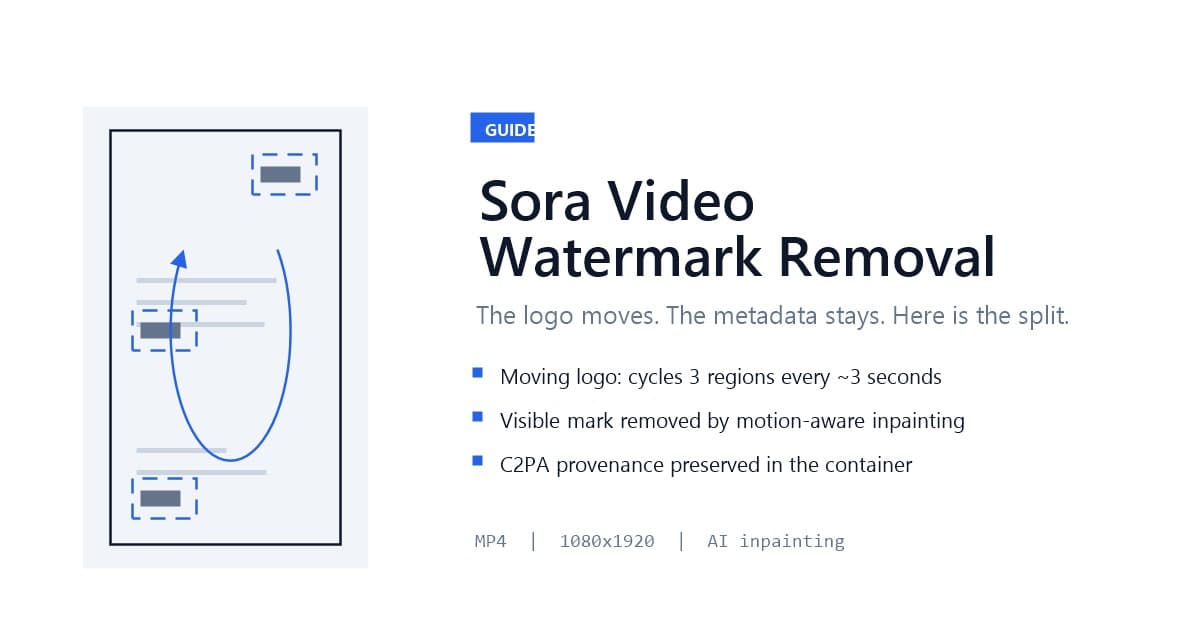
UnMark's approach is to remove only the visible watermark layer while preserving invisible provenance signals. For a technical breakdown of how SynthID and C2PA work — and what can and cannot be removed — see our SynthID vs C2PA guide.
What Should You Check Before Processing?
Before processing any AI-generated video, run through this checklist:
- Do you own the content or have written rights to process it?
- Does the platform's ToS allow modification of the output?
- Are you preserving invisible provenance watermarks (SynthID/C2PA)?
- Will the processed content be used commercially?
- If commercial: have you disclosed AI generation where required?
- Are you removing only visible branding, not CMI from others' work?
- Have you documented the rights chain for brand campaigns?
- Does your use qualify as transformative under Fair Use (if applicable)?
If you answer "no" to question 1 or "yes" to removing others' CMI, stop and consult legal counsel before proceeding. The cost of a legal consultation is a fraction of a single Section 1202 violation penalty.
When Should You Call a Lawyer?
This guide provides general information, not legal advice. Consult a qualified attorney if:
- You're processing content you didn't create
- You're using processed content in commercial advertising
- You've received a takedown notice or legal threat
- You're building a product that processes user-uploaded content
- You're unsure whether your use qualifies as Fair Use
Both the COPIED ACT and EU AI Act are under two years old, and no court has yet interpreted how they apply to AI video watermark removal. The first rulings will likely set the precedents that shape creator workflows for the next decade — worth watching closely if you process AI-generated video at scale.
Removing watermarks from AI-generated videos is legal in many scenarios — particularly when you're processing your own content for legitimate repurposing. But the legal framework is layered: DMCA Section 1202 protects CMI, the COPIED ACT adds AI-specific provenance rules, and platform ToS create additional contractual obligations. Understand the difference between visible branding (often removable) and invisible provenance watermarks (generally worth preserving). When you're working with your own AI-generated content, UnMark can help you remove visible watermarks cleanly while keeping the provenance signals that matter for long-term compliance.
Author's note: When in doubt, document everything. Keep records of where your content came from, what rights you have, and why you're processing it. Good documentation won't make a legal problem disappear, but it's the difference between a defensible position and an impossible one. — Mark Ma
Last updated: July 2026