Download Clean or Remove After: Which Path Gets the Better File (2026)
Mark Ma
Last updated: November 2026
Headlines have spent a year telling creators that Congress is about to make watermark removal a crime. The bills behind those headlines exist, their text is public on govinfo, and neither text says what the summaries claim. The operative concept in both is deception — and almost nobody reporting on the bills has quoted the clause that contains it.
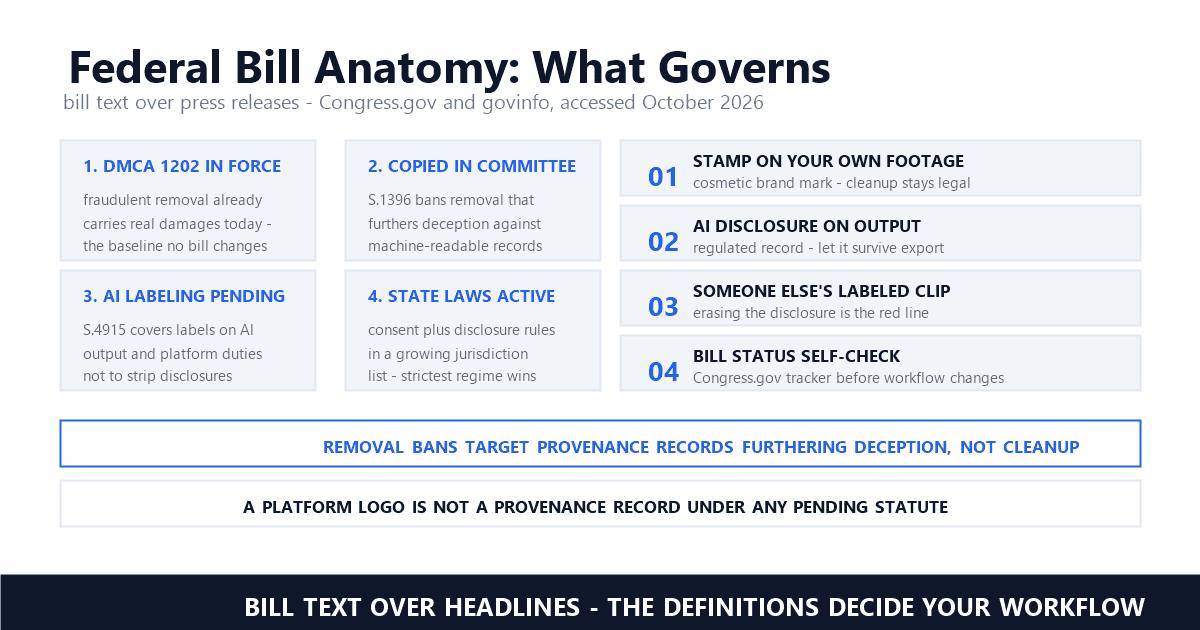
UnMark, the watermark removal product we build, has a stake in the distinction these bills turn on, so before writing this piece we compared both clause by clause: S.1396, the Content Origin Protection and Integrity from Edited and Deepfaked Media Act — COPIED for short — and S.4915, the AI Labeling Act of 2026. Both target provenance: embedded, machine-readable records about where a piece of media came from. Neither makes deleting a platform sticker from your own footage unlawful, and both would rewrite how AI disclosures work if either ever passes.
The distinction that decides everything is the one our Section 1202 explainer drew long before these bills existed: a platform logo burned into pixels is not the same object as content provenance information. The COPIED Act writes that line into federal statute for the first time — then attaches a deception requirement that headline writers keep omitting. This piece walks the actual clause text, the exemptions, the penalties, and what a working editor should change today, which is usually nothing.
The COPIED Act is a Senate bill introduced on April 9, 2025 by Senators Cantwell, Blackburn, and Heinrich. It was read twice and referred to the Committee on Commerce, Science, and Transportation, where it has remained ever since. It is not law, and no floor vote has been scheduled.
Its full title — the Content Origin Protection and Integrity from Edited and Deepfaked Media Act of 2025 — sounds sweeping, but the obligations land on a defined set of services. A covered platform means one drawing at least $50,000,000 in annual revenue, or one that held at least 25,000,000 monthly active users for three of the twelve months before the conduct in question. Small sites, personal projects, and most standalone tools sit outside that perimeter entirely. Both thresholds track the services where synthetic media actually spreads, and both are measured on a rolling twelve-month window rather than a single snapshot.
The bill's engine is provenance. It defines content provenance information as state-of-the-art, machine-readable information documenting the origin and history of a piece of digital content — an image, video, audio file, or text. Watermarking gets its own clause: "the act of embedding information that is intended to be difficult to remove into an output" — Senate Bill 1396, done to verify authenticity or document where the output came from. Section 6(a) then gives commercial generative tools two years after enactment to offer provenance embedding as an option. The model providers that obligation targets are already moving — our state-of-watermarking report tracks SynthID, C2PA manifests, and platform rollouts through 2026.
Three things. Section 6(b)(1) outlaws knowingly removing content provenance information in furtherance of deception. Section 6(b)(2) bars covered platforms from stripping that information at all, with a security-research exception. Section 6(c) outlaws training AI on content whose provenance was stripped without the owner's express, informed consent.
Here is the removal provision, complete: "It shall be unlawful for any person to knowingly remove, alter, tamper with, or disable content provenance information in furtherance of an unfair or deceptive act or practice in or affecting commerce." — Senate Bill 1396. Two elements carry the entire section. The removal must be knowing, and it must serve a deceptive act. Erase either element and the sentence no longer describes your conduct — which is why the deception clause is the single most important phrase in the bill and the one least likely to survive into a headline.
The platform-side duty is stricter but narrower: covered platforms may not remove or separate provenance from content they distribute, except for security research that is necessary, proportionate, and limited to that purpose. The training clause reaches further than removal altogether — building a generative model on media whose provenance was stripped requires the rights holder's express, informed consent, which converts provenance from a nice-to-have credential into an asset with license value. The structure rhymes with existing law: Section 1202 already punishes fraudulent removal of copyright management information, and our 1202 explainer covers that regime — but the new bill reaches provenance regardless of whether copyright attaches at all.
Only when both triggers hold: the mark qualifies as content provenance information, and the removal furthers deception. A TikTok logo carries no provenance record, and deleting one from your own clip deceives nobody. Neither element is met, so the bill's core provision never engages.
Run the first trigger against a platform stamp and it fails on both prongs of the definition. A bitmap logo documents nothing about origin or history, and it is not machine-readable metadata — it is pixels a viewer looks at, not a credential a system parses. That is the same object distinction our ownership pillar builds its entire analysis on, and S.1396 would cement it: Provenance is a defined technical category, not whatever happens to overlay a frame. Invisible credentials behave the opposite way — our methods comparison of SynthID and C2PA explains how each embeds machine-readable records that do meet the definition.
The deception element is where the user base splits. Reconstructing the corner of your own footage so a client deck looks clean deceives no one about anything. Reprocessing a labeled AI clip to pass it off as camera-original — stripping the disclosure and reselling authenticity that does not exist — is the exact conduct the clause was drafted for, and our Veo 3.1 guide is careful to separate those two jobs even while covering the tooling. Honest commentary on removal software has to draw that line rather than blur it, because legislators drew it first.
Senator Schatz introduced S.4915 on June 24, 2026 with Senators Curtis and Warner. It mandates that AI providers label outputs, orders platforms to preserve those labels across re-uploads, and outlaws circumvention tools built or marketed for deceiving people about provenance. It sits in the same committee, equally short of a floor vote.
The provider duty is the floor: every covered AI output carries a clear and conspicuous label plus machine-readable disclosure identifying the content, the system, and a timestamp. Providers also owe a detectability duty — labels have to be findable by the classifiers platforms and researchers actually run, not buried in metadata nobody reads. Platforms take the mirror-image duty, agreeing "not [to] tamper with or remove any such disclosure, including when such covered AI-generated content is transferred to or otherwise shared to another online platform" — Senate Bill 4915. The transfer language matters: labels must survive the cross-posting journeys where they usually die.
Tools sit in Section 3, and intent is the trigger. A product falls within the ban when it "is primarily designed or produced and promoted for the purpose of circumventing, removing, or tampering with any disclosure required under section 2" with the intent or substantial likelihood of deceiving a third party about provenance — Senate Bill 4915. Prong (b) catches devices with no commercially significant purpose beyond circumvention; prong (c) catches anything marketed with knowledge that buyers will use it to deceive. For a removal vendor, this is the provision that matters, and we will state our own position plainly: cleanup aimed at platform stickers stays outside it, while anything promoted as a way to launder AI disclosures into fake authenticity walks into all three prongs. We build and market for the first case only.
The carve-outs are written for exactly the research community this site draws on: "A researcher acting in good faith may circumvent, remove, add, or tamper with a disclosure required under section 2" — Senate Bill 4915, when the purpose is probing how well labels survive attack. Libraries, archives, educational institutions, and law enforcement receive parallel exemptions. Detection research is what those clauses protect — our detector models explainer covers the field they would keep alive.
Both bills route enforcement through agencies rather than courts. The COPIED Act hands violations to the Federal Trade Commission as unfair or deceptive practices; the AI Labeling Act runs civil penalties through the Attorney General. State attorneys general can sue on behalf of residents under both. Neither bill text creates a private right of action for individuals.
Enforcement is a layered affair in S.4915, and the penalty design is granular: up to $2,500 per act of circumvention, capped at $25,000 per proceeding, with triple exposure for repeat violations within three years and reduced penalties where the violator did not know and had no reason to know the facts. Enforcement can also reach the product itself — courts may order modification or destruction of a circumvention device under Section 4(b)(5). Commentators such as the Mintz Washington report expect FTC enforcement to carry most of the weight under S.1396, with an NIST-led working group handling provenance standards groundwork — a reminder that even the bill's supporters treat the technical spec as unfinished.
One citation trap deserves its own paragraph. The Congressional Research Service's summary of the COPIED Act states that "Owners of digital representations of copyrighted content with associated content provenance information may also bring suit" — Congressional Research Service. That sentence describes the summary's reading of how the bill interacts with copyright remedies; the introduced text itself runs through Section 7 with no private-suit clause. Bloggers and even some law-firm alerts quote that line as if it were statutory text — cite the summary as the summary, not as the bill. For the full current-law picture these remedies slot into, our 2026 legality guide and the platform-level rules in our ad compliance piece cover what already binds today.
Federal bills move slowly; state and foreign rules already bind. California's AB 3211 slid its provenance mandate to July 1, 2026, New York's S6954B passed both chambers, Illinois passed S.B. 315 adding digital-replica protections for performers, and the EU AI Act's Article 50 transparency duties began applying in August 2026. China's labeling rules have been in force since September 2025.
The EU layer is the one global publishers feel first: Article 50 requires that synthetic media carry machine-readable markers and that deepfakes be visibly disclosed — obligations our EU AI Act explainer breaks down clause by clause. China's regime runs on mandatory explicit labels plus embedded metadata, covered in our China labeling guide. For removal work the practical rule is that the strictest applicable regime wins: a platform logo stays cosmetic under every one of these statutes, while an embedded provenance credential is treated as a regulated object in an expanding list of jurisdictions. Nothing pending anywhere reclassifies a platform's brand stamp as provenance.
Three habits cover the current landscape. Keep the original project files and any provenance metadata attached to your exports. Treat platform stamps as cosmetic and provenance credentials as legal records. And track the Commerce Committee, because both bills could move without much warning.
Creators working with AI generators should let the disclosure survive export and distribution. The scrubbed-disclosure-on-a-synthetic-clip fact pattern is what both bills were written to catch, and no vendor should be helping produce it. Brand-commissioned work has its own order of operations — authorization for clean delivery belongs in the contract before the file changes hands, as our UGC workflow piece lays out — and stripping an AI label to satisfy a brand request sits on the wrong side of both pending statutes.
Editors holding years of stamped saves can keep cleaning them. Nothing pending reclassifies a platform logo as provenance, so batch jobs over owned archival footage — the workflow our batch cleanup guide automates — stay exactly where they are legally today, and the method choices behind them remain comparison-tested in our inpainting methods breakdown. The realistic federal risk for editors is not a raid over an old TikTok stamp; it is the training-data clause, which will make unprovenanced archives harder to sell into AI pipelines if S.1396 ever advances.
A practical self-check beats secondhand summaries. The Congress.gov pages for both bills list every action the moment it lands, and a scheduled markup or a unanimous-consent request shows up there before trade coverage catches it. Amendments deserve special attention, since a manager's package could attach either bill to must-pass legislation during any end-of-year push. Should that happen, the definitions in Section 3 — not the press release — decide whether your workflow changes, which is exactly why this piece quotes bill text rather than headlines.
Is the COPIED Act law yet?
No. It was introduced on April 9, 2025, read twice, and referred to the Senate Commerce Committee. Its latest recorded action is still that referral — no markup, no committee vote, no floor schedule. Until a version passes both chambers and is signed, existing law is what governs, and existing law already covers fraudulent removal through Section 1202.
Does the COPIED Act make watermark removal illegal?
Not broadly, and not the way summaries describe. The removal ban in Section 6(b)(1) requires content provenance information — a machine-readable origin record, which a platform logo is not — and requires that the removal further an unfair or deceptive act. Strip the stamp off your own footage and neither element holds. Strip an AI disclosure to pass synthetic video off as real, and both hold.
Can I still remove a watermark from my own video?
Yes, under current law and under both bills as drafted. Your own footage carries no rights record in its stamp — the mark is a platform brand, and removing it changes no ownership fact. That is the through-line of our ownership pillar and of this piece. The conduct to avoid is different in kind: reprocessing someone else's labeled AI output to erase its disclosure.
Last updated: November 2026
Congress.gov — S.1396 (119th Congress): COPIED Act, including CRS summary (accessed October 2026)
govinfo — BILLS-119s1396is: Introduced Senate bill text (XML) (accessed October 2026)
Congress.gov — S.4915 (119th Congress): AI Labeling Act of 2026 (accessed October 2026)
govinfo — BILLS-119s4915is: Introduced Senate bill text (XML) (accessed October 2026)
Mintz — AI: The Washington Report — July 2026 Edition (accessed October 2026)
Mark Ma is the founder and lead engineer at UnMark, where he leads the development of AI-powered video watermark removal technology. With over a decade of experience in computer vision, deep learning, and video processing, he has built production systems that process millions of frames per month across TikTok, Instagram Reels, and Google Veo content. His technical work focuses on motion-compensated watermark detection, spatial-temporal inpainting, and quality-preserving reconstruction for short-form vertical video. Before UnMark, Mark shipped computer vision infrastructure at scale for content moderation and ad compliance platforms. He writes this blog to document the real engineering, testing, and regulatory reasoning behind UnMark's processing pipeline — every test result, frame analysis, and benchmark published here is reproduced from actual production data, not synthetic examples. His goal is to give creators, brands, and regulators a verifiable technical reference for AI video watermark removal in 2026.