
Agency Video Watermark Removal: The Client Handoff Guide
Mark Ma
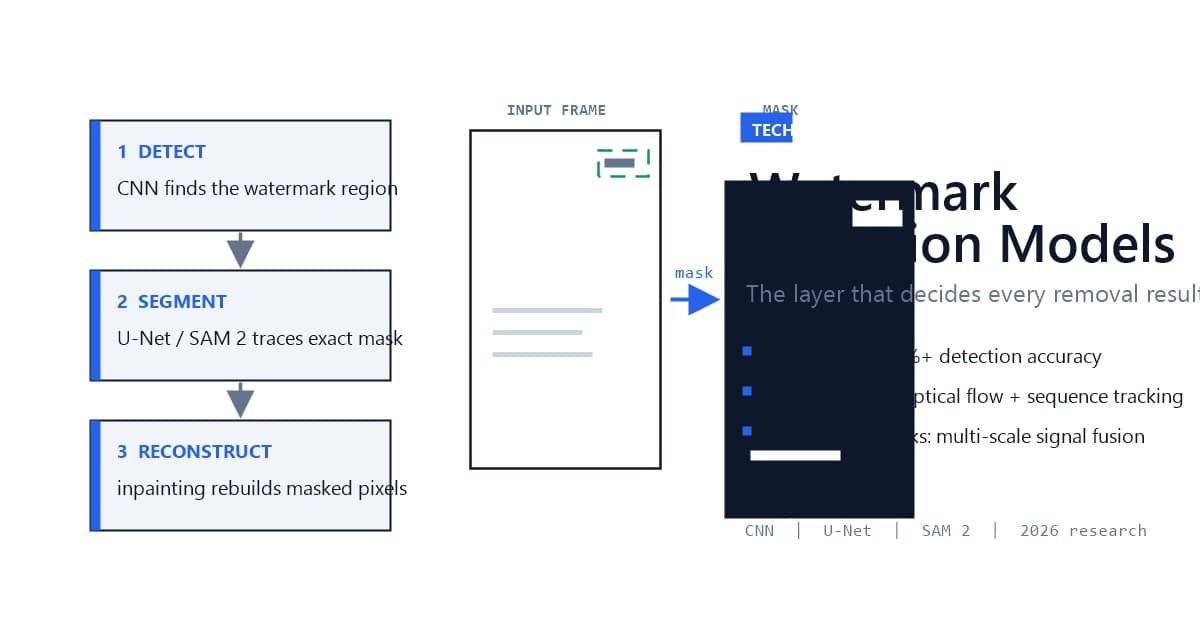
A watermark detection model is the computer-vision system that locates a watermark before anything can be done about it. Given a video frame, it answers two questions: where is the mark, and which pixels does it cover — producing a mask that downstream reconstruction uses to rebuild the covered region. Without accurate detection, removal has nothing to work with: a mask that misses text edges leaves ghost fragments, and a mask that over-covers forces the inpainting model to invent pixels it did not need to touch.
Modern detection pipelines stack three specialized stages — a convolutional feature extractor that recognizes watermark patterns, a segmentation network that traces their exact pixel boundaries, and a temporal tracker that follows moving marks across frames. This guide walks through how each stage works, why moving and semi-transparent watermarks stress them differently, and how the same machine-learning ideas now power the invisible provenance watermarks embedded by AI video generators. It is the layer behind every removal result we publish, explained without the marketing.
Last updated: August 2026
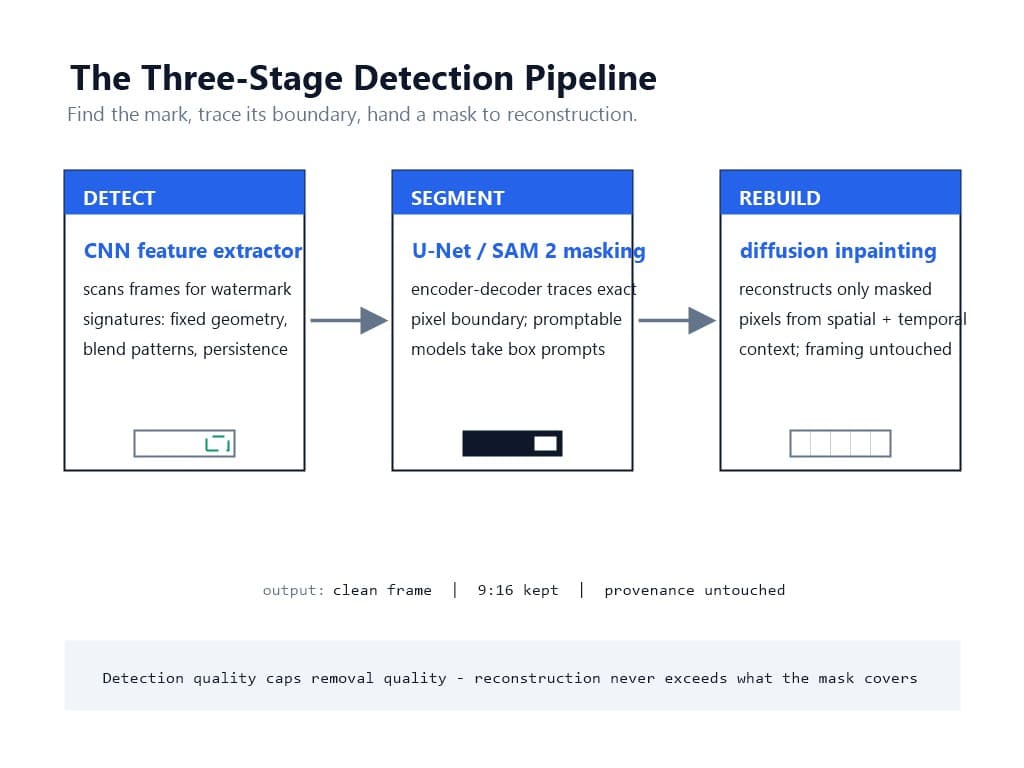
A watermark detection model is a trained neural network that takes video frames as input and outputs the location and shape of any watermark present — classically as a binary mask, a per-pixel map marking which pixels belong to the watermark and which belong to the underlying content. It is the first stage of any automated removal pipeline, and its accuracy caps everything downstream: reconstruction quality can never exceed detection quality.
The industry-standard pipeline splits the job across three modules. A detection network built on convolutional layers scans frames for watermark-like features — the corner logo, the username bar, the semi-transparent glyph. A segmentation network, typically a U-Net-style encoder-decoder, then refines the detected region into a precise mask that hugs the watermark's actual edges. A reconstruction stage finally fills the masked pixels, using generative inpainting informed by surrounding content. The three stages are trained separately and composed, because each optimizes a different objective: finding, tracing, and rebuilding.
Detection models are trained on labeled examples — frames with watermarks and their ground-truth masks. The training teaches the network the visual signature of watermark pixels: local contrast against background, semi-transparent blending, consistent geometry, and temporal persistence across frames. Published benchmarks for well-trained systems report detection accuracy above 98% on static watermarks, which is why static marks have become the easy case in every removal workflow, including the ones we document in our process walkthrough.
Convolutional neural networks recognize watermarks the same way they recognize faces or text: through learned feature hierarchies. Early layers detect primitive patterns — edges, color transitions, opacity shifts. Deeper layers compose those primitives into the structures that distinguish a watermark from ordinary content: a semi-transparent logo holding a fixed position, text strokes that stay crisp while the background moves behind them, a brightness-adaptive overlay that shifts opacity to stay readable.
Three properties make watermark pixels statistically distinctive, and trained detectors key on all of them:
Static watermarks — the Facebook Reels logo, the YouTube Shorts handle, stock-agency marks — fit a detector's assumptions perfectly. Their position never moves, so the model sees the same masked region in every frame with maximum context. That is the technical reason our platform guides rank static marks as the easy first-pass case, from Facebook Reels to YouTube Shorts.
Detection says "the watermark is in this corner." Segmentation says "exactly these pixels." The distinction decides removal quality, because inpainting reconstructs only what the mask covers — no more, no less.
Mask generators are typically encoder-decoder architectures in the U-Net family. The encoder compresses the frame into feature maps that capture what is where; the decoder expands those features back to full resolution, classifying each pixel as watermark or content. The skip connections that define U-Net preserve fine detail through this compression-expansion, which is what lets the output mask trace the thin strokes of a username rather than a rough box around it.
The frontier of this stage is promptable segmentation. Segment Anything Model 2 (SAM 2), released by Meta's segmentation team and now embedded in open-source removal workflows, accepts a point or box prompt and returns a precise object mask. In watermark pipelines, the detection stage's coarse localization becomes the prompt, and SAM 2 produces the fine-grained boundary — the same division of labor its object-segmentation users rely on, applied to overlays. Open-source video workflows pair it with diffusion-based inpainting engines like DiffuEraser to maintain temporal consistency across frames.
Mask quality is where the practical failures live. A loose mask on text leaves edge pixels unmasked — the ghost fragments every creator has seen after a sloppy removal. An over-wide mask destroys background detail that reconstruction must then hallucinate. The tight-hugging mask is the goal, and it is why our removal quality checklist tells you to re-run with a tighter mask rather than blame the reconstruction.
Moving watermarks break the static-position assumption that makes detection easy, so the pipeline adds a temporal stage. TikTok's bouncing logo and Sora's rotating mark change position mid-clip, meaning a mask computed on frame one is wrong by frame forty.
The classical answer is optical flow — per-pixel motion vectors estimated between consecutive frames. Once detection locates the watermark in one frame, optical flow propagates that location forward, and the tracker updates the mask as the mark moves. Modern pipelines lean on learned trackers instead: temporal models that process frames as sequences, predicting the watermark's trajectory the way video models predict any moving object. Research published in 2026 combines convolutional feature extraction with bidirectional sequence models — networks that read the frame sequence both forward and backward — precisely because watermark position depends on where the mark has been and where it is going.
Sora's watermark is the stress test for this stage. It cycles across three screen regions roughly every three seconds and adapts opacity to the background — motion plus varying transparency, two hard problems in one overlay. Our Sora watermark guide documents the behavioral pattern; the technical takeaway is that a tracker must treat each region occupation as a discrete event rather than averaging across jumps, or the reconstruction leaves a faint trail along the rotation path. The frame-by-frame evidence in our TikTok moving watermark test shows the same physics: detection must win at every position, not just the first.
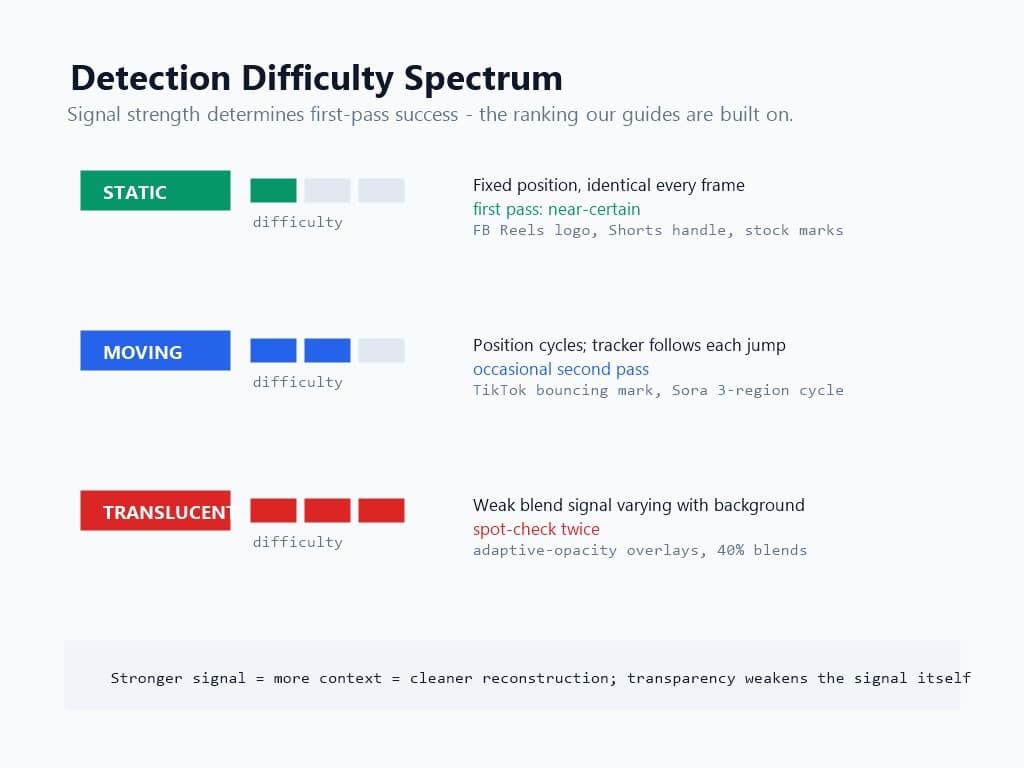
Semi-transparency attacks the detection signal itself. A fully opaque logo has strong local contrast — easy for a conv net. A 40%-opacity overlay over a changing background produces a weak, shifting signature that varies with whatever is behind it: the same watermark reads differently over a dark street and a bright sky.
Detection research attacks this with multi-scale fusion — analyzing the frame at several resolutions and combining the results, so that a signal too weak to detect at full resolution survives at coarser scales where the watermark's structural pattern dominates. Temporal aggregation helps too: because the mark persists while the background moves, averaging detection responses across frames cancels background noise and reinforces the watermark's constant signature. Adaptive-opacity marks like Sora's, which darken on bright scenes and lighten on dark ones, are built to defeat fixed-threshold detection and sit at the top of the difficulty curve for exactly this reason.
For creators, the practical ranking that falls out of the architecture is the one our guides already use: static marks clean on the first pass with near-certainty, moving marks occasionally need a second pass, and translucent overlays are the cases to spot-check twice. The difficulty is not folklore — it is how strong the detection signal is at each step.
Visible watermark detection is only half the 2026 story. AI video generators embed invisible watermarks — signals in pixel statistics or file metadata that identify content as machine-generated — and detecting those is a different discipline with its own research frontier.
SynthID, Google's system embedded in Veo outputs, modifies pixel values in ways statistically detectable by a trained classifier but imperceptible to viewers. C2PA, the standard OpenAI's Sora adopts, embeds a cryptographic manifest in the file container — detection there is a metadata read, not computer vision. Our SynthID vs C2PA comparison maps the two approaches in detail, and the 2026 watermarking landscape covers which platforms ship which.
The research frontier is generation-time watermarking with built-in detection. VidStamp (UMass Amherst, 2025) embeds 48 bits per frame into a video diffusion model's latent space — 768 bits per video — and reports 95% bit-accuracy extraction with no added inference cost, using the temporal components of video architectures to keep watermarks coherent across frames. VideoShield (ICLR 2025) embeds watermark bits into the noise that diffusion models denoise, and its decoder doubles as a tamper localizer: it flags not just whether a video was AI-generated, but which frames and which frame regions were altered after generation. A May 2026 hybrid framework combining CNNs, bidirectional sequence models, and transformer attention reports tamper-detection accuracy of 98.4% under compression, frame-dropping, and geometric attacks.
The two worlds — visible and invisible — are converging on the same tooling. Segmentation masks, temporal models, and learned classifiers power both the removal pipelines creators use and the provenance systems platforms deploy. The direction of the convergence matters for anyone building a workflow: detection keeps getting stronger on both sides, which makes precise, rights-respecting removal more valuable and silent stripping more detectable — the split California's transparency law and the COPIED ACT are now writing into rules.
Detection and masking end where reconstruction begins. The mask hands off to an inpainting model that rebuilds the covered pixels from surrounding context — spatial detail from the frame itself, temporal detail from adjacent frames. Generative approaches, from GAN-based predecessors to today's diffusion-based inpainters like DiffuEraser, synthesize replacement content matched to local texture, color, and motion; the output keeps the original framing because nothing outside the mask is touched.
That handoff is why we keep the method comparison simple for creators: cropping discards the region, blurring damages it, and mask-plus-reconstruction rebuilds it. The full trade-off analysis lives in our AI inpainting vs cropping vs blurring breakdown, and the observable behavior — resolution preserved, aspect ratio intact, background continuous — is what a well-executed detection-to-reconstruction chain produces.
Three metrics govern the published benchmarks, and each maps to something a creator can see:
When a removal result disappoints, the failure is usually upstream of reconstruction. Diagnose in order: was the mark found at all (detection), was its boundary traced (segmentation), did the mask hold across the whole clip (tracking). The spot-check routines in our platform guides operationalize exactly this sequence.
Watermark detection models are the layer that decides every removal outcome: a convolutional detector recognizes the mark, a segmentation network traces its exact boundary, and a temporal tracker holds the mask on moving targets. Static marks give the detector everything it wants, semi-transparent adaptive marks give it the least, and the visible-watermark craft now shares its machinery with the invisible provenance systems platforms are deploying at scale. Understanding the pipeline tells you why results rank the way they do — and why tight masks and clean sources beat every other variable you can control.
The removal workflows built on this pipeline are the ones we test and publish: start with the process walkthrough to see detection-to-reconstruction end to end, then the batch workflow when the queue gets long.
Q1: What does a watermark detection model actually output?
A mask — a per-pixel map marking which pixels belong to the watermark. Detection first localizes the mark, segmentation then traces its exact boundary, and downstream inpainting reconstructs only what the mask covers.
Q2: How do detection models handle moving watermarks like TikTok's?
Through temporal tracking. Optical flow or learned sequence models propagate the detected mask forward frame by frame, updating position as the mark moves. Marks that jump regions, like Sora's three-position cycle, require the tracker to treat each region as a discrete event.
Q3: Why do semi-transparent watermarks fail detection more often?
Their signal varies with the background behind them. Weak blending leaves a faint signature that single-scale detection misses, which is why production systems use multi-scale fusion and temporal aggregation to reinforce the watermark's persistent pattern.
Q4: Can detection models find invisible watermarks like SynthID?
Different tools for a different problem. SynthID is detected by trained classifiers reading statistical pixel patterns; C2PA manifests are read from file metadata. Research systems like VidStamp and VideoShield build detection directly into the generation process, with 95%+ extraction accuracy.
Q5: Does detection accuracy determine removal quality?
Yes — removal can never exceed detection. A loose mask leaves ghost edges, an over-wide mask forces unnecessary reconstruction, and a missed overlay ships uncleaned. When a result disappoints, diagnose detection and segmentation before blaming inpainting.
Mark Ma is the founder and lead engineer at UnMark, where he leads the development of AI-powered video watermark removal technology. With over a decade of experience in computer vision, deep learning, and video processing, he has built production systems that process millions of frames per month across TikTok, Instagram Reels, and Google Veo content. His technical work focuses on motion-compensated watermark detection, spatial-temporal inpainting, and quality-preserving reconstruction for short-form vertical video. Before UnMark, Mark shipped computer vision infrastructure at scale for content moderation and ad compliance platforms. He writes this blog to document the real engineering, testing, and regulatory reasoning behind UnMark's processing pipeline — every test result, frame analysis, and benchmark published here is reproduced from actual production data, not synthetic examples. His goal is to give creators, brands, and regulators a verifiable technical reference for AI video watermark removal in 2026.