COPIED Act vs Watermark Removal: What's Actually Illegal (2026)
Mark Ma
Last updated: October 2026
Search video watermark removal api and the results page reads like a shelf of unopened boxes: product homepages, a model catalog, one cloud console document. Almost nothing answers the questions a developer actually brings to that search — can I integrate this in an afternoon, what will it cost per minute of footage, and where does the meter stop. Those are the questions this guide works through, number by number, from primary sources.
Our company builds UnMark, a watermark removal product, and the API question reaches us from both directions — developers deciding whether to buy credits from a vendor, and teams deciding whether the open-source route is viable at all. We compared the three published options against their official documentation and pulled every price and every limit from the source pages: Dewatermark's video endpoint, Tencent Cloud's RemoveWatermark action, and WaveSpeedAI's prediction-based remover. The marks these tools erase are the ones our series covers one platform at a time — Kling, Seedance, Canva, even Zoom's viewer-identification overlay — and the integration math changes with each of them.
The short version: three production APIs exist, integration follows one common pattern (authenticate, transfer, submit, poll), metered cost lands between $0.05 and $0.84 per minute depending on provider and volume tier, and the leading open-source alternative carries a non-commercial license that quietly takes it off the table for most commercial products.
A video watermark removal API takes an uploaded file, locates logo or text overlays, and reconstructs the covered pixels through video inpainting. You submit a job, poll a status endpoint, and download the cleaned asset. Pricing follows duration or per-run credits, and every provider's documentation carries hard limits that shape the integration.
Under the hood the job is reconstruction, not deletion. A model identifies the overlay region, then synthesizes plausible pixels for everything behind it, frame after frame, keeping up with motion. Video inpainting is a reconstruction discipline, and it is what separates these APIs from the crop-and-blur tricks we break down in our inpainting comparison. Detection and reconstruction are separate skills, and vendors expose the seam differently: Dewatermark's video endpoint accepts an optional mask_brush image to steer the model toward specific regions, while Tencent's action takes no mask at all and decides for itself.
That distinction matters more than any landing page copy. A fixed corner logo over static background reconstructs cleanly; a moving, semi-transparent overlay over busy footage is where every approach leaks artifacts. The same physics runs in our own queue — our processing walkthrough shows it frame by frame — and it is the first thing to check before comparing prices: what kind of mark are you actually feeding these endpoints.
Three services publish developer-facing endpoints today: Dewatermark's video API built on a four-step upload flow, Tencent Cloud's RemoveWatermark action inside its Video on Demand platform, and WaveSpeedAI's prediction-based remover that starts at $0.05 per run. Each targets a different workload, and we compared all three against their official documentation.
Dewatermark is an AI watermark-removal vendor that publishes image and video endpoints under one key. Authentication is a header — X-API-KEY — issued through its API management page, and the image endpoint counts each call as 1 credit while the video endpoint meters by the second. The documented base is platform.dewatermark.ai, with an object_removal/v2 path for images and a video/v1 path for uploads and tasks.
Tencent Cloud takes a different shape entirely: RemoveWatermark is an action on its Video on Demand (VOD) service, described officially as "Removes watermarks intelligently" — Tencent Cloud, RemoveWatermark API Reference. You pass a FileId for media already stored in VOD rather than uploading through the API itself, the call returns a TaskId, and the heavy lifting happens inside Tencent's task pipeline. SDKs ship for Python, Java, PHP, Go, Node.js, .NET, and C++, and the endpoint is rate-capped at 20 requests per second per the official page.
WaveSpeedAI positions its remover as a model in a catalog: "removes Kling and Seedance watermarks, logos, captions, and text from videos while preserving quality" — WaveSpeedAI, Video Watermark Remover API. The catalog explicitly names Kling and Seedance marks as primary targets — the two generation platforms our Kling guide and Seedance guide cover from the user side — and the page claims support for files up to 10 minutes.
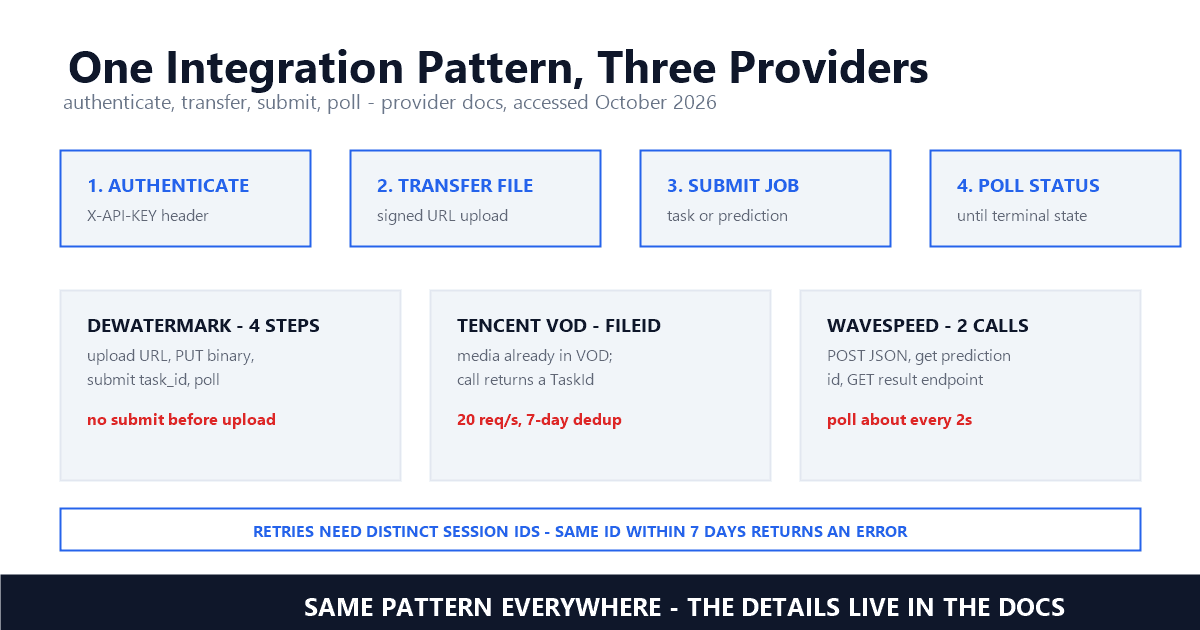
Every provider follows the same shape: authenticate with a key, move the file into provider storage through a signed URL, submit the job, then poll until completion. The differences live in the details — Dewatermark splits its flow into four explicit steps, Tencent operates on files already stored in VOD, and WaveSpeed returns a prediction id immediately.
Dewatermark documents the pattern outright: "The process involves four steps: generating an upload URL, uploading the video file, submitting the task, and polling for completion" — Dewatermark API Reference. Step one is a POST to /api/video/v1/upload that returns a task_id plus a Google Cloud Storage signed URL; step two is an HTTP PUT of the raw file with Content-Type: application/octet-stream; step three submits the task_id (optionally with a mask_brush PNG sized to the video); step four polls until the result is ready. The docs are blunt about sequencing: do not submit before the upload completes.
WaveSpeedAI compresses the same lifecycle into two calls. You POST JSON to the video-watermark-remover endpoint and receive a prediction id, then GET the result endpoint until status is completed — with failed, cancelled, timeout, and deleted as the documented terminal states. The provider recommends polling roughly every 2 seconds and increasing the interval for long-running tasks.
Tencent's action skips file transfer altogether because the input must already live in VOD: pass the FileId, receive a TaskId, and let the task flow run. One guardrail deserves attention — the API deduplicates submissions: "If there has been a request with the same identifier within the past seven days, an error will be returned for the current request" — Tencent Cloud. If your service retries automatically, pass a distinct SessionId or you will meet that error in production.
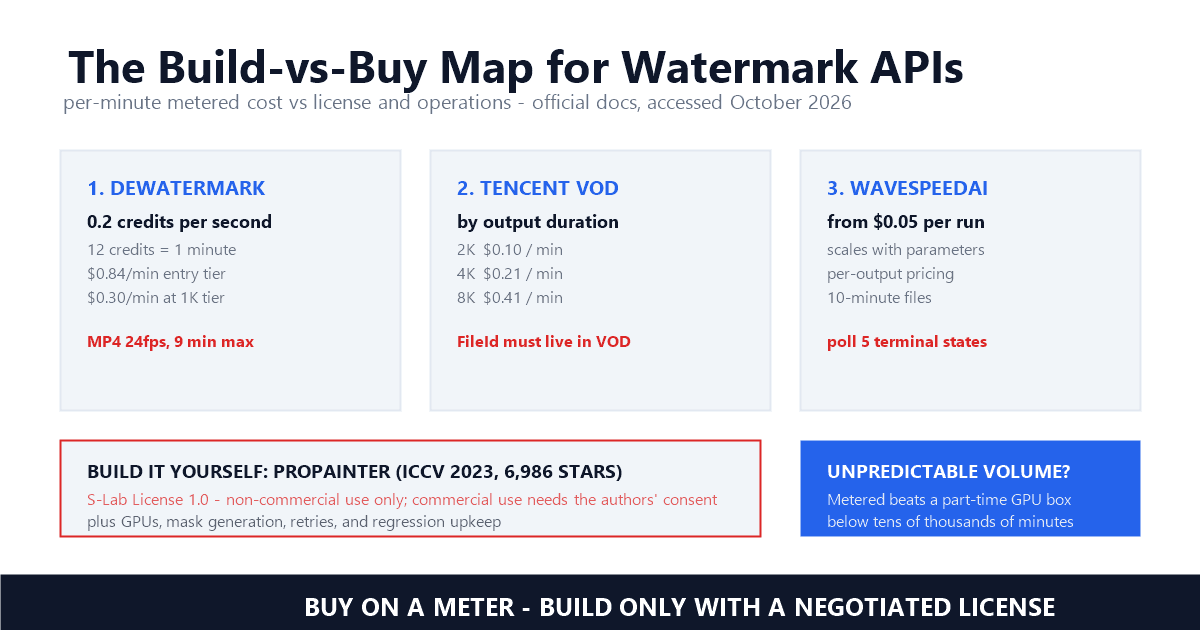
Dewatermark charges 0.2 credits per second, so a one-minute video burns 12 credits — $0.30 at its 1,000-credit tier and about $0.10 at the 100,000-credit tier. Tencent bills Watermark Removing by output duration at $0.10 per minute for 2K and $0.21 for 4K. WaveSpeed starts at $0.05 per run.
The Dewatermark rule is documented in one line: "The credit cost is 0.2 credits per second, which equals 1 credit for a 5-second video. Any failed or timeout tasks will result in a credit refund" — Dewatermark API Reference. The pricing page sells credits in tiers: 100 credits for $7 ($0.070 per credit), 1,000 for $25 ($0.025), 5,000 for $80 ($0.016), and 100,000 for $800 ($0.008). Apply the 12-credits-per-minute rate and a minute of footage costs $0.84 at the entry tier, $0.30 at the 1,000-credit tier, and just under $0.10 at the 100,000-credit tier. Volume is the whole game: the same footage is 8.75 times more expensive at the smallest tier than at the largest.
Tencent's Pay-As-You-Go page lists Watermark Removing under media processing with a resolution-tiered table: 2K (short side ≤ 1440 px) at $0.10 per minute, 4K (short side ≤ 2160 px) at $0.21, and 8K (short side ≤ 4320 px) at $0.41 — Tencent Cloud, VOD Pay-As-You-Go. A 10-minute 2K job therefore lands at $1.00, and the price tracks output duration, not source weight. Note the dependency: RemoveWatermark requires VOD storage and billing in the first place, so the true unit cost also carries storage and any downstream processing Tencent's task pipeline performs.
WaveSpeed's page advertises a starting price of $0.05 per run and clarifies the meter: "Pricing is per-output. The final charge scales with the parameters you set in each variant's playground (resolution, duration, output count, references)" — WaveSpeedAI. That makes per-run pricing the right mental model for spiky, low-volume testing, while per-minute credit and duration models from the other two become cheaper as steady volume accumulates — the crossover every team should compute against its own footage length distribution, the way we did for agency-scale client handoffs.
ProPainter, the most-starred open-source video inpainting model, ships under the S-Lab License 1.0, which permits redistribution and use for non-commercial purpose only — commercial deployment means contacting the authors. Building your own pipeline also means renting GPUs, generating masks, and maintaining the model as research moves on, so we mapped when that trade actually pays off.
ProPainter is a video inpainting model published at ICCV 2023, described in its official repository as "[ICCV 2023] ProPainter: Improving Propagation and Transformer for Video Inpainting" — GitHub, sczhou/ProPainter. The repo counted 6,986 stars and 822 forks as of October 2026, and GitHub classifies the language as Python. It is the default answer when a team searches for self-hosted removal — and then the license surfaces. The S-Lab terms state: "Redistribution and use for non-commercial purpose in source and binary forms, with or without modification, are permitted" — S-Lab License 1.0 — and the commercial clause is explicit: "For the commercial use of the code, please consult Prof. Chen Change Loy (ccloy@ntu.edu.sg)" — S-Lab License 1.0. For a product, that is not a README footnote; it is a contract you must negotiate before shipping.
Even with a license sorted, the operational ledger is real: mask generation for every mark variant, GPU capacity sized to your peak batch, retries for corrupted inputs, and a regression suite because models do not announce their regressions. Then there is input quality — WaveSpeed's own tips state it precisely: "Heavy compression in the watermark region reduces reconstruction quality. If you can source a less-compressed copy, do that first" — WaveSpeedAI. The same page notes that "Logos in fixed positions over relatively static backgrounds yield the cleanest output" — WaveSpeedAI — which is the boundary condition self-hosted pipelines discover the expensive way. Our Veo walkthrough shows what reconstruction quality looks like on real generation marks.
The gotchas are contractual as often as technical: Dewatermark's video endpoint accepts MP4 files at 24fps up to 9 minutes, its credits expire with the membership, and paid plans carry no refund policy. Tencent deduplicates submissions carrying the same identifier for 7 days, and WaveSpeed prices per output, so a batch multiplies the bill.
Dewatermark's format gate is printed in bold in the reference: "Please upload MP4 files with 24fps and a maximum duration of 9 minutes. Other file formats, frame rates, or longer videos might not be compatible and could cause errors" — Dewatermark API Reference. That single sentence disqualifies 30fps phone footage and long-form recordings until they are transcoded — a step someone has to own. The billing page adds two financial edges: "Unused credits will expire when your PRO membership ends" — Dewatermark Pricing — and the FAQ answers the refund question with a flat no, directing users to the free trial instead.
Tencent's gotchas are architectural. The RemoveWatermark error table includes FailedOperation.InvalidVodUser — the VOD service must be enabled — and FailedOperation.TaskDuplicate for repeated submissions. The 7-day SessionId dedup quoted above punishes naive retry logic, and because the action operates on FileId, your pipeline must first ingest media into VOD, which drags storage class rules and retrieval fees into the cost model.
WaveSpeed's per-output pricing is the batch multiplier: ten clips are ten runs, at a starting price of $0.05 each, before any parameter scaling. The documented terminal states — failed, cancelled, timeout, deleted — mean your poller needs five exit paths, not two. None of these details is hidden; all of them are one screen deep in pages most buyers never open.
Buy when the marks are static, the volume is unpredictable, and your team has no machine learning infrastructure of its own. Build only when volume is high and steady, or when hosted privacy terms exclude your data — and remember ProPainter's license makes even the build route a negotiation, not a download.
The rights question comes first, before any vendor call. WaveSpeed's documentation puts it plainly: "Verify you have permission to remove the watermark — the tool doesn't change the source content's licensing" — WaveSpeedAI. That is also our standing rule: removal is for assets you own or are licensed to clean, and the legal scaffolding is in 17 U.S.C. § 1202 and our four-question legality guide. An API key does not launder an unauthorized removal; it just automates it.
For owned assets, the decision collapses to three numbers: footage minutes per month, mark complexity, and the tiered prices above. A team cleaning 200 one-minute clips monthly pays roughly $60 at Dewatermark's 1,000-credit tier, $20 through Tencent's 2K rate, and $10 at WaveSpeed's floor — all cheaper than a part-time GPU box, before counting the engineering hours a self-hosted stack consumes. At tens of thousands of minutes, the calculus inverts, and that is precisely where a negotiated commercial license for something like ProPainter starts to make sense.
There is a third path most searches never surface: a hosted product with the pipeline already built — which is why we built UnMark. Creators running UGC handoffs or batch jobs across 20 videos usually do not want an API key; they want the cleaned file. And if the mark in question belongs to a consumer editor like CapCut or Canva, the subscription upgrade is often cheaper than any metered call. The API route earns its keep for teams wiring removal into a product of their own — and now you have the price table, the flow diagram, and the license wall to make that call on evidence rather than on a search snippet.
How much does it cost to remove a watermark from a 1-minute video through an API?
It depends on the provider and your volume tier. Dewatermark meters 0.2 credits per second, so one minute costs 12 credits — about $0.84 at its 100-credit entry tier, $0.30 at the 1,000-credit tier, and under $0.10 at the 100,000-credit tier. Tencent Cloud bills Watermark Removing at $0.10 per minute for 2K output and $0.21 for 4K. WaveSpeedAI starts at $0.05 per run with pricing that scales by output parameters.
Can I use ProPainter in a commercial watermark removal product?
Not without permission. The repository ships under the S-Lab License 1.0, which permits redistribution and use for non-commercial purpose only, and the license directs commercial users to consult the authors — Prof. Chen Change Loy at NTU — before any commercial deployment. The 6,986-star repo is free to evaluate in a research setting, but shipping it inside a paid product requires a negotiated license first.
Is it legal to remove watermarks through an API?
Permission decides it, not the tooling. Removing marks from assets you own or are licensed to clean is routine; stripping a mark from someone else's content can infringe copyright and, where the mark qualifies as copyright management information, can raise Section 1202 issues. WaveSpeed's own documentation tells integrators to verify permission before removal — the API automates the act, it does not authorize it.
Last updated: October 2026
Dewatermark — API Reference (Official) (accessed October 2026)
Dewatermark — Pricing (Official) (accessed October 2026)
Tencent Cloud — RemoveWatermark API Reference (Official) (accessed October 2026)
Tencent Cloud — VOD Pay-As-You-Go Billing (Official) (accessed October 2026)
WaveSpeedAI — Video Watermark Remover API (Official) (accessed October 2026)
GitHub — sczhou/ProPainter repository (Official) (accessed October 2026)
GitHub — ProPainter LICENSE, S-Lab License 1.0 (Official) (accessed October 2026)
Mark Ma is the founder and lead engineer at UnMark, where he leads the development of AI-powered video watermark removal technology. With over a decade of experience in computer vision, deep learning, and video processing, he has built production systems that process millions of frames per month across TikTok, Instagram Reels, and Google Veo content. His technical work focuses on motion-compensated watermark detection, spatial-temporal inpainting, and quality-preserving reconstruction for short-form vertical video. Before UnMark, Mark shipped computer vision infrastructure at scale for content moderation and ad compliance platforms. He writes this blog to document the real engineering, testing, and regulatory reasoning behind UnMark's processing pipeline — every test result, frame analysis, and benchmark published here is reproduced from actual production data, not synthetic examples. His goal is to give creators, brands, and regulators a verifiable technical reference for AI video watermark removal in 2026.