Hailuo AI Watermark Removal: the Expiring Trial, the Plan Gate, the Corner Stamp (2026)
Last updated: September 2026
A Hailuo AI watermark arrives in our processing queue as the opposite of a mystery. After weeks of the drifting Kling stamps documented in our Kling guide, the mark MiniMax's video platform draws on free downloads parks itself in one corner and holds still — which makes Hailuo files the easy case in our pipeline. What is not easy is everything around the stamp: the billing system, the credit clocks, and a free tier that works differently from what half the search results claim.
Because the claims are where Hailuo trips people up. Reviews will tell you the platform hands out free credits every day; the subscription terms say the free grant is a one-time welcome package that expires in three days. This Hailuo watermark removal guide sorts out the whole system: what the stamp is, which plan lifts it, what credits can and cannot do, and what to do with the files you already have. Every plan and policy fact below was checked against Hailuo's own documentation in September 2026.
What Is the Hailuo AI Watermark?
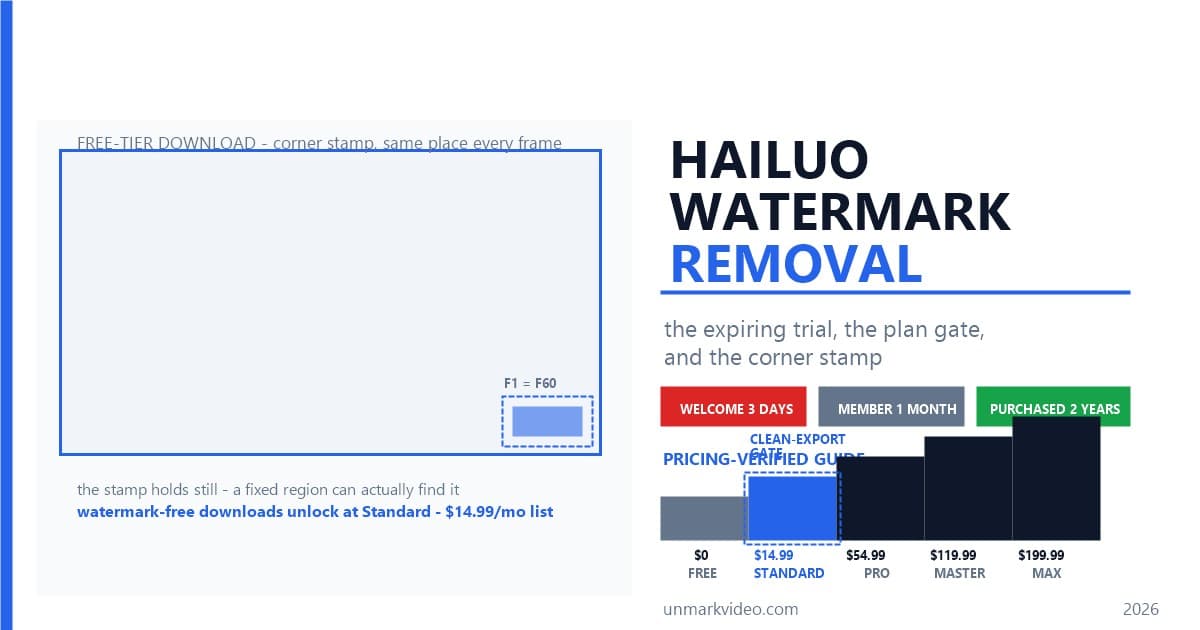
The Hailuo AI watermark is a generation stamp drawn onto free-tier video downloads. Hailuo's subscription terms state it directly: free users' video downloads will include a watermark, and that stamp is the visible line between free output and the watermark-free downloads that begin at the Standard plan.
The official wording is shorter than most platforms manage. The Download and Watermark Conditions section of the Subscription Service Terms reads: "Free Users: Video downloads will include a watermark" — Hailuo AI, Subscription Service Terms. Vendors that catalog platform marks place the stamp in the bottom-right corner of the frame, where it behaves like the classic corner logo rather than anything exotic. One troubleshooting guide that tracks export artifacts across AI platforms adds a wrinkle worth knowing: some "Hailuo presets bake a stylized brand mark into the generation itself, distinct from the platform watermark" — AI Productivity Guide. A corner stamp you can see is one problem; a mark baked into the pixels of certain model presets is a second one, and removal tooling treats them differently.
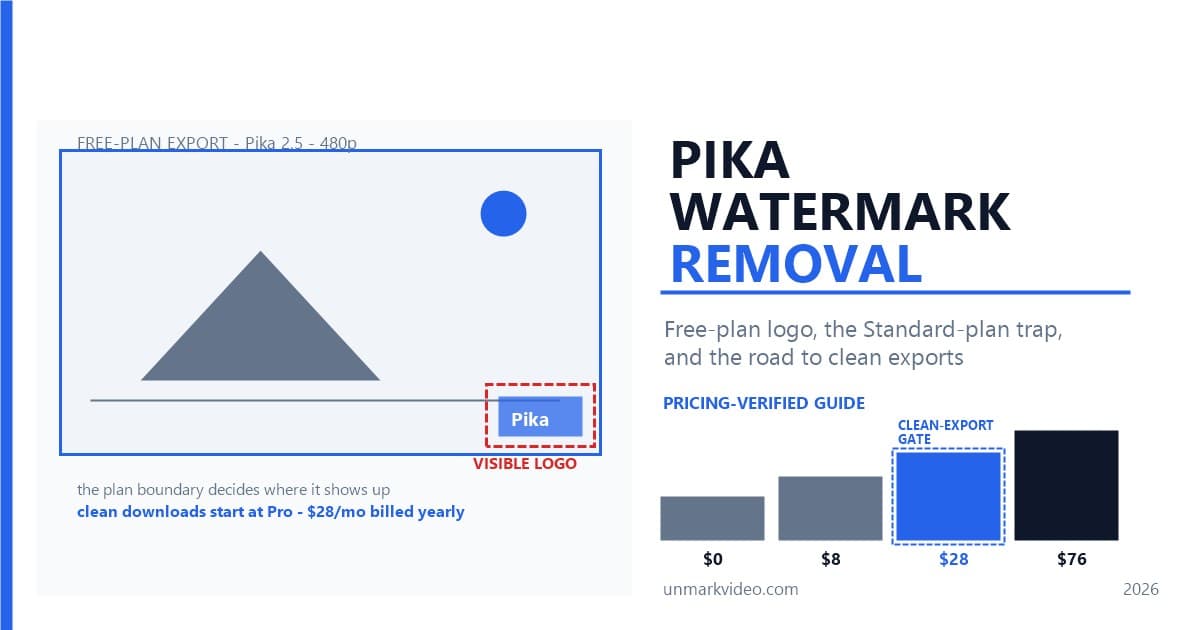
We cover the fixed-logo platforms elsewhere — Veo's corner stamp, Runway's free-tier badge, and Pika's plan-gated logo — and the moving exceptions in Sora's drifting bar and Kling's wandering stamp. Hailuo sits in the fixed camp, and that shapes everything downstream: a stamp that holds still is one a fixed-region tool can actually find, which makes the removal side of this platform more forgiving than the billing side.
Which Hailuo Plan Removes the Watermark?
Watermark-free downloads are included from the Standard plan upward — $14.99 per month in the governing terms, with 1,000 monthly credits. The free tier cannot export clean files, and every plan above Standard carries the same watermark-free benefit alongside queue priority.
Here is the clause that settles it, from the same Download and Watermark Conditions section: "Paid Users: Standard plan subscribers and higher-tier users will be able to download videos without a watermark" — Hailuo AI, Subscription Service Terms. The plan ladder around that clause, read in September 2026:
- Free — $0: watermarked downloads, up to three queued tasks with one generating at a time, lowest queue priority.
- Standard — $14.99 per month: 1,000 credits monthly, accelerated generation with queue priority, watermark-free downloads.
- Pro — $54.99 per month: 4,500 credits monthly, same watermark-free benefit.
- Master — $119.99 per month: 10,000 credits monthly, same watermark-free benefit.
- Ultra — $124.99 per month: the benefits of the legacy Unlimited plan plus 12,000 monthly credits usable with the Hailuo02 model.
- Max — $199.99 per month: 20,000 monthly credits plus unlimited Hailuo01/02 generation in Relax Mode.
One legacy tier sits outside the ladder: the Unlimited Plan at $94.99 was sold only before June 18, 2025, and its unlimited credits work with the Hailuo01 model alone.
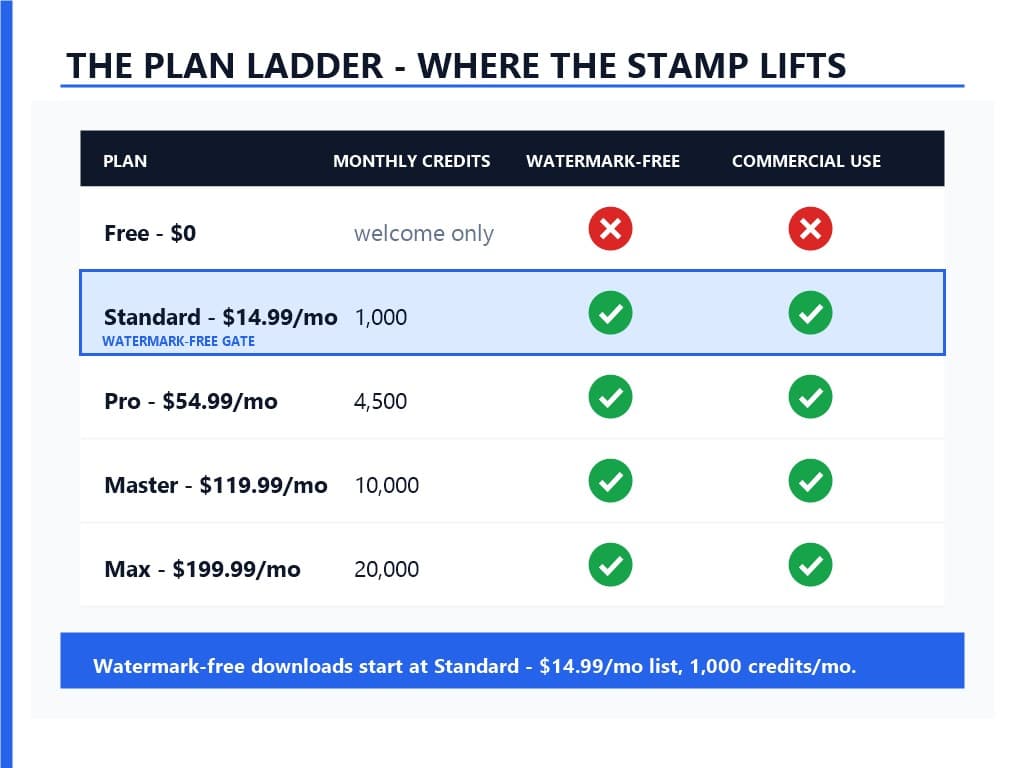
The list price comes with a caveat we verified across third-party sources: it drifts. Reviews published in mid-2026 report checkout promotions around $7.99 for Standard — AI Alleyway's hands-on review dates that figure to July 2026 — and a pricing tracker lists annual-effective rates as low as $6.99 — ToolColumn. The governing terms still say $14.99, so treat checkout as the source of truth and the terms as the entitlement document. Either way the boundary logic matches the rest of this series: Pika gates clean exports behind a $28 Pro tier, Kling includes them from $6.99–$8.80, and Hailuo lands between — one paid step up from free, whichever number the checkout banner shows this month.
Do Hailuo Credits Remove the Watermark?
No — credits buy generations, and watermark-free downloads are a subscription benefit. Hailuo's terms tie clean exports to Standard plan subscribers and higher-tier users; purchased credits carry no such entitlement, so a credit balance is the wrong currency for the stamp.
Hailuo runs three credit types, and none of them is an entitlement key. The Credit System section of the terms splits them into Membership Credits allocated to subscribers, Purchased Credits bought "at a rate of $1 for 70 credits," and Bonus credits granted through promotions. The watermark-free benefit, by contrast, lives in the plan benefit lists and in the Download and Watermark Conditions — both of which attach it to the subscription tier, never to a balance. Hailuo doesn't publish a Kling-style clause saying so in one sentence, but the entitlement language is plan-bound in its own terms, and that is what the plan table pays for.
The trap builds itself. Someone tops up purchased credits — a real balance, valid for years — generates a clip on the free lane, exports it, and the corner stamp rides along. They bought the currency the checkout page sells most visibly, and it was the wrong currency for the job: either the subscription tier changes or the file goes through targeted removal, and more credits touch neither.
Does Hailuo Give Free Daily Credits?
Not according to the governing terms. Hailuo's subscription policy documents exactly one free grant — a one-time welcome package for new accounts that expires three days after it lands. Reviews describing daily refills describe app behavior the billing terms do not guarantee.
The Promotional Offers section is unambiguous: "New users who register an account on or after June 18, 2025 will receive a one-time welcome package of free credits. These credits will expire three days after being granted. This offer is limited to one package per user" — Hailuo AI, Subscription Service Terms. One package, three days, per account. Now compare what the review layer tells people: a pricing guide describes a free tier of "commonly cited as around 3 to 8 short videos a day" that "resets daily" — ZSky; a hands-on review describes roughly 2,000 welcome credits worth "around eighty clips" that are "a fixed grant" — AI Alleyway. The one-time framing matches the terms; the daily reset does not appear anywhere in the document that governs billing. Note also what the terms omit: the package amount. Eighty clips is a reviewer's count, not a published number.
That is a meaningful difference if you are budgeting a project on the free lane. A daily refill, even a small one, supports a content calendar; a three-day welcome package supports a weekend of testing. Sites promising daily Hailuo free credits are describing behavior the terms don't document — and a project that depends on a refill the policy never promised fails mid-project, where a budget failure costs the most.
How Do You Export Hailuo Videos Without the Watermark?
The clean path needs a Standard-or-higher subscription and a download made while it is active. Generate on the paid plan, re-render anything made before you subscribed, and verify the downloaded file rather than the in-app preview before you build on it.
- Start on the right tier. Standard is the cheapest plan whose benefit list includes watermark-free downloads — $14.99 in the terms, with checkout promotions reported lower. There is no cheaper legitimate route to a clean export.
- Mind the queue while you test. The terms give free users three queued tasks with one generating at a time, and paid users five with two generating in parallel. If you are comparing tiers by render speed, that asymmetry is documented platform behavior, not a bug.
- Re-render anything made on the free tier. Output generated before the upgrade carries the stamp it was born with. Re-run the prompt on the paid plan rather than trying to strip the mark from a file the free lane handed you.
- Verify the export, then the model. Play the downloaded file and check the corners at full size — and if a brand-shaped mark survives a paid-tier export, check whether the preset you used bakes its own mark into the generation itself, the behavior the troubleshooting guides flag on certain Hailuo presets.
One boundary matters before you build on the free lane at all: the commercial use language in the terms is attached to paid subscriptions. The Intellectual Property section states: "We do not claim ownership over content you generate and download while on a paid subscription plan... you retain any and all intellectual property rights to such content, including the right to use it for commercial purposes" — Hailuo AI, Subscription Service Terms. The free lane is for learning the tool, not for commercial use. And when a generation fails or fails review, "the system shall automatically refund the credits consumed" — a failed render costs queue time, not credits.
How Do You Remove the Hailuo Logo From an Existing File?
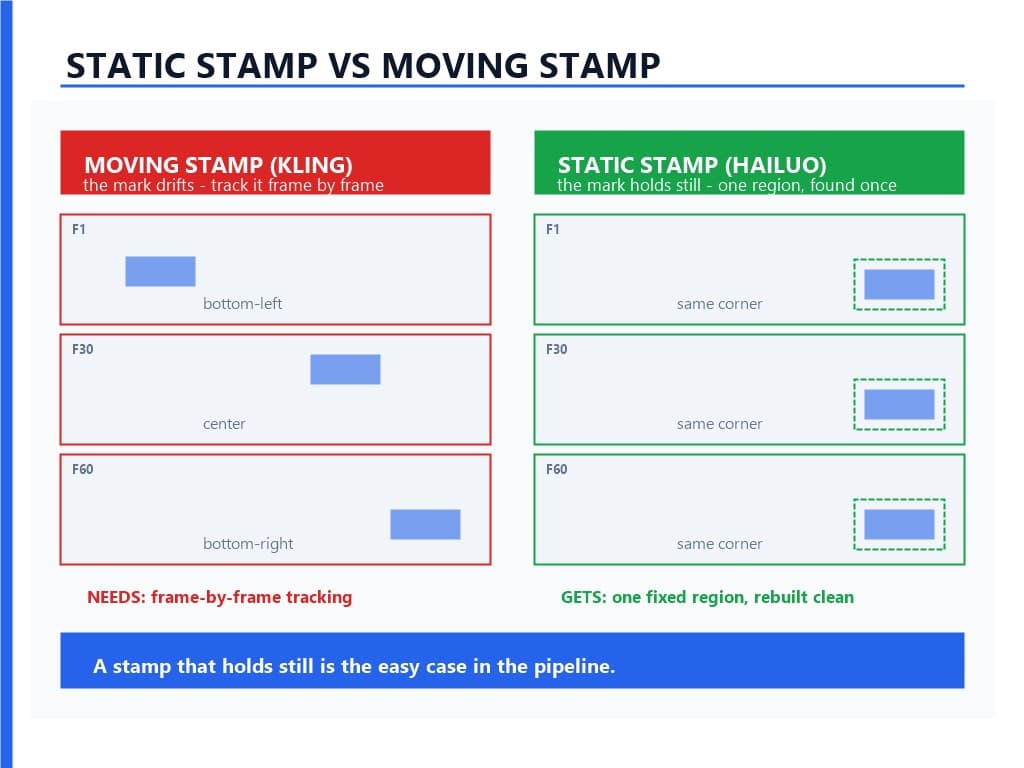
When the keeper clip was generated on the free tier, targeted AI inpainting rebuilds the stamped region frame by frame and leaves the rest of the footage untouched. A static corner stamp is the easy case in this pipeline — the region holds still across the timeline instead of drifting.
Inpainting is a reconstruction technique that rebuilds covered pixels from surrounding context instead of painting a blur over them or cutting them away. The pipeline runs detection, mask, rebuild: the detector finds the stamp's region on every frame, the mask isolates those regions, and the rebuild regenerates the pixels behind them. We compared the three approaches — AI inpainting versus cropping versus blurring — and the full pipeline is documented in our processing walkthrough.
The static mark is where Hailuo files earn their reputation as the gentle case in our queue. In our testing, a fixed corner logo needs its region found once and applied across the whole timeline; a drifting stamp needs the region tracked, frame by frame, before the mask can follow it — the problem we broke down in the Kling moving-stamp guide and the TikTok moving-watermark tests. Hailuo's stamp skips the tracking stage entirely in most files, which shows up downstream as faster processing and cleaner blends. The detection principles behind both cases are covered in our watermark detection models explainer. Upload the file to UnMark's processing page and the stamp is found and rebuilt before you'd finish drawing the box by hand:
Do Free Hailuo Watermark Remover Tools Work?
They work, with tradeoffs worth pricing in advance. Because Hailuo's stamp holds a fixed corner position, crop and fixed-region tools can genuinely land on it — the failure modes that plague moving stamps mostly don't apply here. The real costs are frame area, output quality, and where your footage travels.
Cropping is the blunt instrument: it cuts the stamped corner off and loses composition the platform's vertical and landscape deliverables depend on. Blurring keeps the frame and leaves a smudge that client work won't survive. Fixed-region tools — the open-source pipelines that erase a configured rectangle of pixels — are unusually well suited to a stamp that holds still, with one condition: the configured coordinates have to match the resolution you are processing, the same coordinates that fail their Kling counterparts on drifting marks. On Hailuo the assumption mostly holds.
The third family uploads your footage to someone's server in exchange for convenience — and not every contract allows shipping unreleased footage to a third-party processor. Targeted inpainting that keeps the full frame and hands back the original resolution is what we built UnMark's pipeline to do, and it is the option that costs nothing downstream. A folder of free-tier Hailuo keepers goes through the batch workflow in one session — each clip gets its stamp detected on its own frames, and a static mark makes those detections cheap.
Why Do Hailuo's Credit Clocks Tick at Three Different Speeds?
Because Hailuo runs three credit types with three validity windows: welcome credits last three days, membership credits last one month with no rollover, and purchased credits last until the end of the second calendar year. Each clock rewards a different usage cadence, and mixing them up is how balances quietly die.
The Credit System section sets all three windows in writing. Membership credits "are valid for one month and expire thereafter. Unused credits do not roll over to the next month." Purchased credits run "at a rate of $1 for 70 credits, with a validity extending to December 31st of the second calendar year following the date of purchase." Bonus credits inherit the welcome-package clock: three days. Compare that to Kling, which prices credits at 66 per dollar, or Pika's flat plan boundary — Hailuo's three-clock system is the most granular in the series so far.
Monthly creators whose output tracks a publishing calendar should live on membership credits and accept the monthly reset as the rhythm of the plan. Burst projects — a campaign week that needs twenty renders — fit purchased credits, which outlast the project by years. The welcome package is a trial, not a stake: whatever it holds is gone by day three, so spend it learning the tool's prompt behavior rather than "saving" it. One upgrade note from the same section: remaining membership credits convert to purchased credits when you upgrade tiers, which rescues a balance mid-cycle.
Is It Legal to Remove the Hailuo Watermark?
For clips you generated under a plan that includes watermark-free output, cleaning the mark is routine asset work. Hailuo's terms prohibit removing AI-content notices except where the company permits in writing — and the watermark-free download benefit is exactly that written permission.
The Terms of Use, last modified August 2026, draw the line directly: "You must not remove, obscure, alter, or disable any watermark, metadata, label, or other notice applied by the Company to identify content as AI-generated or manipulated, except where expressly permitted by the Company in writing or required by applicable law" — Hailuo AI, Terms of Use. Read the exception carefully, because it is the whole framework: the watermark-free download that ships with Standard and above is the company's written permission to receive clean output, which makes the official path and the permitted path the same path. What the clause rules out is the unofficial one — stripping the notice from free-tier files you don't hold entitlements on, or removing attribution marks from footage you didn't generate, which is the territory DMCA §1202 penalizes.
Two more clauses shape the picture. The commercial use right attaches to paid-plan downloads in the Intellectual Property section quoted above — so a cleaned free-tier file used in commercial work sits on entitlements the terms never granted, regardless of how clean the pixels look. And the Terms of Use add a disclosure duty: when you publish AI-generated content, "you must clearly disclose that it is AI-generated or manipulated whenever required by applicable law or reasonably necessary to avoid deception" — Hailuo AI, Terms of Use. Removing a platform stamp and disclosing AI provenance are different obligations; the first does not erase the second. The position our legal guide to AI video watermarks holds across the series applies unchanged: clean what you're entitled to clean, attribute what the law requires, and under Thaler v. Perlmutter, purely AI-generated work can't be registered for copyright — human direction on top of the generation is what builds protectable authorship.
What Are Common Hailuo Watermark Problems and Fixes?
Four diagnostics cover most Hailuo stamp cases that reach us: credits bought instead of a subscription, a budget built on the daily-credit myth, keeper clips stranded in the three-day welcome window, and a failed render misread as a watermark problem. Each has a short fix, and none of them requires re-shooting anything.
You bought credits and the stamp is still there. Expected behavior given the terms: watermark-free downloads attach to the Standard tier and above, not to a balance. Either subscribe and re-render, or route the existing files through targeted removal — don't buy more credits for an entitlement they can't reach.
Your free-credit budget ran out mid-project. If the plan assumed a daily refill for non-subscribers, the assumption was the error — the terms document a one-time welcome package with a three-day expiry and nothing recurring. Rebuild the budget on what is documented: purchased credits at $1 per 70, or a subscription whose monthly allowance is the only guaranteed refill.
The keeper clips came from the welcome window. Three days is enough to produce files worth keeping and not enough to produce clean ones. Keep them and clean them — a batch of static-corner stamps goes through the batch workflow in one session, and our e-commerce use case shows what clean product footage needs downstream.
A render failed and the credits vanished. Check again after the queue clears — the terms' Credit Refund Policy says failed and review-rejected generations are refunded automatically. Free-tier renders also wait behind every paying user, so a slow render is not a failed one; the refund clause covers the genuinely failed case.
Conclusion
The Hailuo AI watermark is the straightforward case this series has been waiting for: a corner stamp that holds still, on a platform whose documentation is candid about all of it. The terms draw the boundary cleanly — free downloads carry the watermark, Standard and above download clean, credits buy generations and never entitlements, and the free-credit grant is a one-time welcome package that expires in three days, not the daily refill the review layer keeps describing. The three credit clocks are the platform's real complexity, and they reward matching the credit type to the cadence of the work.
The decision sequence in one line: check the plan table before buying anything, budget on the windows the terms actually document, re-render free-lane keepers when the subscription allows and inpaint the ones it doesn't, and treat the watermark-free benefit as the written permission it is. Hailuo is the sixth platform we've documented end to end, and the pattern across all of them — Veo, Sora, Runway, Pika, Kling, and the watermarking standards they carry — is that every vendor draws its clean-output line in a different place. That's the pipeline we run at UnMark every day — if you'd rather not hand-clean a folder of stamped keepers, upload the file and let the detection and rebuild run themselves.
References
- Hailuo AI — Subscription Service Terms (plan ladder, Download and Watermark Conditions, Credit System, welcome-package clause, Credit Refund Policy)
- Hailuo AI — Terms of Use (watermark and AI-notice removal prohibition, AI disclosure duty, last modified August 2026)
- ToolColumn — Hailuo AI Pricing (price drift between list and checkout rates, app subscription versus API boundary)
- AI Alleyway — Hailuo AI review (hands-on free-trial counts, July 2026 promo pricing)
- ZSky — How Much Does Hailuo AI Cost in 2026 (credit math estimates, the daily-refill claim this article corrects)
- AI Productivity Guide — Remove the Watermark From an AI Video Export (Hailuo presets baking brand marks into generations, moving-versus-static diagnosis)
FAQ
Q1: Which Hailuo plan removes the watermark?
Standard and above. The Subscription Service Terms state that "Standard plan subscribers and higher-tier users will be able to download videos without a watermark," and every higher tier carries the benefit. The free tier's downloads include the watermark.
Q2: Do Hailuo credits remove the watermark?
No. Credits are generation currency in three types — membership, purchased, and bonus — and none carries the watermark-free entitlement. The terms attach clean downloads to the subscription tier itself, so a credit balance cannot substitute for a Standard-or-higher plan.
Q3: Does Hailuo give free credits every day?
The governing terms document only a one-time welcome package for new accounts, expiring three days after it lands, limited to one per user. Daily-refill claims circulate in reviews, but nothing in the subscription terms promises non-subscribers a recurring grant.
Q4: How long do Hailuo credits last?
Three windows: welcome credits expire in three days, membership credits last one month with no rollover, and purchased credits ($1 for 70) remain valid until December 31st of the second calendar year after purchase.
Q5: Can I remove the Hailuo watermark for free?
Not inside Hailuo — the free tier has no clean-export toggle. Because the stamp is static and corner-positioned, fixed-region tools can land on it, and targeted inpainting removes it while keeping the full frame and original resolution.
Last updated: September 2026