EU AI Act Video Watermark Rules: Article 50 Explained for Creators (2026)
Mark Ma
Last updated: October 2026
A few months ago a Shenzhen e-commerce seller showed me his editing queue: 40 product videos a week, half generated with a domestic AI video tool, each one carrying a small corner badge he called "the annoying tag". His question was blunt — can I just crop it out before shipping these to my distributor? He had searched for china ai generated content labeling rules in English and found wire-service news, a wiki page, and a consultancy deck. None of them answered his actual question: what exactly does the law require to be inside the file, and what happens to the guy who strips it out.
I build watermark removal tooling at UnMark, so that question is not academic for me — it is a product boundary. On March 7, 2025, four Chinese regulators — the Cyberspace Administration of China (CAC), the Ministry of Industry and Information Technology, the Ministry of Public Security, and the National Radio and Television Administration — jointly issued the Measures for Labeling AI-Generated Synthetic Content, document number Guoxinban Tongzi [2025] No. 2. The 14-article instrument took effect on September 1, 2025, alongside a mandatory national standard, GB 45438-2025. The English-language coverage stops at the press-release level; the articles that go deeper are written for compliance officers, not for people who ship video files.
This piece walks the actual text — every quote below is my working translation from the official Chinese text published on gov.cn, fetched this October and marked as an unofficial translation where quoted. I cover the two label types, the video-specific placement duties, the export retention rule that makes the label a property of the file, the platform verification ladder, the one legal channel for label-free content, the removal ban that explicitly names tools and services, and how all of this compares with the EU AI Act and US copyright law. Then I close with the line I draw in my own product.
Four regulators issued one 14-article instrument on March 7, 2025, and it went live on September 1, 2025, together with a mandatory national standard that fills in the technical encoding details. Everything a generator, a platform, an app store, or a user does around AI labeling traces back to these 14 articles.
The Measures sit on top of three parent regulations — the algorithm recommendation provisions, the deep synthesis provisions, and the interim generative AI measures — and Article 1 names them as its legal basis. Article 14 closes the text with the date: "These Measures shall come into force on September 1, 2025." — Cyberspace Administration of China (unofficial translation). The companion standard, GB 45438-2025 Cybersecurity Technology — Labeling Method for Content Generated by Artificial Intelligence, is a mandatory national standard issued by SAMR and the Standardization Administration on February 28, 2025; the CAC's own expert interpretation confirms it applies from the same September 1, 2025 date. "Mandatory" here is the GB prefix doing legal work — the technical details are not suggestions.
Scope matters for anyone reading this from outside China. Article 2 applies the Measures to the service providers already defined by those three parent regulations — the companies running generative AI services for the Chinese market. The enforcement logic (Article 13) routes violations back through the parent laws. If you generate video in Shanghai or in San Francisco and publish into Chinese platforms, section four below — the platform verification ladder — is the part that reaches you.
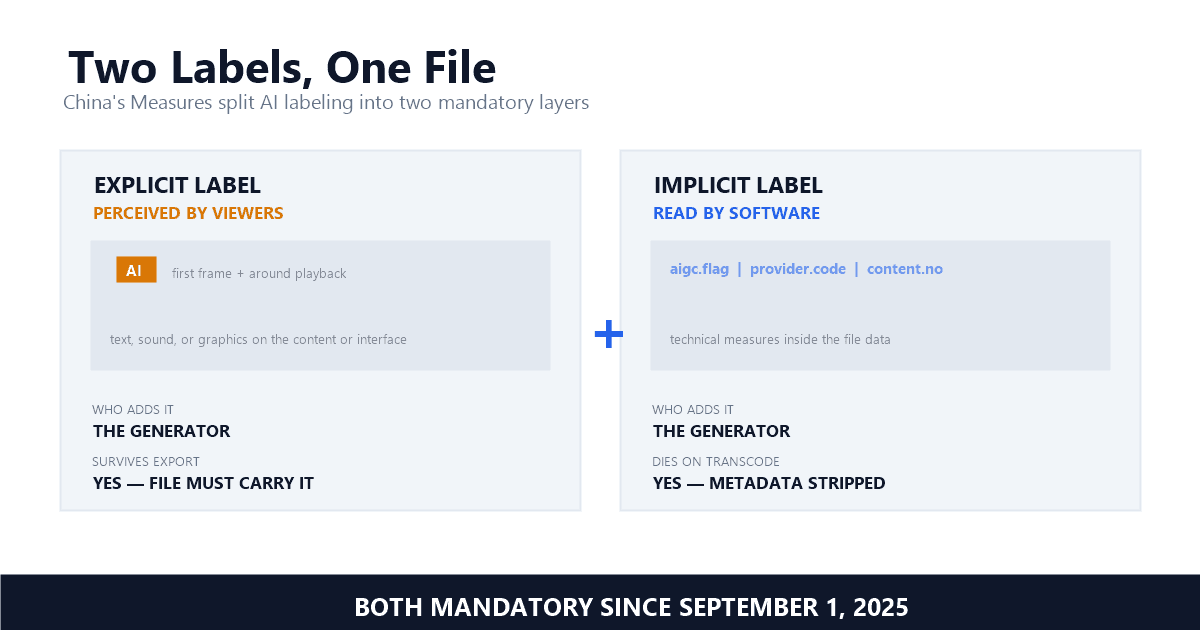
An explicit label is anything a human can perceive — text, sound, or graphics added to the content or its interface. An implicit label is machine-readable information written into the file's data by technical means. Both are mandatory for covered services; they live in different layers and die in different ways.
Article 3 carries both definitions, and the wording rewards a close read. An explicit label "refers to a mark added to the generated synthetic content or the interaction scene interface, presented in text, sound, graphics, or other forms, and clearly perceivable by users" — Cyberspace Administration of China (unofficial translation). An implicit label "refers to a mark added to the data of the generated synthetic content file through technical measures, not easily perceivable by users" — Cyberspace Administration of China (unofficial translation). One is for eyeballs, the other for software. Metadata is the descriptive information embedded into a file header in a specific encoding format, recording the source, attributes, and purpose of the file — that is Article 5's own definition, and it is where implicit labels live.
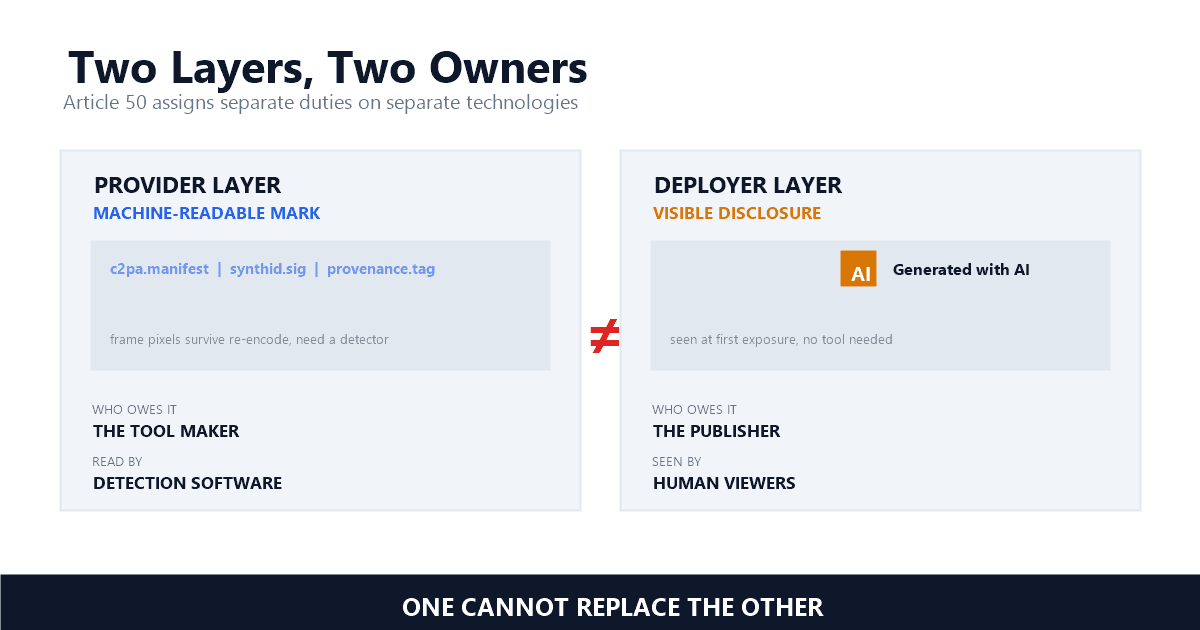
If you have read the EU AI Act Article 50 breakdown, this two-layer design will look familiar: Europe also split provider marking (machine-readable) from deployer disclosure (visible). The Chinese drafters reached the same architecture a year earlier, with one engineering difference — China's explicit label can live in the interaction interface too, not only in the pixels. The technical trade-offs between pixel perturbation marks and metadata marks are the same everywhere; the SynthID vs C2PA comparison covers why metadata dies on transcode while pixel marks survive it.
For video, the explicit label must appear on the first frame and around the playback area, with optional labels at the end or middle. Then comes the clause most coverage skips: when the provider offers download, copy, or export functions, the file itself must carry a compliant explicit label.
Article 4(4) sets the placement: for video, "add a conspicuous label at an appropriate position on the video's first frame and around video playback, and may add conspicuous labels at appropriate positions at the end and middle of the video" — Cyberspace Administration of China (unofficial translation). Article 4(3) puts a conspicuous label at an appropriate position on images. Article 4(1) and 4(2) handle text and audio with start, middle, or end placements. The first-frame requirement is why domestic tools like Kling and Hailuo burn their marks into the opening seconds — the corner badge is not a branding choice; it is the compliance surface.
The load-bearing sentence is Article 4's final paragraph: "Where service providers provide functions to download, copy, or export generated synthetic content, they shall ensure that the file contains explicit labels that meet the requirements." — Cyberspace Administration of China (unofficial translation). Read that as an engineering spec, because that is what it is. A label living only in the web player's interface overlay vanishes the moment the file is downloaded — the exact failure mode the EU icons rule anticipates with "The icon must be visible when content is reshared or downloaded". China's drafters solved it directly: the exported file must carry the label. That makes the explicit label a property of the file, not of the player, and it is the reason a downloaded AI clip from a compliant Chinese generator still shows its badge after export. The state of AI video watermarking 2026 maps which Western generators do and do not behave this way.
Four layers carry duties: providers label at generation, dissemination platforms verify and add their own notices, app stores check labeling materials at listing time, and users must declare AI content when publishing. The platform layer is where an overseas creator uploading into China actually feels the rules.
Article 6 builds a four-step verification ladder for platforms that distribute content, and the third step is the one that catches undeclared AI footage. Where the file metadata contains no implicit label and the user made no declaration, but the platform "detects an explicit label or other traces of AI generation, it shall identify the content as suspected AI-generated synthetic content and add a conspicuous notice label around the published content to remind the public" — Cyberspace Administration of China (unofficial translation). That phrase "other traces of AI generation" is a mandate for visual detection — the same detector technology the watermark detection models piece covers — running inside every major Chinese platform. Platforms that accept a label-bearing file must also write their own distribution info into the metadata (platform name or code, content number), per Article 6's closing paragraph.
Article 7 reaches app stores: before listing an app, the store must ask whether it provides generative AI services and verify its labeling materials if so. Article 10 paragraph 1 reaches you as a user: when publishing generated synthetic content through a dissemination service, "the user shall proactively declare it and use the labeling functions provided by the service provider to label it" — Cyberspace Administration of China (unofficial translation). The practical sequence for a marketer repurposing AI clips onto Chinese platforms is therefore fixed: declare at upload, or the platform's detector runs and pins a suspected-AI notice on the post anyway — and the Meta and Google Ads rules show Western ad platforms converging on similar AI-disclosure expectations.
Yes — through the front door. Article 9 lets a user request content without explicit labels, and lets the provider agree after contractually clarifying the user's labeling duties, while keeping request logs for at least 6 months. It is the only sanctioned no-label channel I have found across the three major AI labeling regimes.
The text is precise about the sequence: "Where a user applies to the service provider for generated synthetic content without added explicit labels, the service provider may, after clarifying the user's labeling obligations and usage responsibilities through the user agreement, provide such content without explicit labels, and shall retain logs on the identity of the provision recipient and other relevant information for no less than 6 months in accordance with the law." — Cyberspace Administration of China (unofficial translation). Three conditions ride along: the user agreement must spell out who owns the labeling duty after handoff, the logs must identify who received the label-free file, and the retention floor is 6 months. The implicit label in the metadata is not mentioned as removable here — the channel waives the visible layer.
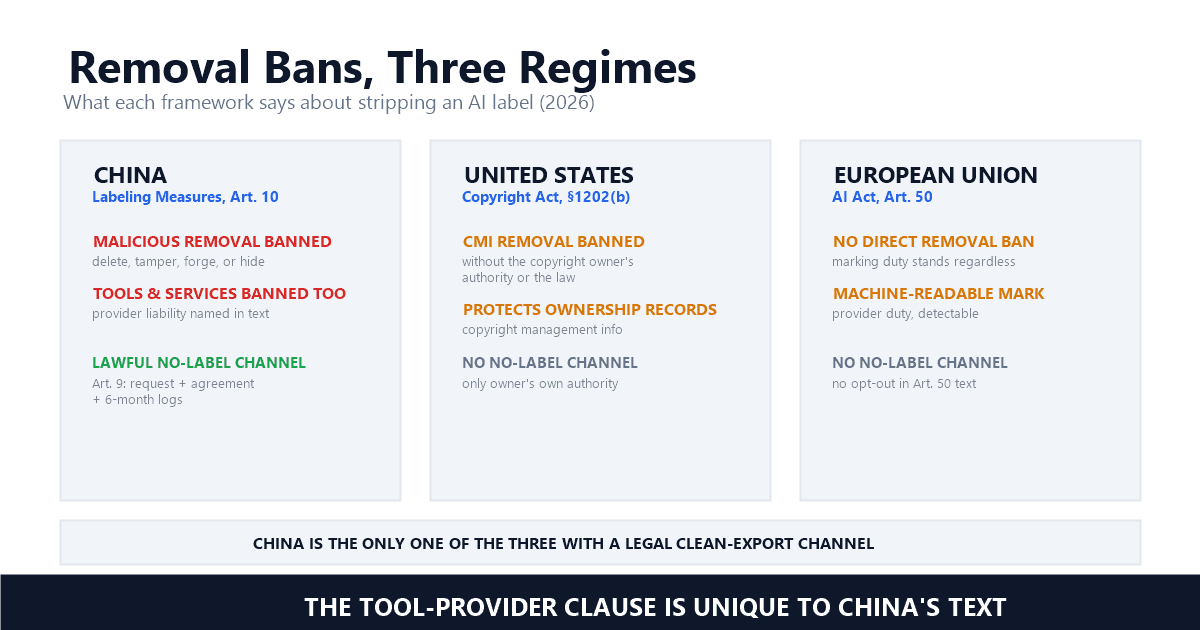
Why this matters beyond China: neither the US statute nor the EU AI Act contains anything like it. American law has no mechanism to authorize removal of copyright management information short of the copyright owner's own authority; Europe has no opt-out from Article 50's marking at all. China — the strictest labeling regime of the three — is the only one that concedes a lawful, logged, provider-mediated path to clean output. If you need label-free AI footage for a legitimate pipeline, the compliant move in China is to request it from the generator, not to strip the badge yourself. My own benchmarks with removal pipelines say the same thing in engineering terms: the export-side badge is burned into pixels by design, so clean reconstruction is slower and noisier than simply getting a clean file.
Article 10 bans maliciously deleting, tampering with, forging, or hiding the mandated labels — and goes one step no other regime takes: it bans providing tools or services for others to do it. Article 13 then routes violations to the parent laws for actual penalties.
The full prohibition deserves its verbatim moment: "No organization or individual may maliciously delete, tamper with, forge, or hide the labels of AI-generated synthetic content provided for in these Measures, may not provide tools or services for others to commit the above malicious acts, and may not harm the lawful rights and interests of others through improper labeling means." — Cyberspace Administration of China (unofficial translation). Compare the American analogue: Section 1202(b) provides that "No person shall, without the authority of the copyright owner or the law—(1) intentionally remove or alter any copyright management information" — Legal Information Institute, 17 U.S. Code § 1202. The US ban protects ownership records tied to copyright authority; China's ban protects disclosure labels regardless of who owns the footage, and the second clause names tool providers as a distinct prohibited category. Europe, by contrast, has no direct anti-removal clause in Article 50 — its machine-readable mark obligation reads that providers "shall ensure that the outputs of the AI system are marked in a machine-readable format and detectable as artificially generated or manipulated" — AI Act Service Desk, Article 50 — but stripping the mark is left to other theories of liability. The DMCA §1202 explainer and the multi-jurisdiction legality guide handle both frameworks line by line.
For a tool builder like me, that second clause is the product boundary in statutory text. A remover marketed as "erase the AI-generated badge so it passes as camera footage" is not a gray area under these Measures — it is the conduct the article describes, provided as a tool or service. My own line at UnMark: cleanup of branding marks, editor draft overlays, and stock previews on footage the user owns or is authorized to process is ordinary post-production — the pipeline walkthrough shows what that reconstruction involves. But compliance labels written into files by the labeling law are not decoration. Where a mark is a legal disclosure surface — a provider's explicit label under China's Article 4, or the provider's machine-readable mark under Europe's Article 50 — the right answer is to keep it, or to source label-free output through the provider channel. In my testing, that distinction also happens to be the technically safer one: compliance badges sit on or in the frame by design, and the technology trends piece records what reconstruction does to footage when marks and content are entangled.
Four moves cover most of the exposure: keep the metadata intact through your pipeline, check your generator's GB 45438-2025 conformance if you publish into China, declare AI content at upload instead of letting the platform's detector tag it, and archive the original labeled file as your evidence layer.
First, the archive discipline. The implicit label lives in metadata, and cross-platform distribution strips metadata — every major social platform transcodes on ingest. Archive the original export from your generator, with its metadata and first-frame label untouched; it is your proof of a compliant chain, and the agency handoff guide builds the same archive-first discipline for delivery chains. Second, conformance: if your tool serves Chinese users, the labeling fields it writes should match GB 45438-2025's encoding spec, and your user agreement needs the Article 8 disclosure of labeling methods. Third, declare at upload — the Article 6 ladder treats an undeclared, detector-flagged upload worse than a declared one, and a suspected-AI notice pinned by the platform is permanent surface area on your post. Fourth, source clean output through Article 9's provider channel when you genuinely need label-free material, with the agreement and the 6-month log in place.
One thing I would not do: build or adopt tooling whose pitch is evading the disclosure layer. The statutory text catches the tool provider, not just the user. Detection is the other half of the story underneath the platforms, and it keeps improving — the same detection-model architecture used for brand marks now runs as the third rung of the Article 6 ladder. Compliance labels are infrastructure, and the cropping analysis makes the visual case for why partial removal leaves artifacts that detectors can still see.
The Measures govern service providers within the three parent regulations' scope — generators serving the Chinese market. If you generate abroad and publish into Chinese platforms, the platform-side Article 6 ladder applies to your upload: declare the content, or the platform's detection of explicit labels or other AI traces will pin a suspected-AI notice on it.
No — they are different layers with different owners. The provider's explicit label comes with the file under Article 4 (first frame and playback surroundings for video). The platform's notice is added at distribution under Article 6 when metadata checks, user declarations, or detectors indicate AI content. A single post can carry both.
It is the mandatory national standard — Cybersecurity Technology: Labeling Method for Content Generated by Artificial Intelligence — issued on February 28, 2025, and effective September 1, 2025, the same day as the Measures. It specifies the technical detail the articles deliberately leave out: which metadata fields carry the implicit label, in which file formats, and how they are encoded.
Last updated: October 2026
Mark Ma is the founder and lead engineer at UnMark, where he leads the development of AI-powered video watermark removal technology. With over a decade of experience in computer vision, deep learning, and video processing, he has built production systems that process millions of frames per month across TikTok, Instagram Reels, and Google Veo content. His technical work focuses on motion-compensated watermark detection, spatial-temporal inpainting, and quality-preserving reconstruction for short-form vertical video. Before UnMark, Mark shipped computer vision infrastructure at scale for content moderation and ad compliance platforms. He writes this blog to document the real engineering, testing, and regulatory reasoning behind UnMark's processing pipeline — every test result, frame analysis, and benchmark published here is reproduced from actual production data, not synthetic examples. His goal is to give creators, brands, and regulators a verifiable technical reference for AI video watermark removal in 2026.