How to Remove the InShot Watermark From Your Videos (2026)
Mark Ma
Last updated: November 2026
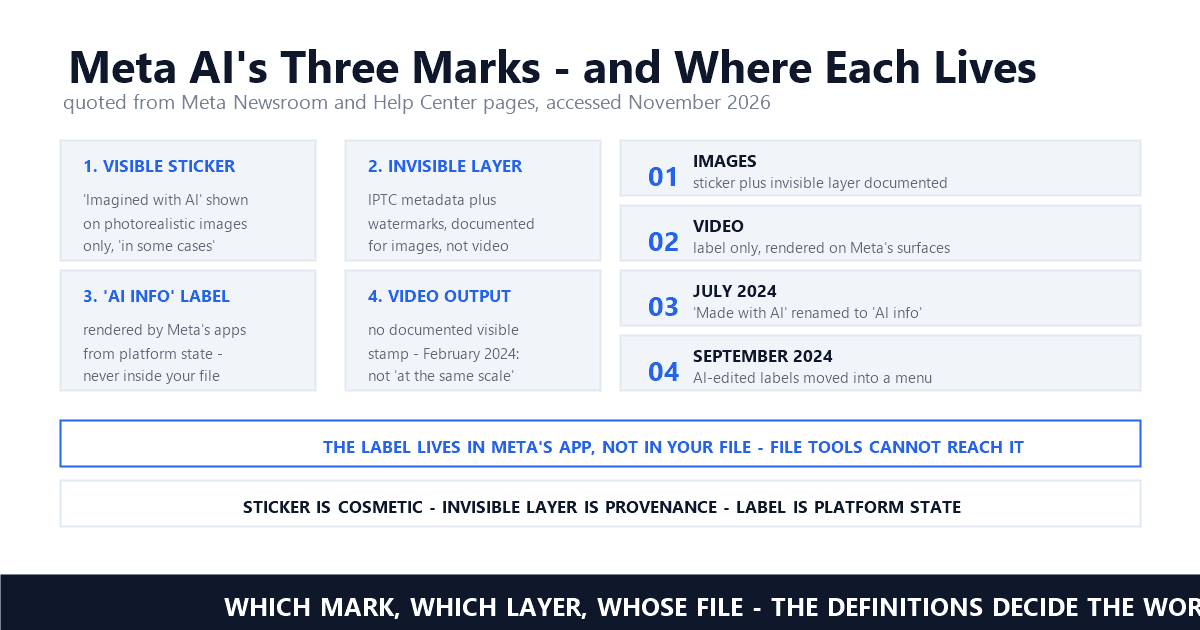
Type "Meta AI watermark removal" into a search bar and you get a market for a product whose object nobody has bothered to define. The Python Package Index currently hosts three separate packages named remove-ai-watermarks, comparison sites slot a Meta AI remover between their Kling and Pika entries, and none of the listings says which mark it claims to erase. Meta's own documentation — public, dated, and quoted below — describes three different marks that behave nothing alike.
Video cleanup is the trade this site exists for — UnMark, the watermark removal tool we run, spends its working days restoring branded footage, and Meta AI output reaches our queue often enough that we wanted the record set straight from Meta's own posts rather than from tool-listing copy. Our analysis below reads only primary sources: two Meta Newsroom posts from 2024, the Vibes announcement, two Help Center pages, and Meta's June 2025 video-editing release.
Provenance is the machine-readable record of where a piece of media came from, and it is the word most of the removal market hides behind. Pull Meta's actual marks apart — a visible sticker that belongs to pictures, an invisible watermark-plus-metadata layer documented for images while video was pointedly left out, and an "AI info" label rendered by Meta's apps rather than stored in your file — and most of the sector dissolves. Keep them blurred, and you buy tools for problems your files do not have.
Meta has never documented a visible watermark on Meta AI video output. The one visible mark it does describe — "Imagined with AI" — attaches to photorealistic images in some cases. What video carries today is an "AI info" label rendered on Meta's surfaces, plus your disclosure duty when posting.
Meta's video stack has grown around this gap. In September 2025 the company introduced Vibes, describing it as "a new feed of AI videos at the center of the Meta AI app" with tools to "remix an existing video by adding music or changing the style" — Meta Newsroom. Four months earlier it had shipped generative AI video editing across the Meta AI app, the Meta.AI website, and the Edits app — Meta Newsroom. Neither announcement mentions a visible watermark on output, and the contrast with photographs is deliberate: for images, Meta has said in plain text what it applies.
The Help Center page for generating images with Meta AI walks the whole flow — submit a prompt, receive images, click Edit, then "Animate the image: You can have Meta AI generate a short animation of the generated images" — before download and reporting — Meta Help Center. No watermark step appears anywhere in it. That omission matters more than it sounds: the short clips Meta AI produces by animating an image descend from the image pipeline — right where Meta documents its marks living.
If a generator visibly stamps video, the mark shows up in frame-by-frame audit, and our Veo 3.1 guide treats it as an editing problem with editing answers. Nothing equivalent is documented for Meta AI or Vibes output — hence our Grok Imagine guide and this piece gets to ask the matching question of two companies and get structurally different answers from each company's own pages.
For images, Meta applies three things at once: visible markers, invisible watermarks, and metadata inside the file. The invisible layer pairs IPTC fields with watermarks aligned to Partnership on AI guidance, and FAIR's Stable Signature bakes marking into generation itself. Audio and video, Meta said in February 2024, lacked those signals "at the same scale".
The fullest statement is Nick Clegg's February 6, 2024 post. On images: making sure people know AI is involved means "putting visible markers that you can see on the images, and both invisible watermarks and metadata embedded within image files" — Meta Newsroom. The pairing is deliberate engineering, not decoration: Clegg explained that layering the two makes each marker harder to scrub and easier for rival platforms to recognize.
Clegg named the spec plainly: "IPTC metadata and invisible watermarks" — Meta Newsroom — aligned with Partnership on AI guidance rather than a proprietary scheme. IPTC Photo Metadata, the standard the post links, is the very field set stock libraries and news wires read. And the video gap is stated without hedging: image generators were starting to include signals, but companies "haven't started including them in AI tools that generate audio and video at the same scale, so we can't yet detect those signals and label this content from other companies" — Meta Newsroom.
Meta admitted the limits in the same post: "it's not yet possible to identify all AI-generated content, and there are ways that people can strip out invisible markers" — Meta Newsroom. Its countermeasure is Stable Signature, FAIR's scheme that "integrates the watermarking mechanism directly into the image generation process for some types of image generators", valuable for open models "so the watermarking can't be disabled" — Meta Newsroom. That is an image-generation technique; the post names no video equivalent. How this embedded layer compares with Google's machine-readable approach is laid out in our SynthID vs C2PA comparison, and the classifiers Meta said it was building to catch stripped files are the field our detector models explainer covers.
The label is the third object and the least like a watermark. Meta applies "AI info" when it detects industry-standard signals or once the uploader discloses AI use; the label was renamed from "Made with AI" on July 1, 2024, and in September 2024 labels for AI-edited content moved into a menu while AI-generated content kept the visible tag.
Monika Bickert's April 5, 2024 announcement set the trigger: "We will begin adding 'AI info' labels to a wider range of video, audio and image content when we detect industry standard AI image indicators or when people disclose that they're uploading AI-generated content" — Meta Newsroom, updated July 1, 2024. Video is named explicitly, and the mechanism is detection or disclosure — not anything embedded in your export.
Meta's Help Center runs parallel logic today: "Any content that contains industry-standard signals that it's generated by AI will be labeled with 'AI info.' This includes content that is created or edited using third-party AI tools." Content made with Meta's own tools "may be automatically labeled as 'AI' content or in some cases, feature a visible watermark that says 'Imagined with AI'" — Meta Help Center. Read the second sentence carefully: the visible-watermark wording sits inside the labeling doc, describing Meta's AI material shared to Facebook, Instagram, and Threads — the sticker resurfacing as a distribution fact, not a new video stamp.
The September 12, 2024 update sharpened the distinction: labels would "better reflect the extent of AI used in content", with AI-edited content's label moving into a menu while AI-generated content keeps it — Meta Newsroom. The operational takeaway for editors is geometric: the label is rendered via Meta's apps onto Meta's surfaces from platform state, not from your file. It is not a region of pixels in your MP4, it travels nowhere, and "removing" it is a category error — the file never contained it. Where labels do govern behavior is distribution: paid-amplification rules for labeled media are the territory of our ad compliance piece.
Because three different marks got blended into one keyword. Listings sell image-sticker crops as if video stamps existed, treat the platform label as a file feature, and relabel metadata wipes as removal. What ships is stripping, inpainting, and re-encoding — none of it touches a label rendered from platform state, none is needed for the video stamp never documented.
Search the phrase and the front page remains the tell. Three PyPI packages named remove-ai-watermarks still hold their rank, and the newer arrivals are no more careful: a downloader site now sells a "Meta AI video watermark remover" on the premise Meta AI stamps a visible mark onto each clip it emits, and an editing-suite guide repeats the image-side tale as though footage obeyed identical rules. Missing from those results: an English page from Meta, a Help Center entry, an explainer grounded in Meta's posts. The demand is keyword-shaped: people saw a sticker on an image, generalized it to all Meta AI output, and a tool market formed around the generalization. The free-tier watermarks that generate visually identical demand are real and stamped — the trade-off families our Pika guide and Kling guide document — which makes the Meta case look familiar while being structurally different.
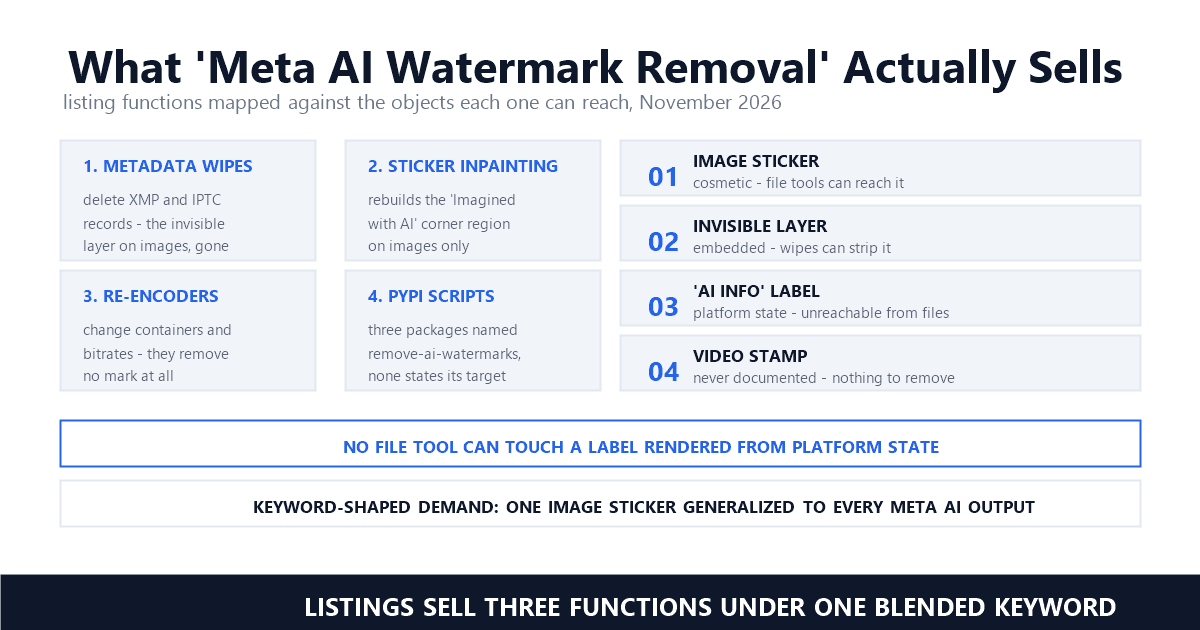
Take the listings apart and three functions fall out. Metadata wipes delete XMP and IPTC records — the invisible layer on images, gone cleanly in a single pass. Corner-sticker inpainting reconstructs the "Imagined with AI" region on images, the analogous class of edit our methods breakdown covers. Re-encoders change containers and bitrates and drop no mark at all. All three operate against your file; none can affect the "AI info" label, because the label is rendered from platform state rather than file bytes. That split is hardly academic for us — requests landing in our support inbox sort into precisely those three buckets, and the third one, "make the label go away," is the one we decline in writing, because the object lives on Meta's side of the wall and no artifact we handle contains it. Whether any of this is yours to do is a question of ownership and jurisdiction, which is where the analysis goes next.
No statute names the Meta AI watermark. Your exports are ordinary assets, and Meta's terms govern what you may do on its surfaces. The red lines appear where removal serves deception: EU AI Act Article 50 expects machine-readable marking on synthetic media, China's rules punish malicious label deletion, and Section 1202 punishes fraudulent removal of copyright records.
In Europe, Article 50 of the AI Act obliges providers and deployers of synthetic content to keep machine-readable markers and to disclose deepfakes to viewers; those duties began applying in August 2026, and our EU AI Act explainer walks the clauses. Stripping the embedded marker from synthetic media you then distribute is squarely the fact pattern those duties anticipate — the invisible layer is a regulated object there, not a cosmetic annoyance.
China's regime is blunter. The labeling measures in force since September 2025 require explicit and implicit labels on AI-generated content and penalize malicious deletion or alteration of those labels; our China labeling guide maps the articles. A Meta AI clip is less likely to carry a Chinese-mandated embedded label than domestic-tool output, but re-generating or re-publishing through domestic tools puts their labels — and their protections — on your file.
In the United States, Section 1202 spans removal of copyright management information with intent to enable infringement — our 1202 explainer details the fraud requirement, and an invisible AI watermark alone is not CMI unless copyright records ride along with it. The ordinary creator case — cleaning cosmetic marks off your Meta AI export for a client deck or an ad test — sits outside all three regimes and is the through-line of our ownership pillar and our 2026 legality guide. Seen through that lens, the niche's usual repair kit — crop, inpaint, re-encode — aims at marks anchored in pixels, whereas each of Meta's three objects dodges that definition in its own fashion, and blanket tooling keeps missing the target as a result; only provenance-aware pipelines and account-side toggles move that needle worldwide. The conduct to refuse is different in kind: relabeling AI output as camera footage, which compounds platform penalties — Meta said non-disclosing uploaders may face them — alongside deepfake exposure under emerging statutes.
Keep the original export and its metadata whenever provenance could matter. Treat the image sticker as cosmetic on your own assets, and leave AI disclosures intact when you post. Expect the video-side gap to close: Meta said image signals ran ahead of audio and video, and every newsroom update since has narrowed, not widened, that gap.
Three file-handling habits do most of the work. First, the original export is the provenance copy: if a client, a stock library, or a platform dispute ever asks where the recording came from, intact metadata answers in seconds — and Animate outputs inherit their history from the source picture, so keep the image too. Second, Vibes remixes stack AI on AI: restyling or adding music makes a clip more synthetic, not less, and no cleanup rewrites the trail. Third, treat platform stamps on owned footage as the cosmetic objects they are; batch cleanup of archives stays routine — the workflow our batch cleanup guide and UGC workflow piece already automate.
Distribution is where labels genuinely bind. Labeled content might face restrictions when boosted or run as advertising, the subject of our ad compliance piece, and deleting an AI disclosure before cross-posting creates exactly the deception record the new statutes target. The safe sequence is boring: disclose when Meta asks, let the label ride, and keep the clean master for licensed uses — with the method choices for the cleanup itself comparison-tested in our inpainting methods breakdown.
Finally, watch Meta's pages rather than tool-listing rumor. Both the July 1 and September 12, 2024 changes arrived as quiet updates to existing newsroom posts; the same will be true when video-side signaling arrives. Everything in this piece was sourced from those pages in November 2026, and the definitions that decide workflows — which mark, which layer, whose file — are exactly what will shift when they do.
Does Meta AI video have a watermark?
Not a visible one — Meta has never documented a visible watermark on Meta AI video output. The visible mark it documents, "Imagined with AI", applies to photorealistic images in some cases. Invisible watermarks and metadata are documented for stills; for audio and video, Meta said in February 2024 that generators had not started including signals at the same scale.
Can you remove the Meta AI watermark?
Depends which mark. The image sticker can be cropped or reconstructed like any cosmetic overlay on your exports. The "AI info" label cannot be removed from a file because it is rendered by Meta's apps and never lived in the file. Scripts sold as watermark removal mostly strip metadata — legal to run on your own images in most places, regulated when the removal serves deception about origin.
Why does my Meta AI image say "Imagined with AI"?
Because Meta has applied that visible label to photorealistic images made with Meta AI since the feature launched, as Nick Clegg's February 2024 post states. The Help Center adds that content made with Meta's AI tools may be automatically labeled as "AI" content or, in some cases, carry that visible watermark when circulated to Facebook, Instagram, or Threads.
Last updated: November 2026
Meta Newsroom — Labeling AI-Generated Images on Facebook, Instagram and Threads (Nick Clegg) (accessed November 2026; published February 6, 2024)
Meta Newsroom — Our Approach to Labeling AI-Generated Content and Manipulated Media (Monika Bickert) (accessed November 2026; published April 5, 2024, updated July 1 and September 12, 2024)
Meta Newsroom — Introducing Vibes: A New Way to Discover and Create AI Videos (accessed November 2026)
Meta Newsroom — You Can Now Edit Videos With Meta AI (accessed November 2026)
Meta Help Center — How AI-Generated Content Is Identified and Labeled on Meta (accessed November 2026)
Meta Help Center — Generate Images Using Meta AI at www.meta.ai (accessed November 2026)
Partnership on AI — Glossary for Synthetic Media Transparency Methods: Indirect Disclosure (accessed November 2026; linked from Meta's February 2024 post)
Mark Ma is the founder and lead engineer at UnMark, where he leads the development of AI-powered video watermark removal technology. With over a decade of experience in computer vision, deep learning, and video processing, he has built production systems that process millions of frames per month across TikTok, Instagram Reels, and Google Veo content. His technical work focuses on motion-compensated watermark detection, spatial-temporal inpainting, and quality-preserving reconstruction for short-form vertical video. Before UnMark, Mark shipped computer vision infrastructure at scale for content moderation and ad compliance platforms. He writes this blog to document the real engineering, testing, and regulatory reasoning behind UnMark's processing pipeline — every test result, frame analysis, and benchmark published here is reproduced from actual production data, not synthetic examples. His goal is to give creators, brands, and regulators a verifiable technical reference for AI video watermark removal in 2026.