Agency Video Watermark Removal: The Client Handoff Guide
Mark Ma
Last updated: October 2026
Three weeks ago a producer in Rotterdam asked our support channel a question no compliance summary had answered for her: her team generates marketing videos with an AI tool, the tool stamps a small logo in the corner, and she wanted to know whether that logo satisfies "the EU rules" or whether her agency still had to add its own label before the campaign went live. She had searched for eu ai act video watermark guidance and found two kinds of pages — official texts written for lawyers, and consultancy summaries written for risk officers. Neither one told her what actually has to be in the file.
I build watermark removal tooling at UnMark, so I spend my days inside the pixel-level reality that Article 50 only gestures at: marks embedded in metadata that die on the first re-encode, visible labels that survive a download, and the gap between what a regulation requires and what a video file can carry. Article 50 is now live — "These transparency rules apply from 2 August 2026." — European Commission, Quick Facts. And almost every creator-facing summary flattens it into one idea: "AI videos need a watermark." That flattening is exactly wrong.
This piece walks the real structure of Article 50 from a working developer's angle: the two separate layers of obligation, why the machine-readable mark and the visible label are different technologies that cannot substitute for each other, who the rules reach outside the EU, what happens to videos made before the deadline, and where removing an AI watermark sits legally. Every quote comes from the Commission's own pages or the AI Act's consolidated text, fetched this October.
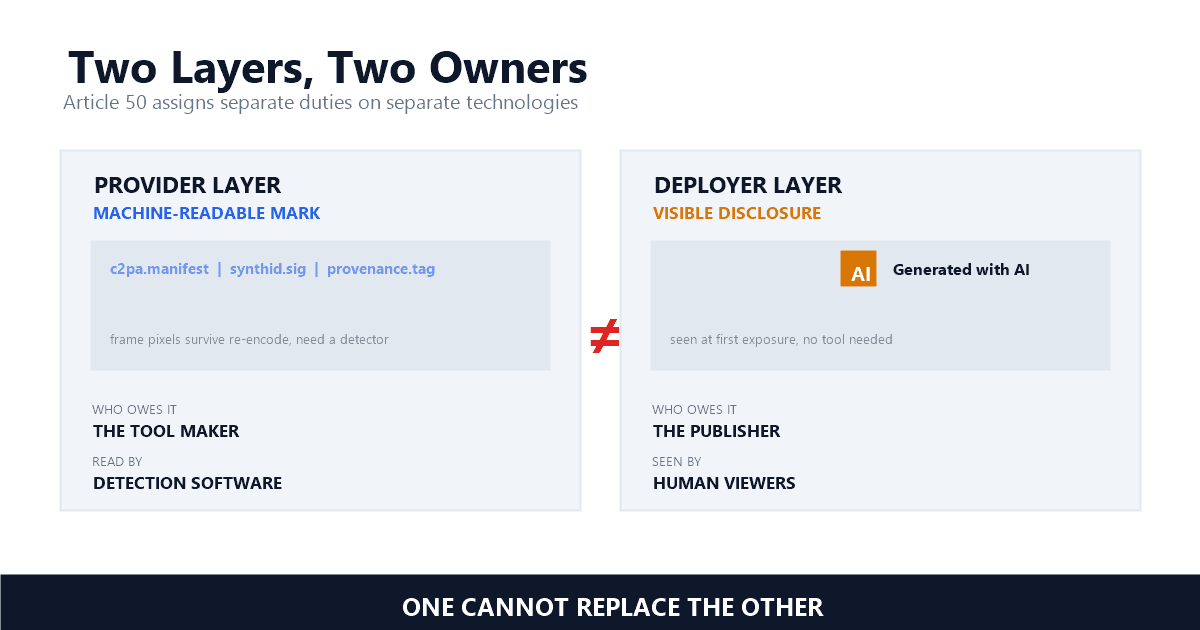
Article 50 splits transparency into two jobs assigned to two different actors. Providers — the companies that build generative AI systems — must mark outputs in a machine-readable format. Deployers — the people using those systems professionally — must disclose deepfakes to the humans watching. The duties run on different technologies.
The provider side is Article 50(2), and the consolidated text is worth reading exactly: providers of AI systems generating synthetic audio, image, video or text content "shall ensure that the outputs of the AI system are marked in a machine-readable format and detectable as artificially generated or manipulated" — AI Act Service Desk, Article 50. The Commission's fact page adds the boundary in plain language: "Providers must apply a machine-readable mark to synthetic content generated or manipulated by AI and enable its detection, unless the AI system performs an assistive function for standard editing or does not substantially alter the input data or its semantics provided by the deployer." — European Commission, Quick Facts. The company that generates your footage owes you an invisible, software-readable signature.
The deployer side is Article 50(4). When a video counts as a deepfake, the person or organisation using the AI system professionally must disclose that fact to the audience: "Deployers must disclose deepfakes and mark text on matters of public interest with clear and perceivable labels." — European Commission, Quick Facts. If you run an agency, a channel, or a freelance operation and you publish AI video, the disclosure duty is yours, not your tool vendor's. The agency handoff guide covers the same division of responsibility from the delivery side. Article 50 also covers chatbot disclosure and emotion recognition warnings — real duties, but outside video publishing, so I leave them to the lawyers.
Because the Commission says a deployer cannot rely on the provider's embedded mark to fulfil the disclosure duty — one signal is written for software to read, the other for humans to see at first exposure. Metadata marks die on re-encode, pixel marks need detectors, and an interface icon dies on download.
The explicit sentence: a deployer "cannot simply rely on the machine-readable marking embedded in the content by the provider under Article 50(2) of the AI Act to fulfil their disclosure obligation" — European Commission, Article 50 FAQ. Metadata is a passenger in the file container — C2PA content credentials, provenance fields — and it dies the moment a platform transcodes your upload and strips exotic metadata, which every major social platform does on ingest. SynthID is a family of imperceptible pixel perturbations that survive re-encoding but need a detector to reveal. The SynthID vs C2PA comparison walks that trade-off in engineering depth.
Visible disclosure is a different product: an on-screen label, icon, or spoken statement a viewer perceives without any tool. Article 50(5) sets its timing — the information must arrive "in a clear and distinguishable manner at the latest at the time of the first interaction or exposure" — AI Act Service Desk, Article 50. A metadata field no human sees cannot satisfy it. That was the gap my Rotterdam producer fell into: her tool's corner logo is a visible mark the vendor chose to add, but nothing about it reads as "generated with AI".
The two layers also behave oppositely in an editor. The visible label is trivially croppable — cut the bottom strip and it is gone. The pixel mark survives cropping and re-encoding. The metadata layer survives almost nothing. If you are auditing your own library, check all three separately; the state of AI video watermarking 2026 maps which major generators use which layer.
Yes, in the case that matters to most creators: the rule follows the output, not the office. A US generator whose clips are published by an EU business is inside the perimeter, and the EU business is a deployer with disclosure duties. Freelancers count as professionals too.
The Commission states the extraterritorial reach without hedging: "Providers of AI systems established or located outside the EU are also subject to the provisions of the AI Act if the output of their AI system is used in the EU." — European Commission, Article 50 FAQ. The deployer definition is where individual creators get caught. Using an AI system in a purely personal capacity falls outside the Act entirely, but "if it is an activity through which they gain an economic benefit on a regular basis (or are otherwise involved in a business, trade, occupational or freelance activity) this is considered a 'professional' activity. In this case, the natural person is considered to be a deployer of that AI system." — European Commission, Article 50 FAQ. Monetised channel, client work, freelance gig: you are a deployer with duties.
There is comfort for employees in the same FAQ: where a company is the deployer, "the individual employees that act under the instructions and under the control of that legal person (e.g. digital animators, web designers, content creators, journalists) should not be considered as separate deployers" — European Commission, Article 50 FAQ. The duty consolidates at the company level. The same person freelancing on nights and weekends is a different story. If you license an AI video tool for your team, ask the vendor whether it carries Article 50(2) marking and whether the vendor signed the Code of Practice described below.
The Act defines a deepfake narrowly, and the narrowness is load-bearing: AI-generated or manipulated image, audio, or video content that resembles existing persons, objects, places, entities or events and would falsely appear authentic or truthful. Three cumulative criteria must all hold before the disclosure duty engages.
The definition sits in Article 3(60), and the Commission FAQ decomposes it into resemblance to the simulated subject, existence of what is simulated, and a false appearance of authenticity. The third criterion is where the real analysis happens, because the FAQ lets deployers weigh context: resemblance level, substantive message, deployment context, and audience expectations. Its own example cuts in favour of ordinary production work — AI-generated background scenes, special effects, and technical post-processing "as part of standard movie production processes are not likely to make content falsely appear to the audience to be authentic or truthful" — European Commission, Article 50 FAQ. A fully synthetic explainer avatar nobody would mistake for a real anchor is not a deepfake under this test. A synthetic clip of a real mayor "announcing" a flood is.
Then there is the escape hatch for art. Where deepfake content forms part of an evidently artistic, creative, satirical, fictional or analogous work, the obligation shrinks to disclosure "in an appropriate manner that does not hamper the display or enjoyment of the work" — AI Act Service Desk, Article 50. The label still has to exist; it can live in the credits rather than stamped across the frame. My working test is blunt: does the output depict something real that could be believed as real footage? If yes, disclose. Platform policies like the Meta and Google Ads watermarked-video rules apply regardless.
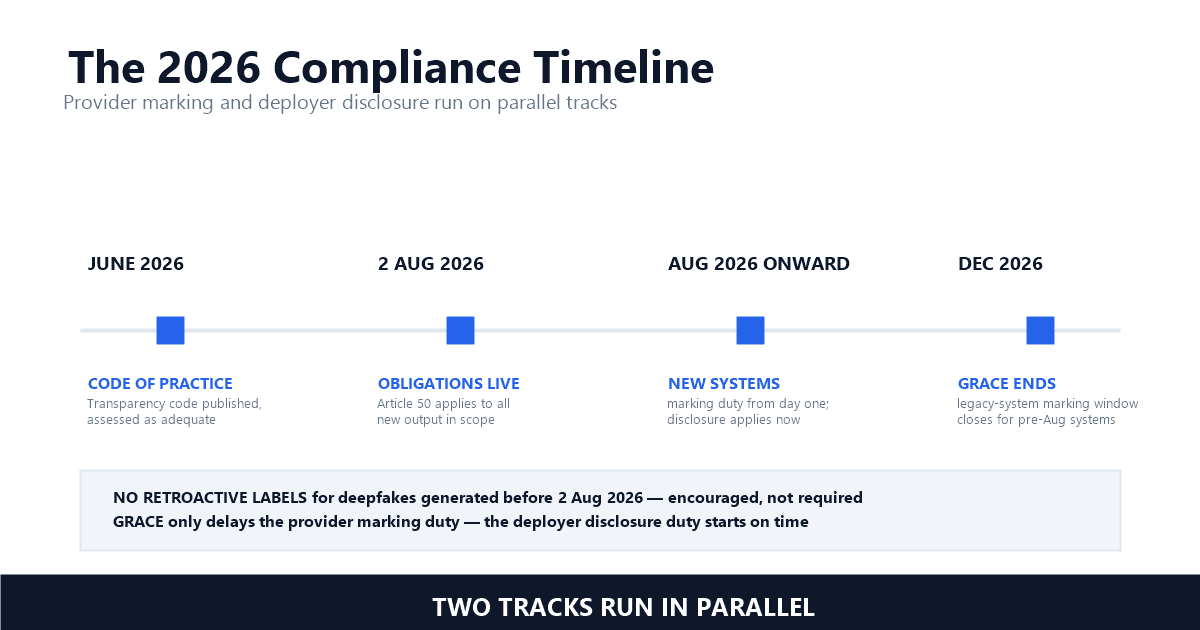
Nothing retroactive, with one narrow exception. The marking duty for systems already on the market before 2 August 2026 was postponed to December 2026 by the AI Omnibus amendments. Deepfakes generated before the deadline never need retroactive labelling. Content generated from the deadline onward is fully in scope immediately.
The Commission's fact page states the transitional position verbatim: "Deepfakes generated before 2 August 2026: no mandatory retroactive labelling but encouraged." And for providers: "Grace period for marking obligation until December 2026 for generative AI systems placed on the market before 2 August 2026 (Article 50(2) AI Act, amended by AI Omnibus)." — European Commission, Quick Facts. Read as a timeline: legacy systems get the marking grace window to December 2026; systems launched from the deadline onward carry the marking duty from day one; old deepfakes never need retroactive labels; new deepfakes published by professional deployers need disclosure at first exposure immediately.
Note what the grace period does not cover. It delays the provider's marking duty for legacy systems; it does not delay your disclosure duty for newly generated deepfakes, and it does not apply to tools launched after the deadline. If your agency's favourite generator is a 2024-era product, its vendor has until December 2026 to retrofit machine-readable marks — but if you generate a deepfake with it next week, your disclosure obligation applies now. The dates run on parallel tracks, and conflating them is how the "I thought there was a grace period" conversation starts.
Enforcement, for those who ask: fines "up to €15M, or up to 3% of total worldwide annual turnover for companies", with a €750k ceiling for EU institutions and explicit proportionality for smaller players — European Commission, Quick Facts. National market surveillance authorities do the policing.
Article 50 contains no clause directly prohibiting a third party from stripping a mark — nothing like the American statute that bans removing copyright management information. But the analysis becomes multi-jurisdictional: removal still risks US liability, destroys the detectability the EU framework depends on, and is explicitly banned under China's labelling measures.
The contrast is structural. Section 1202(b) of the US Copyright Act provides that "No person shall, without the authority of the copyright owner or the law—(1) intentionally remove or alter any copyright management information" — Legal Information Institute, 17 U.S. Code § 1202. The US statute criminalises tampering with ownership records; the EU regulates the producers and publishers of AI content instead. Strip the machine-readable mark from an AI video in Europe and you have broken nothing in Article 50's text — but you have destroyed the detectability the whole framework depends on, you may still be inside §1202(b) where the act touches US commerce, and China's rules go further by prohibiting malicious removal outright. The legal guide to removing watermarks from AI videos keeps the multi-country map, and the DMCA §1202 explainer handles the American statute line by line.
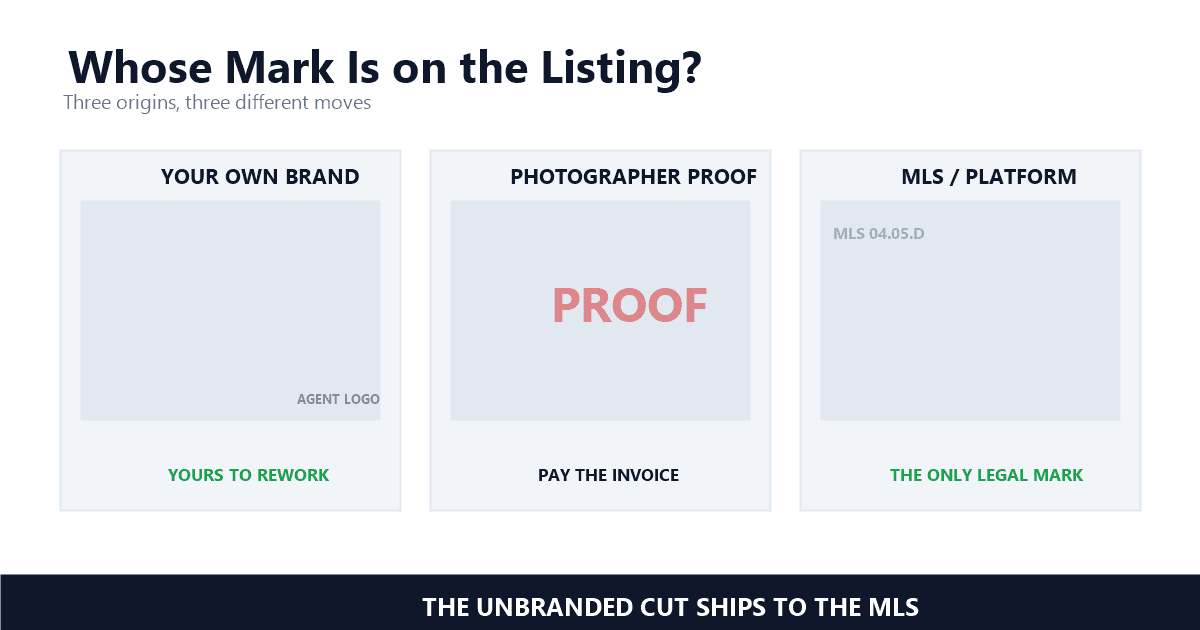
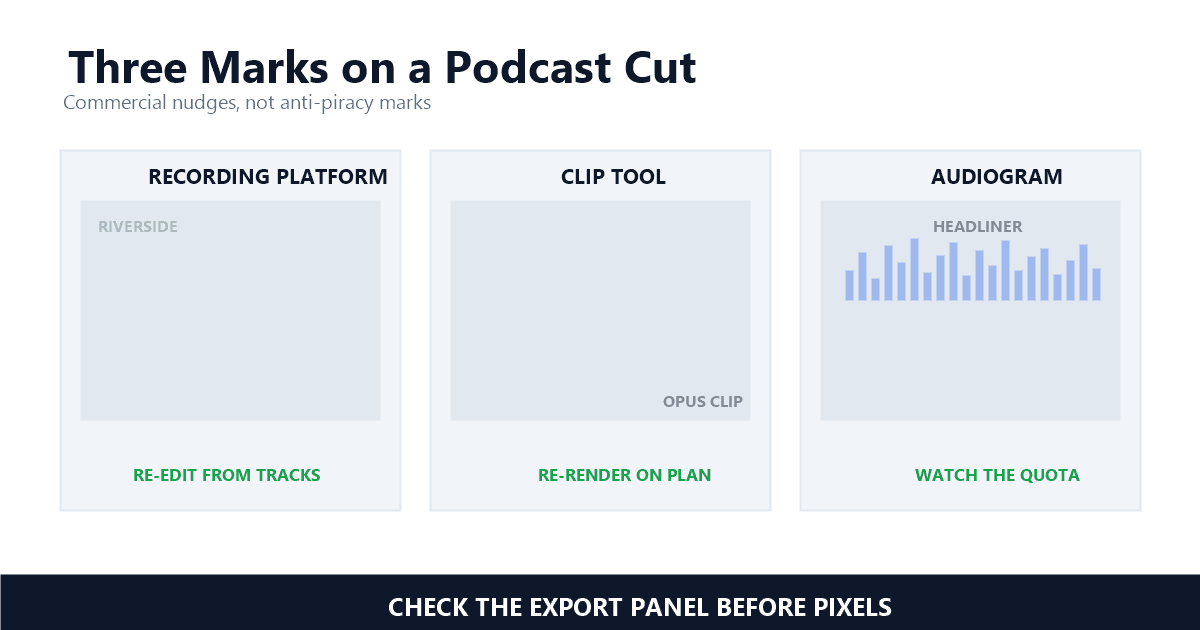
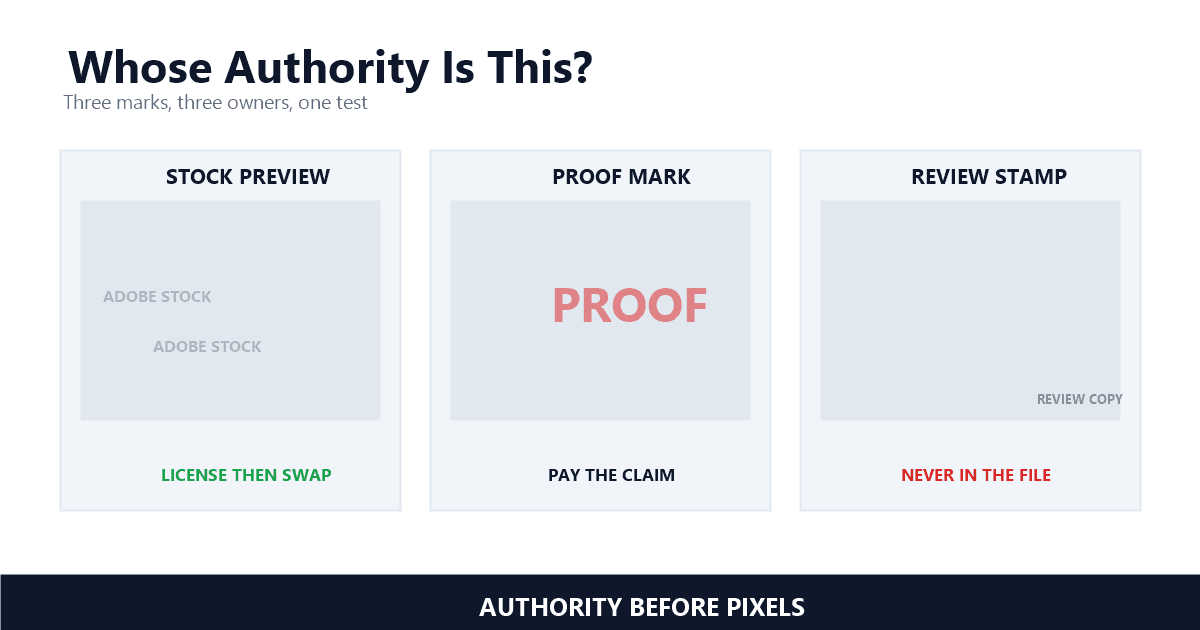
For the legitimate case — cleaning your own branding, an editor's draft overlay, or a stock preview from footage you own — the mark's origin decides the move, same as everywhere. The online course guide and the podcast creator guide both walk real cases where the mark was the creator's own or their tool's, which is ordinary post-production. What Article 50 adds from 2026 onward is a new category of mark — the provider's machine-readable signature — that you should treat as infrastructure, not decoration. In my testing, pixel-level marks are the hardest to remove cleanly, and my benchmarks across removal pipelines say the same: reconstruction beats deletion when the mark is entangled with real image content, as the full pipeline walkthrough shows.
My practical guidance for EU-facing creators: never strip a provider's machine-readable mark before republishing AI footage, even where the visible label is yours to manage. The mark is the cheapest evidence of a compliant stack, and the disclosure duty is yours anyway.
The Commission publishes a free three-icon set — basic, fully AI-generated, partially AI-modified — and its placement rules encode a real engineering constraint: the icon must stay visible when content is reshared or downloaded, which usually means burning it into the pixels rather than leaving it in the player interface.
Each icon ships in black, white, and 50-percent-transparency variants, free to use with no attribution. The basic icon covers when AI was involved in deepfake content; "Fully AI-Generated" covers content with no human-created elements; "Partially AI-Modified" covers human-made content that AI altered into a deepfake — European Commission, EU Icons. The Commission's own user-testing found recognition improved when the basic icon was paired with a text label. The placement rule that matters most: "The icon must be visible when content is reshared or downloaded." — European Commission, EU Icons. An icon living only in your player's interface overlay disappears the moment the file leaves your platform — the metadata problem again, in visible form. The Commission's answer is to embed the icon into the pixels of the deepfake itself unless an equivalent interface alternative exists. Plan label placement before export, not after — adding a visible label to an already-encoded file means a re-encode, and the technology trends piece covers what re-encoding does to existing marks. The same host-layer versus pixel-layer distinction runs through the real-estate video workflow.
For the layer above the icons, the voluntary Code of Practice on Transparency of AI-generated Content, published in June 2026, is the mechanism the Commission and the AI Board assessed as adequate: signatories "may rely on an approved code that they have signed", while those who skip it must prove compliance by other adequate means — European Commission, Article 50 FAQ. As a deployer you cannot sign your way out of Article 50(4), but your vendor's signature on the code is the strongest single signal that its machine-readable marking works. One caveat: the Service Desk notes the Digital Omnibus has amended the provision and the displayed text may not yet reflect every change — the grace period is exactly that kind of amendment. For high-stakes campaigns, read the current FAQ page alongside the consolidated text.
No. The visible disclosure duty applies to deepfakes published by professional deployers and to AI text on matters of public interest. The machine-readable mark on synthetic output is the provider's duty and is invisible by design. A stylised AI animation no viewer would mistake for real footage may never trigger the deepfake disclosure at all.
Both of you have exposure on different tracks. The Commission treats regularly monetised activity, including freelance work, as professional use that makes the individual a deployer, and your EU client publishing the output is a deployer too. Agree in the contract who adds the label.
No. The Commission states that deployers cannot rely on the provider's machine-readable marking to fulfil the disclosure obligation — the mark is for detection software, the disclosure is for humans at first exposure. Use a visible label such as the EU icons, embedded so it survives resharing and downloading.
Last updated: October 2026
Mark Ma is the founder and lead engineer at UnMark, where he leads the development of AI-powered video watermark removal technology. With over a decade of experience in computer vision, deep learning, and video processing, he has built production systems that process millions of frames per month across TikTok, Instagram Reels, and Google Veo content. His technical work focuses on motion-compensated watermark detection, spatial-temporal inpainting, and quality-preserving reconstruction for short-form vertical video. Before UnMark, Mark shipped computer vision infrastructure at scale for content moderation and ad compliance platforms. He writes this blog to document the real engineering, testing, and regulatory reasoning behind UnMark's processing pipeline — every test result, frame analysis, and benchmark published here is reproduced from actual production data, not synthetic examples. His goal is to give creators, brands, and regulators a verifiable technical reference for AI video watermark removal in 2026.