China's AI Content Labeling Rules: What the CAC Measures Mean for Video Creators
Mark Ma
Last updated: October 2026
The question lands in our support inbox almost every week, and it is never asked by a pirate. A filmmaker who generated B-roll with a paid plan and wants the corner logo out of her festival cut. A small agency holding generation rights for a client who now needs clean masters. A course creator whose editor left draft overlays in the final export. Each of them owns the footage or the rights to it, each searched for whether it is legal to remove a watermark from your own AI video, and each got the same useless answer: "it depends".
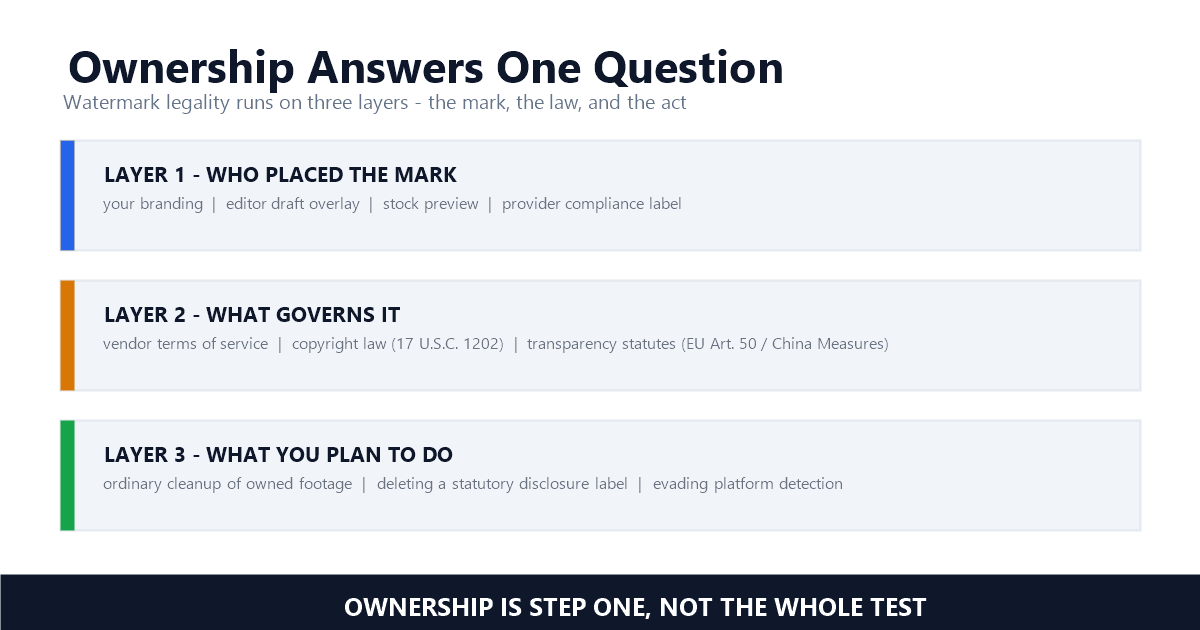
I build watermark removal tooling at UnMark, which means I have had to draw the legal line for my own product, not just describe everyone else's. The honest answer has three moving parts that most guides blur together. Copyright law asks what kind of information you deleted. Contract law — the vendor's terms — asks what you promised. Transparency statutes, new as of this decade, ask whether the mark was a legally mandated disclosure. "It depends" is true only until you run the four checks below, and none of them require a lawyer for the common cases.
Every statute quoted here is pulled from the official text — Cornell's copy of US Code, the European Commission's AI Act pages, and China's gov.cn publication of the labeling Measures — all fetched this October. The short version: for footage you own, cleaning a branding mark is ordinary post-production; deleting a statutory AI disclosure label is a different act with named statutes behind it, and China's version even bans the tools themselves. Here is the full map.
Often yes — but ownership is only the first question, not the last. A mark you or your tool placed as branding is yours to manage. A mark the law required the vendor to embed is a disclosure surface, and deleting it can violate statutes that apply even to owners. The vendor's terms sit above both.
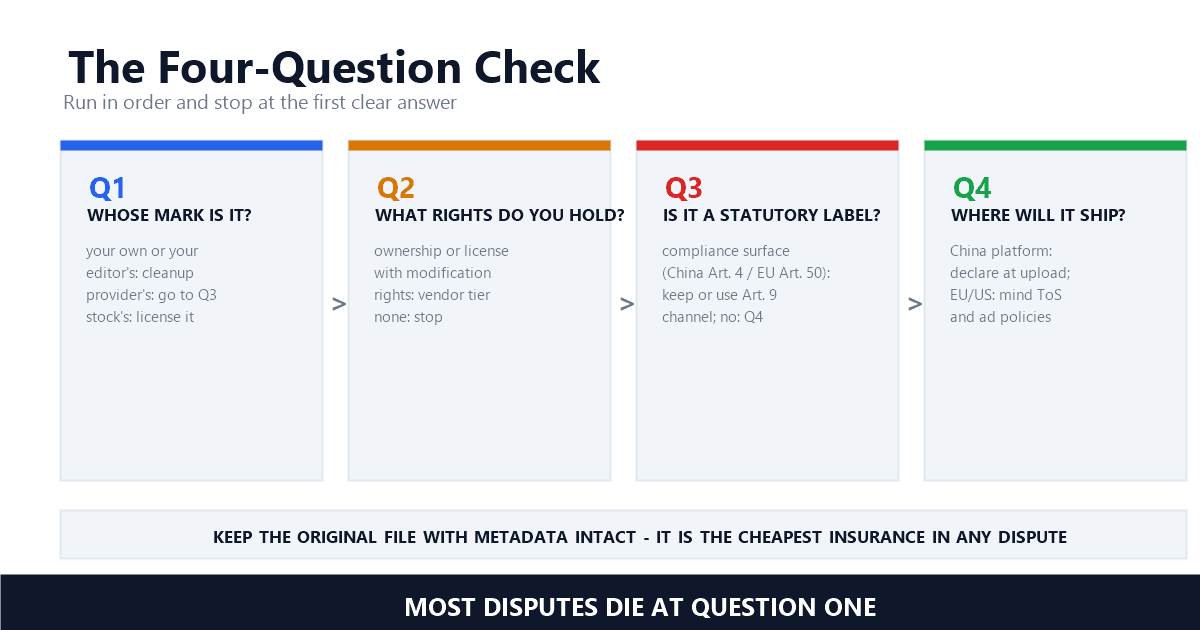
Run the four checks in order. First, whose mark is it — yours, your editor's, a stock house's, or the AI provider's. Second, what rights you hold over the footage: ownership, a license with modification rights, or nothing. Third, what the mark legally is: decoration, a contract signal, or a statutory disclosure label under a transparency law. Fourth, where you publish, because 2026 is the year three regimes with different rules are live at once. Most "can I do this" questions resolve at step three — the mark's legal character decides the statute, and the statute decides the risk.
Why does the "own video" framing mislead? Because two of the three relevant bodies of law do not care whether you own the footage. China's labeling statute binds "any organization or individual" — owner or not. The vendor's terms of service bind you by contract the moment you clicked accept, and a breach gets your account and your generated library frozen regardless of ownership. The earlier general guide on this site covers the intuition; this piece goes statute by statute.
Three bodies of law touch AI video marks in 2026: the American statute protecting copyright management information, the EU AI Act's transparency article, and China's labeling Measures — plus the vendor's terms of service, which is contract, not statute. They protect different things and bite in different places.
The US layer is 17 U.S.C. §1202, and its removal clause reads: "No person shall, without the authority of the copyright owner or the law—(1) intentionally remove or alter any copyright management information" — Legal Information Institute, 17 U.S. Code § 1202. Copyright management information is the legal record of authorship and ownership — the statute protects the accuracy of that record, not the pixels of a logo. Attribution is the public claim about who made a piece of media, and copyright management information is the legal record behind that claim; the two overlap but are not identical. The DMCA §1202 explainer walks the statute line by line, including the Authority question that decides most creator cases.
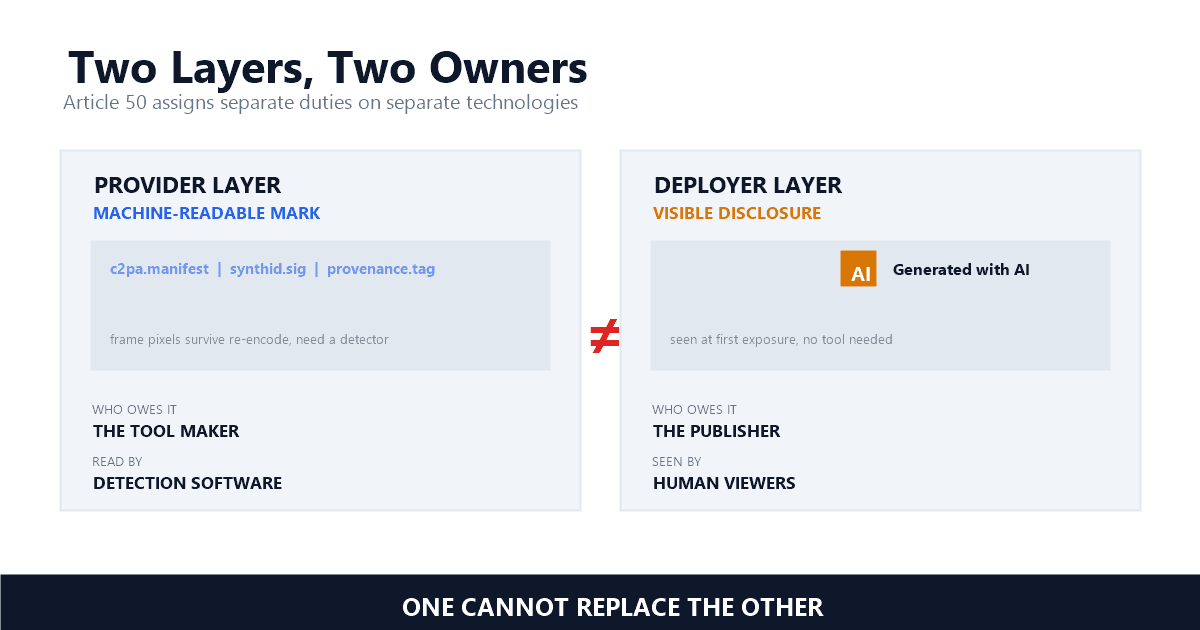
The EU layer is Article 50 of the AI Act, live since August 2026: providers "shall ensure that the outputs of the AI system are marked in a machine-readable format and detectable as artificially generated or manipulated" — AI Act Service Desk, Article 50. Article 50 contains no direct anti-removal clause — Europe regulates the marking duty and the deployer's disclosure duty, and leaves stripping to other theories of liability. The Article 50 breakdown covers the two-layer design and the December 2026 grace window. The China layer is the strictest: the labeling Measures in force since September 1, 2025, whose Article 10 is quoted in full below — and it has its own section in this piece.
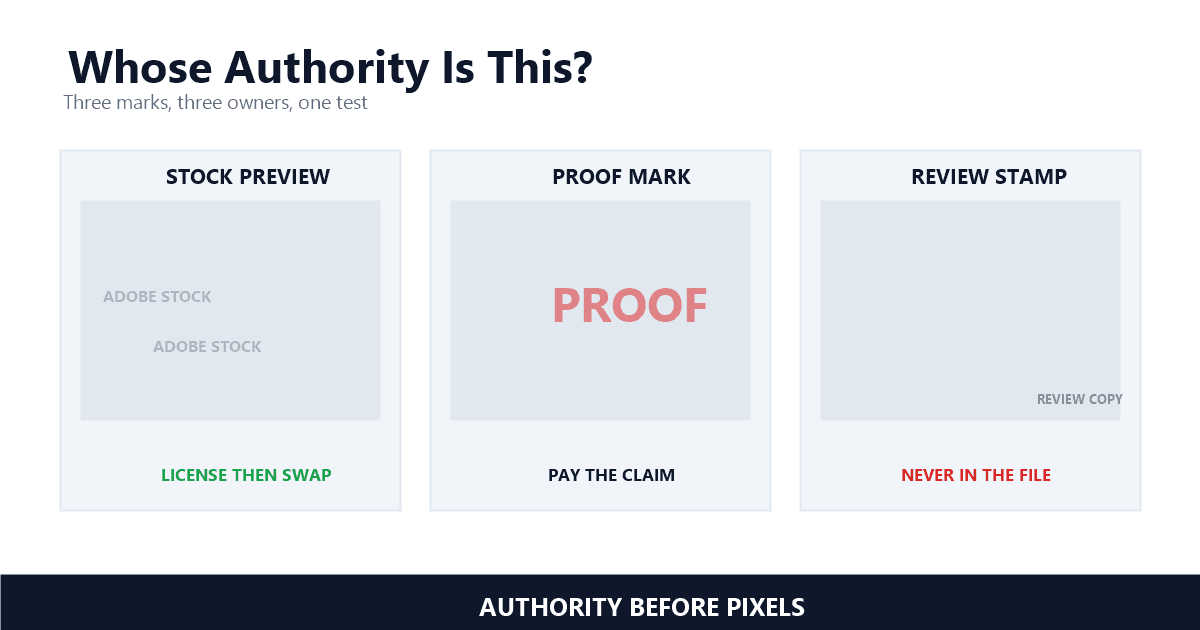
Four situations put you on safe ground: the mark is your own or your editor's; the mark is a stock preview and you have since licensed the asset; the vendor itself offers a watermark-free tier or export; or the vendor removes the mark for you on request. In all four, no statute is implicated and no contract is breached.
The common thread is authority. Section 1202(b) bans removal "without the authority of the copyright owner" — when you are the owner, or you hold a license that grants modification rights, the statutory predicate fails and the act is ordinary post-production. Cleaning your own branding, an editor's draft overlay, or a rebranding pass on client footage you are authorized to process falls here; the agency handoff guide and the online course guide walk real cases. The stock case has its own rhythm — the preview watermark is the license state, and it comes off through the license, not around it.
Vendor-side paths deserve more use than they get. Some generators sell a watermark-free export tier; some strip marks on paid plans automatically; a few ship official removal tooling for their own marks. The trap to avoid is the credits illusion: some platforms sell credits that unlock generation features while the watermark stays tied to plan level, a split the Kling guide documents from the vendor's own policy text. And in China, the vendor-side path is statutory — Article 9 of the labeling Measures, quoted below, is a legal no-label channel that neither the US nor the EU offers.
Three situations carry real exposure: removing marks from footage you do not own or are not licensed to modify; stripping a statutory disclosure label from AI content; and breaching the vendor's terms even where no statute is implicated. The third one is the most underestimated.
The ownership case is classic infringement territory — a removed mark on someone else's work is evidence destruction plus infringement, and §1202 adds statutory damages on top. The disclosure-label case is newer: where a mark is the compliance surface a statute requires — the provider's explicit label under China's Article 4, which must survive into downloaded files, or Europe's machine-readable mark — deleting it targets the legally protected layer itself. In my testing, that distinction also shows up in the pixels: compliance marks are engineered to survive export, so they sit deeper in the frame than the branding overlays the pipeline walkthrough reconstructs. The detection models piece explains why partial removal leaves detectable artifacts — a fact that matters more when the platform is legally required to run detectors.
Then the contract layer. Nearly every AI video vendor's terms forbid third-party removal tooling on their output, and the penalty is contractual: account termination, loss of your generated library, and in the worst cases a claim for breach. A platform can enforce this against you even when copyright law would have allowed the removal — the Runway export guide shows how plan-level watermark rules are written into the terms rather than the law. Ad platforms add a fourth layer: the Meta and Google Ads policies reject watermarked creative regardless of who owns the mark, so the practical penalty for a dirty export is a rejected campaign.
Less than most summaries assume — and more than nothing. Article 50 obliges providers to mark outputs and deployers to disclose deepfakes, but its text contains no removal ban. The risk in Europe is structural: delete the mark and the disclosure framework loses the evidence it runs on, while your disclosure duty stays.
The marking duty is Article 50(2), quoted above. The disclosure duty is Article 50(4), and the Commission's own FAQ closes the loophole between them: deployers "cannot simply rely on the machine-readable marking embedded in the content by the provider under Article 50(2) of the AI Act to fulfil their disclosure obligation" — European Commission, Article 50 FAQ. Translation for editors: the invisible mark and the visible label are two separate obligations, and managing one never discharges the other. The Commission's enforcement headline: fines "up to €15 million, or up to 3% of total worldwide annual turnover for companies" — European Commission, Quick Facts. The 3% figure is why EU-facing teams treat the machine-readable mark as infrastructure; my benchmarks with removal pipelines say the same thing in engineering terms — the mark is cheaper to keep than to reconstruct around.
So is removal "legal" in Europe? Removing a provider's machine-readable mark from AI footage you own violates no explicit clause of Article 50 — that is a genuine gap in the text, not an oversight in this article. But the act's deployer disclosure duties still apply to what you publish, platform policies still bind, and if the footage touches US commerce, §1202 still reaches it. The SynthID vs C2PA comparison covers what the mark technically dies of, and the state of AI video watermarking 2026 maps which generators mark which layer.
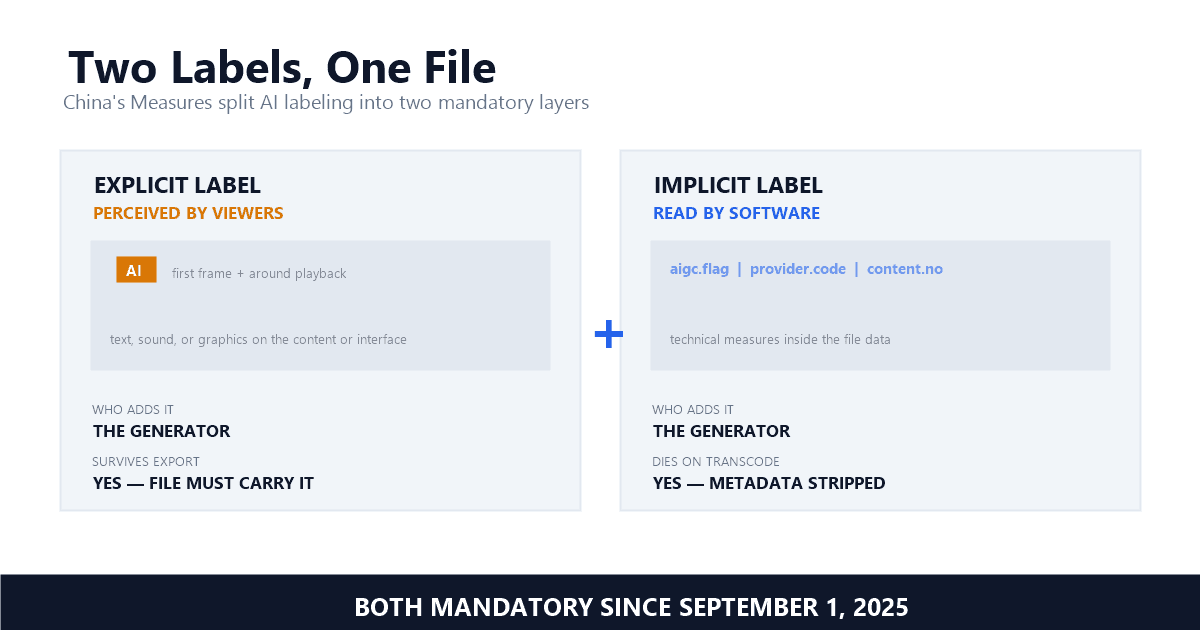
The most explicit rules of the three regimes. Since September 1, 2025, China's Measures ban malicious deletion or hiding of mandated labels, ban providing the tools to do it, and — uniquely — offer a lawful provider-mediated channel for label-free content. If your footage reaches Chinese platforms, this is the regime that bites.
Article 10 in full: "No organization or individual may maliciously delete, tamper with, forge, or hide the labels of AI-generated synthetic content provided for in these Measures, may not provide tools or services for others to commit the above malicious acts, and may not harm the lawful rights and interests of others through improper labeling means." — Cyberspace Administration of China (unofficial translation). Three things worth noticing. The ban binds "any organization or individual" — ownership of the footage is irrelevant. The second clause names tool providers as a distinct prohibited category, which makes "erase the AI badge" a prohibited product category, not just a prohibited act. And Article 4's export rule means the explicit label is legally required to be inside the downloaded file — the mark is not the player's decoration; it is the file's payload. The China labeling Measures deep dive walks every article with the official text.
The counterweight is Article 9: "Where a user applies to the service provider for generated synthetic content without added explicit labels, the service provider may, after clarifying the user's labeling obligations and usage responsibilities through the user agreement, provide such content without explicit labels, and shall retain logs on the identity of the provision recipient and other relevant information for no less than 6 months in accordance with the law." — Cyberspace Administration of China (unofficial translation). Of the three regimes, only China concedes a lawful clean-output channel — logged, contracted, provider-mediated. For legitimate pipelines the compliant sequence is to request label-free output up front, not to strip the badge after the fact.
Ask the four questions in order and stop at the first clear answer. Whose mark is it? What do you hold on the footage? Is the mark a statutory disclosure label? Which regime's platforms will carry it? The first three have yes-or-no answers; the fourth decides which statute book to read.
Disclosure is the duty the third question protects: the legal requirement that viewers be told content is machine-generated, and it is the reason "my own video" is not a trump card. If the mark is a provider's compliance surface under China's Measures or the machine-readable mark under Europe's Article 50, treat it as infrastructure — keep it, or source clean output through the vendor channel. If it is branding — your own logo, an editor's overlay, a stock preview you have licensed — removal is ordinary post-production, and the engineering question is reconstruction quality, which the inpainting vs cropping comparison measures. When the mark's status is genuinely ambiguous, ask the vendor in writing: an answer in your inbox is worth more than any guide, and it converts an ambiguity into a record.
My working sequence for a flagged asset, refined across two years of running a removal product: identify the mark's placer first, read the vendor's terms second, check the destination platform's AI-disclosure rules third, and only then decide whether the mark comes off through a right, a purchase, a provider channel, or not at all. In my testing, most disputes die at step one — people argue about law when the actual question is who placed the mark. Keep the archived original with its metadata untouched either way; the cropping analysis shows why half-measures leave detectable traces, and an intact original is the cheapest insurance in any later dispute.
Section 1202 applies to copyright management information, wherever the video was made — AI or camera. If the footage is protectable and the mark records authorship or ownership, removing it without the owner's authority triggers the statute. The AI origin of the footage changes the analysis less than people expect; the mark's legal character matters more.
Yes — contract and law are separate tracks. Vendors write watermark rules into their terms of service, and platforms enforce them with account termination and library loss regardless of what copyright law would permit. Ad platforms add a third layer by rejecting watermarked creative outright. Legal is the floor, not the ceiling.
Paying for generation is not the same as holding modification rights — check what you bought. Paid plans often ship watermark-free exports by design, which is the vendor's own channel; if the plan tiers keep the mark, the terms usually route removal through upgrades, not tools. The credits illusion is real: generation credits do not always unlock a clean export.
Last updated: October 2026
Mark Ma is the founder and lead engineer at UnMark, where he leads the development of AI-powered video watermark removal technology. With over a decade of experience in computer vision, deep learning, and video processing, he has built production systems that process millions of frames per month across TikTok, Instagram Reels, and Google Veo content. His technical work focuses on motion-compensated watermark detection, spatial-temporal inpainting, and quality-preserving reconstruction for short-form vertical video. Before UnMark, Mark shipped computer vision infrastructure at scale for content moderation and ad compliance platforms. He writes this blog to document the real engineering, testing, and regulatory reasoning behind UnMark's processing pipeline — every test result, frame analysis, and benchmark published here is reproduced from actual production data, not synthetic examples. His goal is to give creators, brands, and regulators a verifiable technical reference for AI video watermark removal in 2026.