Is It Legal to Remove a Watermark From Your Own AI Video? (2026 Guide)
Mark Ma
Last updated: October 2026
The searches for grok imagine video watermark removal split into two crowds, and our support inbox sees both. The first crowd just generated a clip they love and wants the corner badge gone for a client deliverable. The second crowd already paid for an upgrade because a blog post told them the watermark disappears on paid plans — and then it didn't. Both crowds deserve a straighter answer than the search results give them, because the results are a mix of tool landing pages and upgrade advice that contradicts xAI's own documentation.
I build watermark removal tooling at UnMark, and my product's terms exclude Grok output — not because the watermark is technically hard, but because the vendor's policy forbids touching it, and my product doesn't process marks a provider explicitly protects. That policy decision forced me to read xAI's actual documentation the way a lawyer would, and what I found is worth laying out: the FAQ is unusually blunt, the Acceptable Use Policy closes every workaround the FAQ leaves open, and the rumors about paid tiers are solving a problem that xAI never priced into the plans.
This piece quotes the official text, separates what paying actually changes from what it doesn't, maps the legal and contractual consequences of removing the badge anyway, and ends with the legitimate options that remain. Every quote was checked against xAI's documentation and policy pages this October.
Yes — both outputs, every plan, no exceptions stated anywhere in the documentation. The watermark is applied at generation time as a built-in feature of the product, which is why no export setting anywhere in the app offers a clean version.
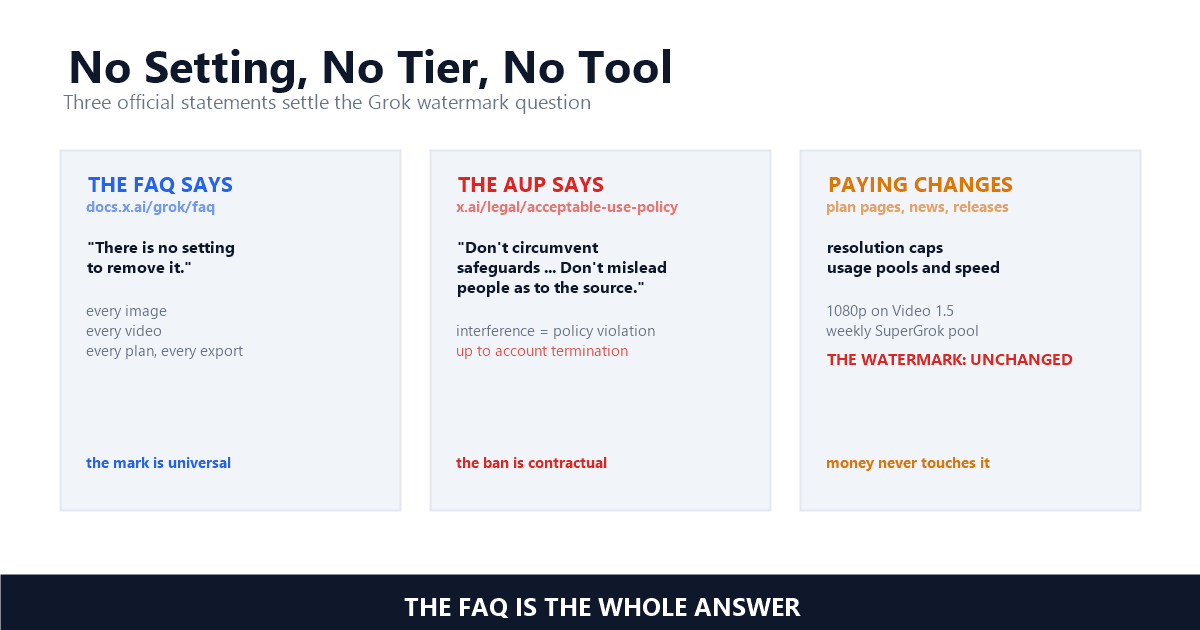
xAI's consumer FAQ states it in one sentence: "Generated images and videos include a Grok watermark. There is no setting to remove it. Removing, altering, or obscuring the watermark is prohibited under the Acceptable Use Policy." — FAQ, xAI Docs. Three claims in two sentences: the mark is universal, there is no toggle, and interference with it is a policy violation — not just a broken promise but a rule with an enforcement section behind it. That is a stricter stance than most competitors take, and the comparison section below shows how much stricter.
The mark's persistence is also architectural. Because it is applied during generation rather than overlaid at download, every export path carries it — the web studio, the mobile apps, and shared links alike. There is no known export route that skips it, which is exactly why third-party remover tools advertise themselves as the only way out. Whether that way out is safe is a different question, and it gets its own section.
The FAQ text quoted above is the complete policy statement on the watermark's existence, and it has stayed consistent across independent copies of the documentation. A second FAQ line covers what happens to video quality when a plan's ceiling is hit: "720p videos automatically fall back to 480p once you hit the 720p cap for your tier." — FAQ, xAI Docs.
That fallback line matters more than it looks, because it reveals how xAI thinks about plan limits. Resolution caps are plan features — the thing you buy when you upgrade is headroom, not freedom. The watermark sits outside that entire system: it is not a plan feature at any level, so no plan change can reach it. People conflate the two because other AI video vendors have trained them to — on Kling and Pika, paying is literally how the mark comes off. xAI's design is the opposite, and the upgrade rumors are imported intuition from those vendors.
Provenance is the record of where a piece of media came from — who or what made it — and the Grok watermark is that record made visible. xAI does not name a technical standard for the mark; unlike SynthID and C2PA, no cryptographic specification is published for it. It is a product-level signal enforced by product-level rules, which is why the policy document — not a technical standard — is where the real enforcement lives.
No. No tier in xAI's lineup — past or present — offers watermark-free generation, and the FAQ's no-setting sentence is not qualified by plan level anywhere. The upgrade rumors circulating on third-party blogs are contradicted by the documentation, plainly and without exception.
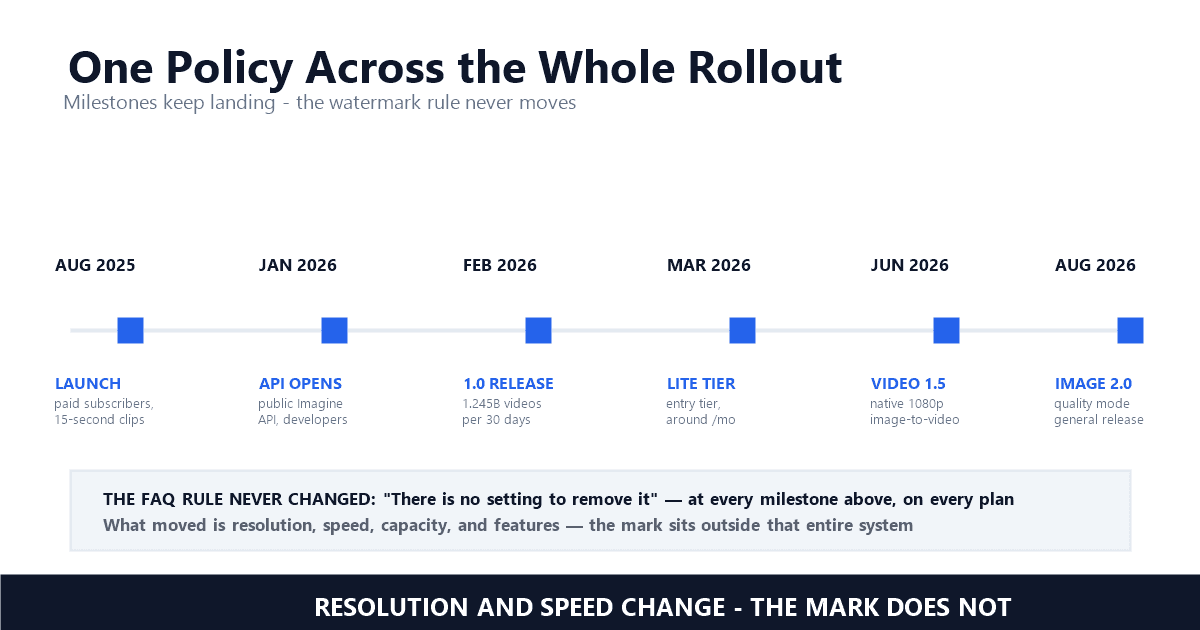
What paying actually buys is capacity and quality headroom. xAI's rollout timeline shows the product launched to paid subscribers in August 2025, opened a public API in January 2026, and reached its tagged 1.0 release that February with the company citing roughly 1.245 billion videos generated per 30 days. In March 2026 a cheaper entry tier arrived at around ten dollars a month, and by June the Video 1.5 model brought native 1080p to image-to-video — a resolution ceiling, attached to a model and a tier, exactly the kind of feature plans sell. None of these announcements touches the watermark. The pattern holds across every milestone: resolution, speed, usage pools, and reference features change; the mark does not.
Some third-party sites go further and advertise paid tiers with watermark-free downloads that do not exist in xAI's own pricing. Treat any page promising a plan-level clean export with suspicion unless it links the official FAQ — and note that even the blogs advising upgrades to escape the watermark describe a benefit the documentation never promised. If a vendor ever changes this stance, the change will appear in xAI's FAQ and plan pages first, not in affiliate posts. As of this October, the mark is universal.
It breaches xAI's terms in every case, and depending on the footage and jurisdiction it can also trip federal statute. This is the one platform covered on this site where I recommend against processing output at all — the policy layer alone is dispositive.
The contract layer first. The Acceptable Use Policy that every Grok user agrees to contains a conduct section titled "Respect guardrails and don't mislead": "Don't circumvent safeguards unless you are part of an official Red Team or otherwise have our official blessing. Don't mislead people as to the nature and source of Outputs, including images. You should be transparent and disclose your use of AI assistance and potential limitations, as applicable." — Acceptable Use Policy, xAI. A watermark is a safeguard in the plain meaning of the clause, and passing stripped output off as clean media misleads about the source. The same document states the stakes: "Violating our policies could result in action against your account, up to suspension or termination." — Acceptable Use Policy, xAI. Your generated library goes with the account.
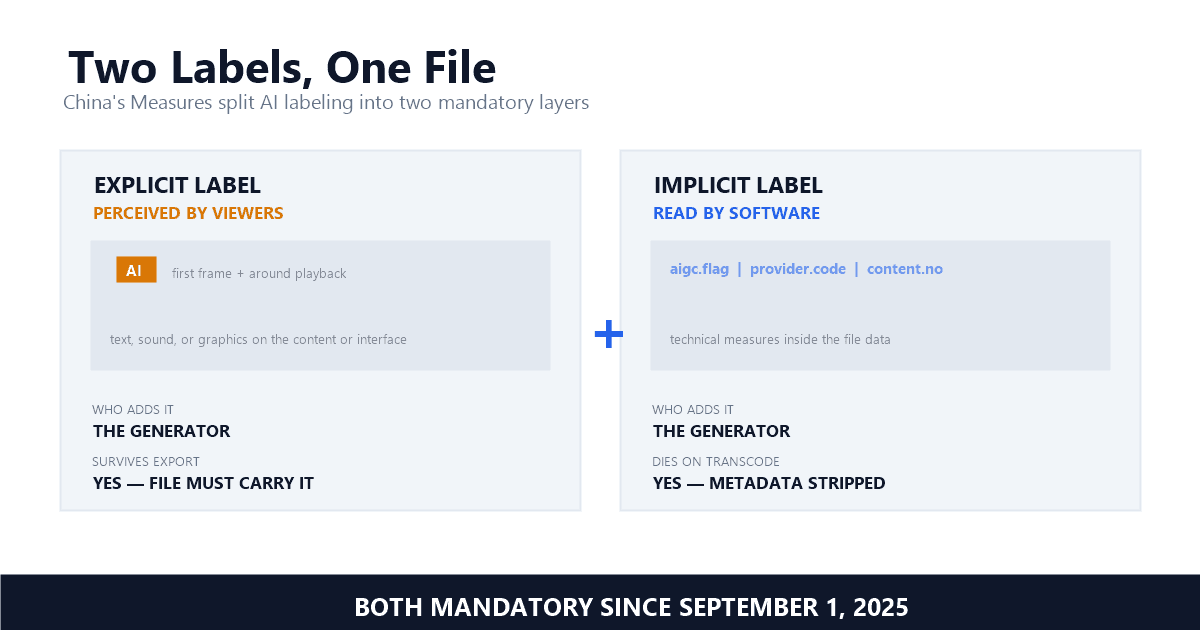
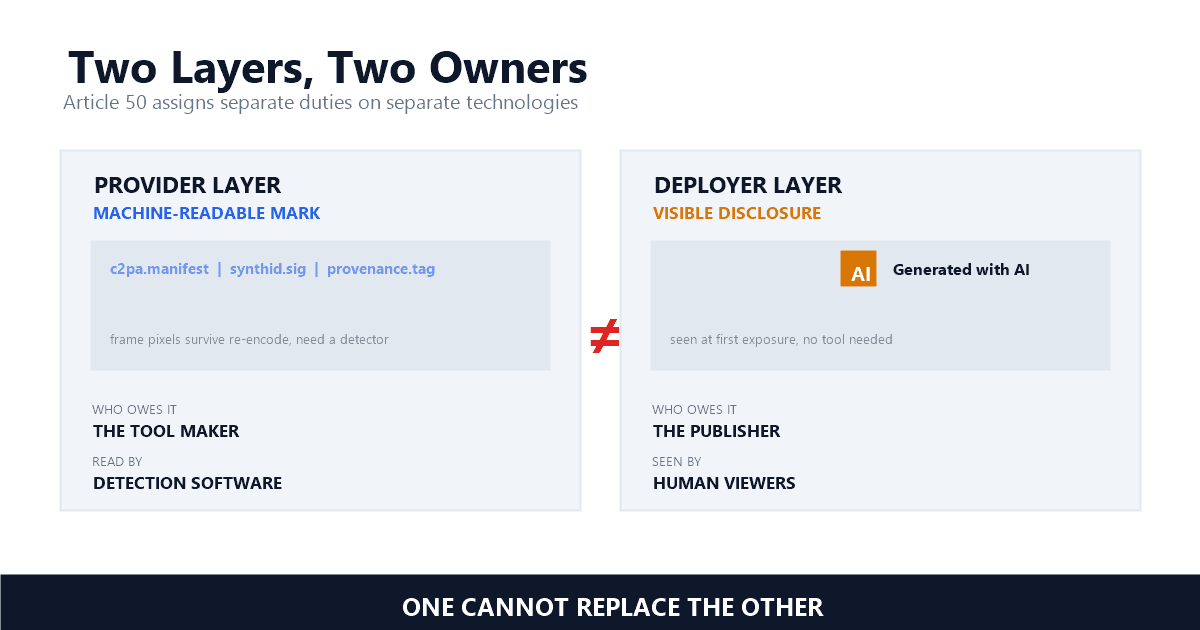
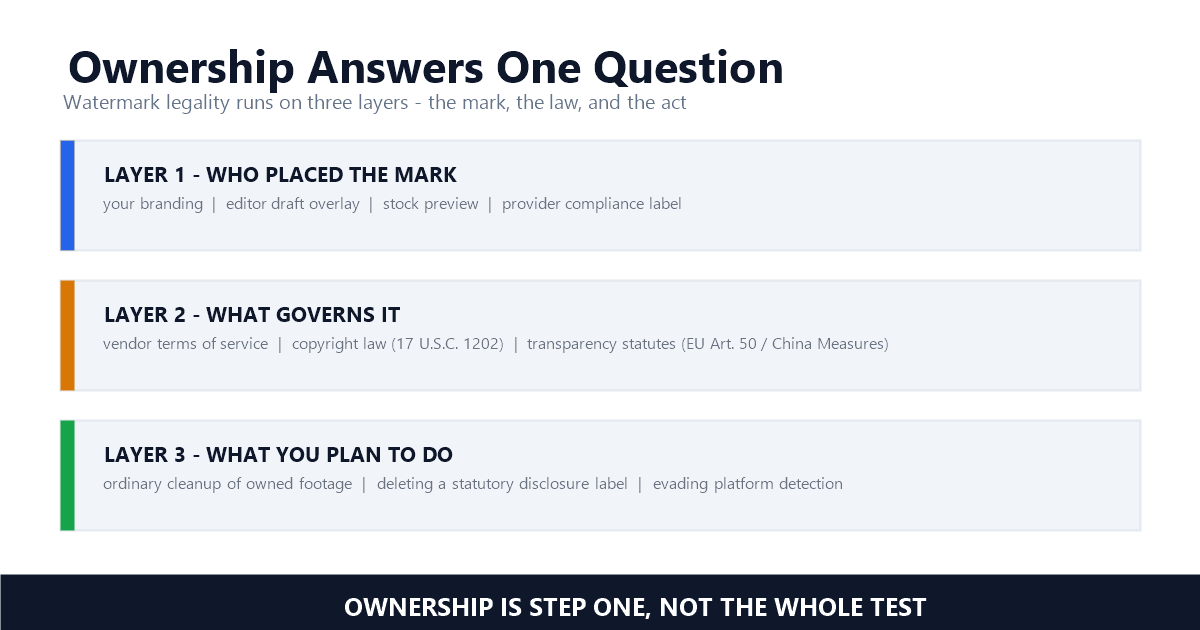
The statutory layer varies by what the mark records and where you publish. In the US, 17 U.S.C. §1202(b) bans removing copyright management information without authority — "No person shall, without the authority of the copyright owner or the law—(1) intentionally remove or alter any copyright management information" — Legal Information Institute, 17 U.S. Code § 1202 — and attribution signals can qualify when they record authorship; the §1202 explainer covers where that line sits. In the EU, Article 50's deployer disclosure duties still apply to what you publish regardless of what you did to the pixels — the Article 50 breakdown details the two-layer design. In China, the labeling Measures go furthest of all: Article 10 bans malicious deletion of mandated labels and separately bans providing the tools that do it — "any organization or individual," owner or not. The China Measures deep dive quotes the article in full. And the four-question legality check on this site resolves most platforms at step three; for Grok output, step two — the vendor's terms — already answers it.
Scale and history. Grok Imagine became one of the most-used consumer video generators on the market within months of launch, and it did so while carrying the heaviest content-controversy baggage of any mainstream tool. A visible, non-removable mark is the cheapest provenance infrastructure for output at that volume.
The numbers justify the infrastructure. A billion-plus videos a month is volume at which invisible metadata alone would be pointless to most viewers — the people seeing a clip on a feed would never run a detector. A visible badge travels with the content everywhere it is reshared, which is precisely the property a provenance signal needs at feed scale. The FAQ's phrasing — a watermark with no setting, protected by policy — reads like a deliberate design decision, not a leftover.
The enforcement risk xAI carries is also visible in its own policy document. The AUP's law-compliance section lists intellectual-property violations first among prohibited uses, and the guardrails section quoted above treats deception about output origins as a standalone violation. Regulators have scrutinized the product's outputs since launch; a removable watermark would make every downstream misuse harder to attribute. Strictness, in this context, is liability management. The state of AI video watermarking survey shows xAI's approach is the strictest end of a spectrum that runs from removable-on-paid to permanent-and-visible.
Four realistic paths remain, and none of them involve a remover tool. Each one works with the policy instead of against it, which is what keeps your account — and your generated library — safe. Pick the one that matches where the output needs to go.
First, publish with the mark. For organic social content, the badge is a cost, not a blocker — feeds are saturated with marked AI content, and the platform-level disclosure duties (Article 50 in the EU, the labeling Measures in China) attach to AI content regardless of badges. Second, keep Grok output out of paid advertising: ad platforms reject watermarked creative anyway, and the Meta and Google Ads compliance piece explains why a marked clip fails review before policy questions even arise. Third, use Grok for what it does well — ideation, motion tests, storyboards — and move final client work to tools whose terms permit clean exports, the workflow split the UGC creator guide describes. Fourth, reserve removal tooling for footage where it is actually permitted: your own branding, editor overlays, and stock previews you have licensed — the pipeline walkthrough shows what compliant processing looks like, and the batch cleanup guide scales it across a library.
The option that does not exist is the one the tool landing pages sell. Inpainting-based removers can reconstruct pixels — my own benchmarks show the technique works on static marks — but technique is not authorization. On Grok output, a technically clean result is still a policy violation with your account name attached to it, and detection is a cat-and-mouse the detection models piece explains from the platform's side of the glass.
Grok sits at the strict end of the industry spectrum: universal mark, no paid escape, policy-backed prohibition on interference. Most competitors monetize the mark instead — selling its removal as a plan feature — and one major competitor hides its mark entirely.
The Veo 3.1 guide documents Google's dual-layer design: a visible mark on outputs plus invisible SynthID in the pixels, neither sold away separately. Sora ships a moving visible badge whose motion is itself an anti-removal feature. Runway and Hailuo follow the freemium model — mark on free, clean on paid — which trains the market intuition that Grok breaks. Across every competitor, at least one legitimate clean-output path exists: a tier, a license, or a provider channel. For Grok Imagine, as of this October, none does — the FAQ's sentence is the whole answer.
No. Resolution and watermarking are separate systems. 1080p is a model-and-tier capability on Video 1.5 image-to-video; the watermark applies to output at every resolution. Upgrading buys pixels, not permission — the FAQ's no-setting sentence has no plan qualifier.
Cropping is interference. The FAQ bans removing, altering, or obscuring the mark, and obscuring covers reframes that push it out of frame, overlays that cover it, and blurs that soften it. Crop the mark and you have altered the output's provenance signal — same policy violation, less effort.
The documented consequence is account action up to suspension or termination, with your generated library attached. Third-party tools add their own risks — no authorization, variable quality, and no recourse when a platform's detector flags the output. On Grok footage, no clean result is a safe result.
Last updated: October 2026
Mark Ma is the founder and lead engineer at UnMark, where he leads the development of AI-powered video watermark removal technology. With over a decade of experience in computer vision, deep learning, and video processing, he has built production systems that process millions of frames per month across TikTok, Instagram Reels, and Google Veo content. His technical work focuses on motion-compensated watermark detection, spatial-temporal inpainting, and quality-preserving reconstruction for short-form vertical video. Before UnMark, Mark shipped computer vision infrastructure at scale for content moderation and ad compliance platforms. He writes this blog to document the real engineering, testing, and regulatory reasoning behind UnMark's processing pipeline — every test result, frame analysis, and benchmark published here is reproduced from actual production data, not synthetic examples. His goal is to give creators, brands, and regulators a verifiable technical reference for AI video watermark removal in 2026.