Agency Video Watermark Removal: The Client Handoff Guide
Mark Ma
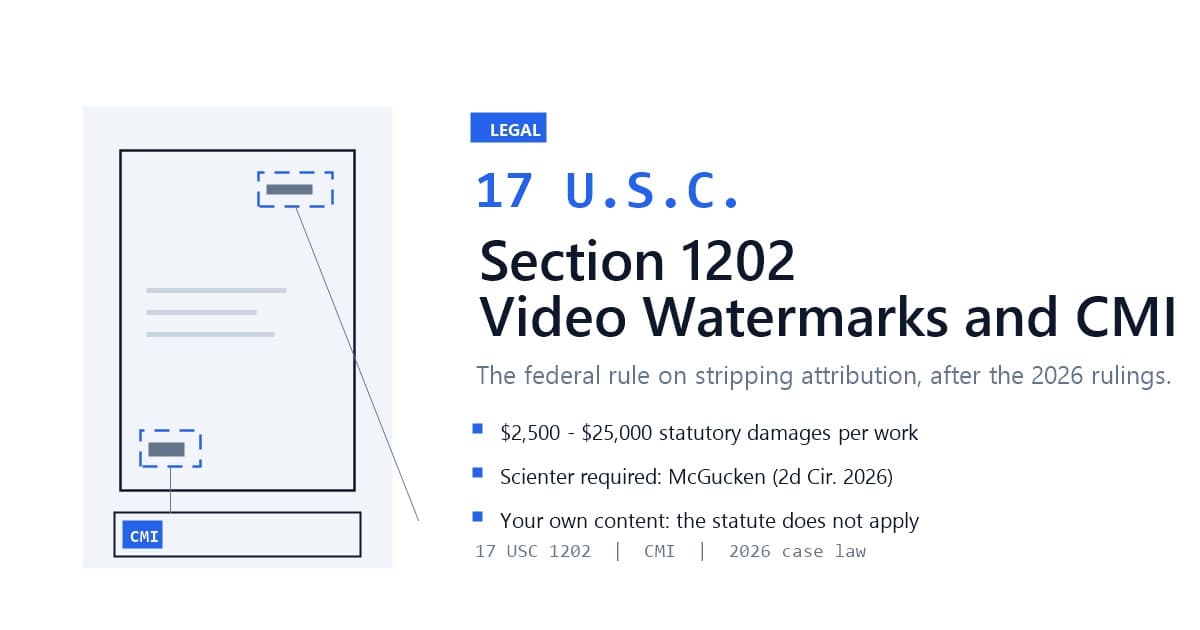
DMCA Section 1202 is the U.S. law that makes it illegal to intentionally remove or alter copyright management information — the CMI — from a copyrighted work. For video, CMI includes the visible elements creators think of as watermarks (logos, usernames, channel handles) and the invisible metadata embedded in the file. Remove someone else's CMI knowingly and you face statutory damages of $2,500 to $25,000 per work, on top of ordinary copyright infringement claims. Remove your own, and the statute does not apply — you cannot strip your own rights-management information.
That distinction sounds simple, but 2026 case law just sharpened it in ways every creator should understand. In February, the Second Circuit affirmed that Section 1202 requires proof of scienter — knowledge that you are removing CMI without authorization plus intent tied to infringement. In March, a Connecticut jury hit an offshore content operation with a $75 million verdict built partly on watermark stripping. This guide breaks down what the statute says, what courts now require, and where the legal lines actually fall for video creators.
Last updated: August 2026
Section 1202 is part of the Digital Millennium Copyright Act of 1998, codified at 17 U.S.C. § 1202, and it protects the integrity of copyright management information. Where copyright law (Section 106) protects the work itself, Section 1202 protects the information attached to the work — the attribution and ownership data that lets the market function. Congress's logic was direct: if anyone could legally scrub authorship off a file, attribution would collapse, and enforcement would become nearly impossible.
The statute prohibits two categories of conduct. Section 1202(a) bans knowingly providing false CMI or distributing CMI that is false, with the intent to induce, enable, facilitate, or conceal infringement. Section 1202(b) — the provision that matters for watermark removal — bans intentionally removing or altering CMI, or distributing works knowing that CMI has been removed, again with the same knowledge-and-intent requirements. The two prongs cover different acts: falsifying attribution versus stripping it.
For creators, the practical translation is one sentence: the law targets people who detach creator identity from creative work to hide infringement. It does not target the copyright owner managing their own content — a point the statute's own language makes by requiring conduct "without the authority of the copyright owner or the law."
The statute defines CMI at 17 U.S.C. § 1202(c), and the list is broader than most creators expect. It includes the title and other information identifying the work, the author's name, the copyright owner's name, the copyright notice, terms and conditions of use, identifying numbers or symbols referring to that information, and links to any of it.
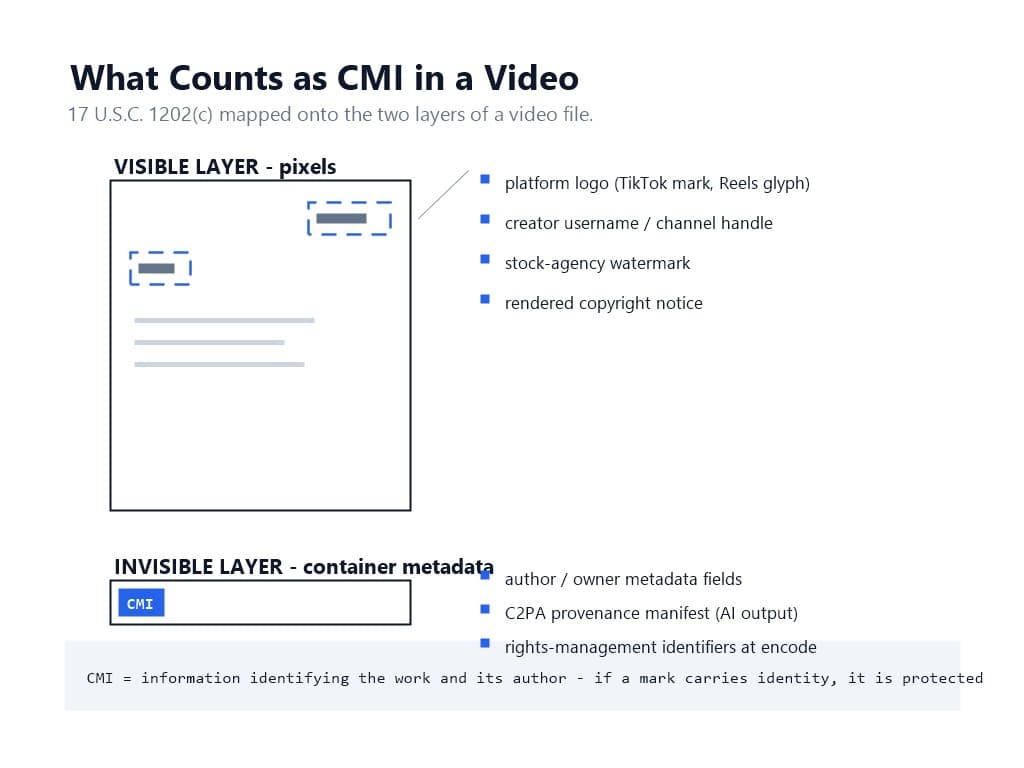
Applied to video, that definition covers two layers, and the mapping matters for anyone evaluating legal exposure:
The invisible layer deserves emphasis in 2026. When an AI generator embeds a C2PA manifest identifying the file as machine-generated, that manifest is information identifying the work — the provenance equivalent of a copyright notice. Our SynthID vs C2PA comparison walks through how these manifests are structured and what survives various edits.
One boundary worth knowing: CMI must convey information about the work's identity or ownership. A purely decorative element that identifies nothing — a graphic that carries no authorship data — sits outside the definition. Platform marks almost always carry a username or platform identity, which is why they fall inside it.
Four elements, and the last one decided the biggest 2026 case:
That fourth element — scienter — is what separates liability from mere technical violations, and McGucken v. Shutterstock (2nd Cir., February 10, 2026) is now the leading illustration. A professional photographer found hundreds of his images on Shutterstock, uploaded by third-party accounts, with their metadata stripped. He sued under Section 1202. The Second Circuit affirmed dismissal of that claim anyway.
The court's reasoning: Shutterstock's automated pipeline removed CMI from all uploads as a security measure — to block malware and scrub personally identifiable information — not to conceal infringement. No evidence showed the company knew it was removing McGucken's CMI without authorization, and none showed intent tied to infringement. Automated stripping with a legitimate purpose and no targeting defeated scienter.
Read alongside the statute, McGucken clarifies what the law actually punishes. The creator who downloads a stranger's video, deliberately removes the visible username to disguise the source, and re-uploads it for reach — that is textbook 1202(b) exposure on every element. The pipeline that processes files without targeting anyone's authorship is a different case entirely. Intent is the fulcrum.
The civil penalties are per-work, which is how small acts scale into large judgments:
Criminal liability exists for willful violations done for commercial advantage or private financial gain — up to five years' imprisonment for a first offense and up to ten for repeat offenses, with fines that can reach $250,000. Criminal prosecutions are rare, but the commercial-gain trigger maps directly onto monetized reposting.
The per-work multiplier is what turns a content operation into a catastrophe. In March 2026, a Connecticut jury returned a verdict against a European e-learning group that had scraped a university's course materials — 3,015 registered works — stripped the embedded CMI and university branding, and resold subscriptions behind an offshore shell. The jury applied the full $25,000 per-work multiplier, aggravated by the identity concealment and evidence destruction: a $75.4 million statutory damages total, alongside the underlying infringement findings. The watermark stripping was not a footnote to the case — it was an independent basis of liability.
The statute protects CMI in copyrighted works, which is where AI-generated video raises genuinely new questions — and where the honest answer has structure but no guarantees.
Start with what is settled. If you generated a clip yourself and the platform's terms grant you ownership of the output, the CMI attached to that file is yours. Removing your own watermark from your own content is not a Section 1202 violation — the statute criminalizes removal "without the authority of the copyright owner," and you are the owner. This is the legal foundation under every repurposing workflow we publish, from Sora watermark removal to batch cleanup.
The unsettled part is the provenance layer. When an AI generator embeds a C2PA manifest, that manifest identifies the work as AI-generated — but the generator, not you, created that information. Whether platform terms give you authority to remove it, and whether provenance metadata qualifies as CMI about authorship or as something new, are questions the courts have not squarely answered. Two regulatory developments push the same direction: California's transparency law (operative August 2, 2026) bars covered providers from stripping latent provenance signals, and the COPIED ACT advancing in Congress targets exactly this removal.
Our position is the one we have published since the standards emerged: clean the visible branding from your own content, preserve the provenance manifest. It keeps you clear of 1202's plain text today and aligned with where the law is visibly moving. The 2026 legal guide covers the full framework.
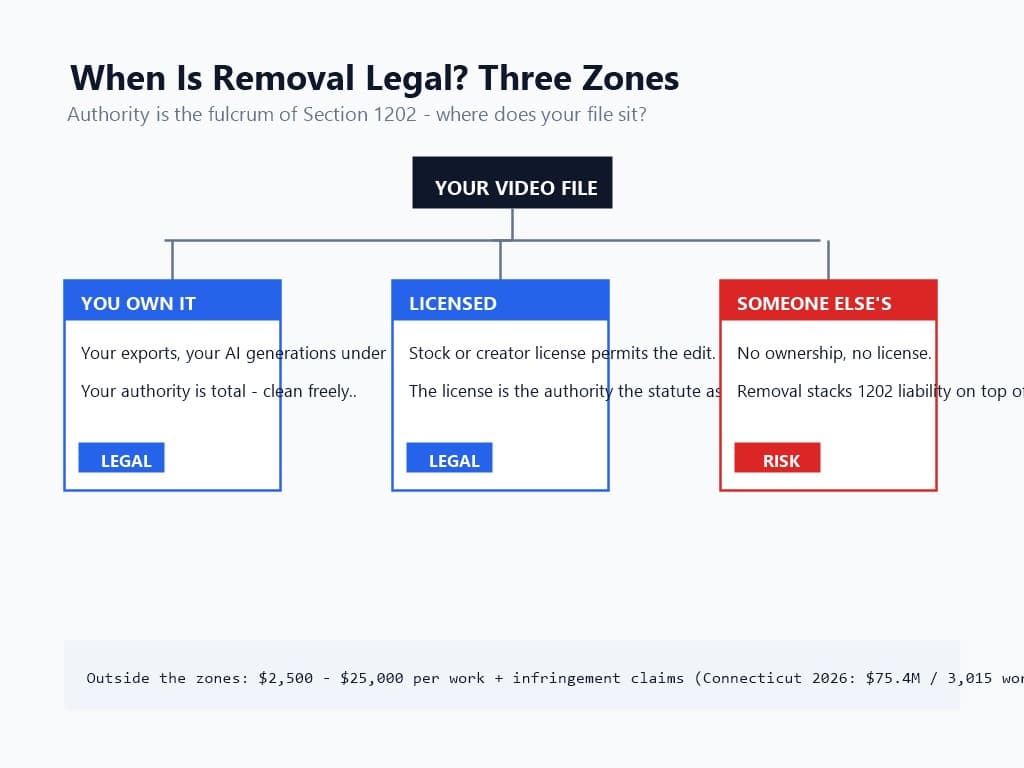
The three defensible zones, in descending order of clarity:
You own the content. Your exports, your AI generations under ownership-granting terms, your old uploads — removing your own marks is yours to do. The statute requires lack of authority, and your authority is total.
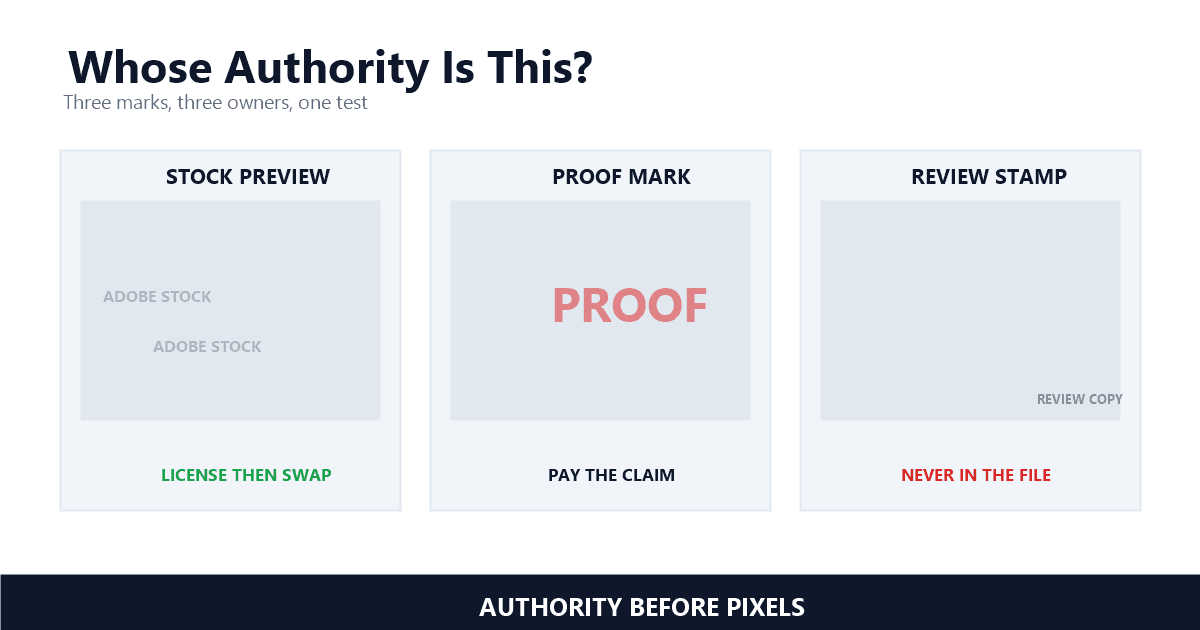
Your license permits it. Stock licenses typically deliver clean files after purchase; creator agreements often address re-editing rights. The license is the authority the statute asks for — read it before you edit, not after.
The law independently authorizes it. Fair use is a defense rather than an authorization, but genuine statutory permissions and public-domain works exist. This is the narrowest zone, and the one where a lawyer earns their fee.
Outside those zones, the map is uniformly hostile: removing marks from others' content for reposting, monetized or not, stacks a 1202 claim on top of infringement. Platform enforcement adds its own layer — Meta's Content Protection fingerprints originals across Facebook and Instagram, and ad networks reject watermarked creative outright, as our ad compliance analysis documents. Teams running creator content should route every acquisition through the rights-checklist structure in the UGC workflow guide precisely because the per-work math above does not forgive volume.
Section 1202 is the federal floor, and 2026 built upward from it.
The COPIED ACT, advancing in Congress, would create federal liability for removing, disabling, or tampering with provenance data — including the content provenance and watermarking systems AI platforms deploy — and would empower the FTC to enforce against violators. It targets the invisible layer more directly than 1202 ever did, closing the gap between visible-watermark law and provenance law.
California's AI Transparency Act (SB 942, amended by AB 853) became operative August 2, 2026, and bars covered providers from knowingly stripping latent provenance where detection is feasible, while requiring free detection tools and disclosure mechanisms. It binds providers rather than end users, but it hardens the infrastructure every downstream workflow inherits.
Platform policy operates faster than either statute. Meta's Content Protection, TikTok's and Instagram's watermark penalties on foreign marks, and YouTube's own attribution systems each enforce rules that are stricter and swifter than court. A file can be fully legal and still unrecoverable as distribution.
The direction of travel is one-way. Each layer added since 1998 — DMCA to C2PA to state statutes to platform systems — has protected attribution more strongly than the layer before it. Bets against provenance are bets against the entire regulatory gradient.
Four operating rules keep a content pipeline on the right side of every layer above:
DMCA Section 1202 turns watermark stripping into independent, per-work liability — $2,500 to $25,000 per violation — but only when the removal is intentional, unauthorized, and tied to infringement. The 2026 cases drew both edges of that blade: scienter defeats claims against legitimate automated processing (McGucken), while deliberate stripping at scale drives eight-figure verdicts (Connecticut, March 2026). For creators, the statute's structure maps cleanly onto behavior: your own content is yours to clean, licensed content follows its license, and everyone else's content is a legal boundary no tool erases.
The compliant workflow is the one UnMark has published since the beginning: remove the visible marks from content you own, keep the provenance manifest in the file, and let attribution live where the law can see it.
Q1: Does DMCA Section 1202 apply to removing watermarks from videos?
Yes. Visible watermarks carrying authorship information — logos, usernames, channel handles — qualify as copyright management information under 17 U.S.C. § 1202(c), and intentionally removing them without authority violates § 1202(b).
Q2: Can I remove a watermark from my own video?
Yes. Section 1202 prohibits removal "without the authority of the copyright owner." If you own the content, you hold that authority, whether the mark came from your editing app or a platform's export pipeline.
Q3: What are the penalties for a Section 1202 violation?
Civil statutory damages run $2,500 to $25,000 per work, plus actual damages, attorney's fees, and injunctions. Willful violations for commercial gain can trigger criminal liability of up to five years' imprisonment and $250,000 in fines.
Q4: What did the 2026 Shutterstock case decide?
The Second Circuit held that Section 1202 requires scienter — knowledge of unauthorized removal plus intent tied to infringement. Shutterstock's automated metadata stripping for security purposes, without targeting, lacked that intent, so the claim failed.
Q5: Does Section 1202 cover AI-generated video watermarks?
For content you own under the platform's terms, cleaning your own visible marks falls within your authority. Whether removing AI provenance manifests (like C2PA) is covered remains unsettled — pending federal and state laws increasingly treat provenance stripping as its own violation.
Mark Ma is the founder and lead engineer at UnMark, where he leads the development of AI-powered video watermark removal technology. With over a decade of experience in computer vision, deep learning, and video processing, he has built production systems that process millions of frames per month across TikTok, Instagram Reels, and Google Veo content. His technical work focuses on motion-compensated watermark detection, spatial-temporal inpainting, and quality-preserving reconstruction for short-form vertical video. Before UnMark, Mark shipped computer vision infrastructure at scale for content moderation and ad compliance platforms. He writes this blog to document the real engineering, testing, and regulatory reasoning behind UnMark's processing pipeline — every test result, frame analysis, and benchmark published here is reproduced from actual production data, not synthetic examples. His goal is to give creators, brands, and regulators a verifiable technical reference for AI video watermark removal in 2026.