COPIED Act vs Watermark Removal: What's Actually Illegal (2026)
Mark Ma
Last updated: October 2026
Search results for vidu ai watermark removal describe two different companies having two different conversations. On one side sits Vidu's own tool page, titled Watermark Remover for Owned Media, which offers AI-assisted cleanup with a rights boundary attached. On the other side sit three results from vidau.ai — a marketing-video company that is not Vidu at all — plus a stack of remover tools promising to scrub the badge Vidu's own pricing page puts there. Nobody in the results explains both lines at once.
My day job is building UnMark, a watermark removal product, and Vidu is the first platform we have watched publish its own remover tool page while simultaneously gating its own mark behind a subscription. That combination deserves a careful read, because it splits the world into two kinds of marks: marks on footage you are permitted to edit, and the mark Vidu puts on its own free-plan exports as a licensing signal. Conflating them is how people end up running cleanup tools on files they have no license to clean.
The short version: Vidu's remover page is for owned or rights-cleared media — third-party logos, outdated labels, mockup annotations — and it explicitly rules out bypassing licensing. The watermark on free-plan exports is the other category. It comes off through the plan ladder, first at Standard, $8 per month on yearly billing, together with commercial rights. Everything else — the name-alike tools, the unofficial Vidu sites, the API rate cards — is navigation around those two facts.
Yes. On the free plan, by design. Vidu's own pricing page lists "Download without watermark" and "Commercial use allowed" as paid-tier features — the free card offers ten references a month and neither of those lines. Third-party reviewers read the page the same way: free output ships watermarked, with no commercial license.
The structure is visible on Vidu's pricing page itself. Each paid card carries the line "Generated content can be used commercially" — Standard, Premium, and Ultimate all repeat it — while the free card's entire content is "10 references/month". Further down, the comparison table lists "Commercial use allowed" and "Download without watermark" as rows that appear from Standard upward. Resolution and credits get all the marketing attention, but those two quiet table rows are the actual reason to subscribe.
Independent reviewers read it identically. HokAI's review, checked September 17, 2026, states: "Because the paid tiers specifically advertise removing the watermark and unlocking commercial use, free-tier output ships watermarked and is not licensed for commercial work" — HokAI, Vidu Review. FindAITools puts it flatly: "The free plan does not include watermark removal or commercial use rights." And the free tier is not a stub — it includes unlimited generation during off-peak hours, which makes it the exploration layer of the whole platform. You can iterate prompts all night; the export is still stamped and the license is still personal.
It is a cleanup page Vidu built for media you own or are permitted to edit — third-party logos, old labels, mockup annotations. Its rights boundary says use only owned or permitted assets. The page never offers to strip Vidu's own mark; that job belongs to the subscription ladder.
The page lives at go.vidu.com and is titled "Watermark Remover for Owned Media". Its framing is careful from the first sentence: "Use Vidu to test watermark cleanup on images or clips you own or have permission to edit. Upload a file, review the draft result, and decide whether it is ready for refinement or export" — Vidu, Watermark Remover for Owned Media. A decision table on the same page pins the boundary into a single row: "Use only owned or permitted assets, then keep the cleanup task inside the Vidu editing flow for review." The workflow it describes is conventional — upload the source file, describe the mark in a prompt, generate, and inspect the edited area for "blur, artifacts, repeated texture, or missing detail" before export.
What makes the page unusual is the second boundary sentence: "It should not be used to hide ownership, bypass licensing, or misrepresent someone else's work." Vendor remover pages rarely say that part out loud. Read together, the two sentences define a tool for an editor's genuine backlog — a campaign mockup with placeholder marks, an archive clip with an outdated label, a rights-cleared asset with a third-party logo — and draw a hard line around everything else. Tellingly, the page's own FAQ declines to promise free results even inside that scope: "You can't rely on Vidu for a guaranteed free watermark removal result on images" — Vidu, Watermark Remover FAQ. The tool is a review workflow, not a promise.
Through the subscription, not the remover. The pricing page's comparison table lists "Download without watermark" as a plan feature, and Standard — $8 monthly billed yearly — is the first tier that includes it. For clips already generated on the free tier, the compliant fix is regenerating the prompt under an active paid plan.
HokAI compresses the whole mechanism into one sentence: "Standard clears the watermark and licenses output for commercial use" — HokAI, Vidu Review. That is the official path in its entirety: the mark is a feature row on a pricing table, and paying for the row is how it leaves your exports. There is no tool, toggle, or support ticket that strips it from a free-tier file, and the remover page's FAQ — the one about guaranteed free removal — is the closest Vidu comes to acknowledging that.
The practical workflow follows the shape we documented for Kling and Pika: iterate prompts on the free tier's off-peak queue, then regenerate the approved shot under Standard so the export is born clean and commercially licensed. The same split drives Runway's free-plan rules and Hailuo's, and Luma pushes it furthest — Luma attaches the license at generation time, so no upgrade ever cleans an old clip. Whether every Vidu plan change works the same way is not stated on the pages we accessed — which is exactly why the regenerate-under-paid-plan habit is the safe default: your rights follow the render, not the receipt.
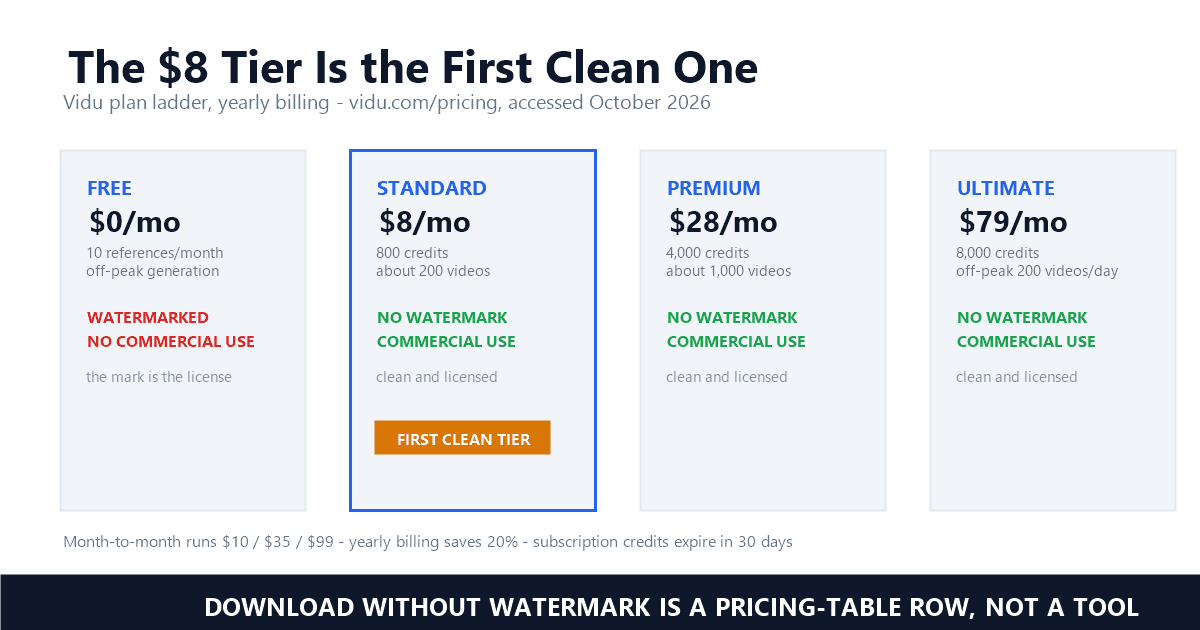
Eight dollars a month on yearly billing. Standard carries 800 credits — about 200 videos — plus commercial rights and clean downloads; Premium and Ultimate at $28 and $79 raise the credit ceiling. Watch the edges, though: subscription credits expire in 30 days, failed renders still consume them, and Vidu does not issue refunds.
The ladder, straight from the pricing page with yearly billing: Standard at $8 monthly, billed as $96 a year, 800 credits, up to 200 videos; Premium at $28, billed as $336, 4,000 credits, up to 1,000 videos; Ultimate at $79, billed as $948, 8,000 credits plus free off-peak mode with up to 200 videos submitted daily and unlimited Q2 1080p image generation. Ultimate is the throughput ceiling of the ladder, and nothing in its row changes the watermark terms. Month-to-month pricing runs $10, $35, and $99 — the yearly rate is a 20% discount. All three paid tiers support 3–16 second generation, 1080p video, four videos at once, and H.265 Pro encoding; only Ultimate's comparison row reaches "Ultra HD up to 4K".
The fine print bites in three places. Credit expiry is tiered by origin — "Subscription Credits: Credits included in your plan, valid for 30 days. Purchased Credits: Additional credits available for purchase on demand, valid for 2 years. Bonus Credits: Extra credits earned through events, competitions, or the Artist Program, valid for 2 years" — Vidu, Pricing FAQ. Refunds do not exist: "We're sorry, but we are unable to provide refunds" — Vidu, Pricing FAQ, with Stripe handling automatic charges. And failed renders still burn credits: "Failed renders consume credits with no compensation" — HokAI, Vidu Review, which pairs a Trustpilot score of 2.0 with that observation. Budget for the effective cost, not the advertised one.
Because three unrelated products share the name. The Vidu that watermarks videos is vidu.com, built by ShengShu Technology; VidAU at vidau.ai is a separate marketing-video company that holds several results for this exact search, and an unofficial Vidu-branded site rounds out the mix. Domain checks settle it in seconds.
The confusion is structural, not accidental. ShengShu Technology — the Beijing startup founded in March 2023 by Tsinghua researchers, which raised a $293 million Series B led by Alibaba Cloud in April 2026 and counts total funding above $987 million — sells its video model under the name Vidu at vidu.com, with the API at platform.vidu.com and tool pages at go.vidu.com. VidAU at vidau.ai is a different company entirely, selling avatar and marketing-video tools including its own subtitle-and-watermark remover; for the search this article targets, it held three of the top organic slots when we tested the results. vidu.io is a third product — AI-personalized sales videos from $39 a month — and an unofficial Vidu-branded site at vidualai.pro quotes a 40-credit free tier that appears on no official page.
The third-party removal tools themselves span the honesty spectrum. Remover.work's Vidu page is refreshingly candid: "Vidu currently uses the general logo-removal path while we calibrate a validated platform sample set" — Remover.work, Vidu Watermark Remover — and its FAQ answers the obvious question with "Not yet. This page currently uses the general logo-removal path, so we do not claim guaranteed coverage for every Vidu export." The same page offers two pieces of advice worth keeping regardless of which tool you use: treat the free five-second preview as a quality gate before paying for a full export, and "Upload the file downloaded from Vidu rather than a copy forwarded through chat or a social network", because an extra compression pass degrades the texture the inpainting model needs. A tool that discloses its limits is easier to trust than one that doesn't — and the five-second habit applies to moving-logo cases and Grok Imagine alike.
It is a separate production channel, not a loophole. API credits cost $0.005 each through platform.vidu.com, metered per second of video — Q3-turbo at 1080p runs $0.065 in standard hours and $0.035 off-peak — and the API wallet is separate from web credits. The terms grant commercial freedom without mentioning the subscription mark.
The API rate card prices by the second. "Credits are available for $0.005 each, with applicable sales tax based on your location" — Vidu API Platform, Pricing. At that rate, Q3-turbo 1080p costs $0.065 per second in standard hours and $0.035 off-peak; Q3-pro runs $0.12 and $0.06; Q3-pro-fast, an image-to-video variant, runs $0.125. A five-second 1080p Q3-turbo clip therefore costs about $0.325 at standard rates — against a Standard subscription whose 800 credits cover roughly 200 videos. The subscription is the better deal for interactive volume; the API is the better deal for pipelines, where batch throughput matters more than per-clip price.
Two structural facts matter for planning. First, the wallets do not talk to each other: "API credits separate from web app credits — dual budgeting required" — HokAI, Vidu Review. Second, the API's terms are deliberately terse about usage: "We don't restrict your use for commercial purposes" — Vidu API Platform, Terms of Use. What the API pages we accessed do not state is whether API exports carry the subscription mark at all — we will not assert it either way, and neither should a guide that has not checked. What is verifiable is the cost structure, and it rewards the discipline we described in our processing walkthrough: meter everything, retry deliberately, and never let a failing render loop burn a metered wallet.
When the mark is not Vidu's. Vidu's own remover page draws the line cleanly: cleanup is for owned or permitted media, and it should not be used to hide ownership or bypass licensing. A plan-gated watermark is a license fee made visible — the lawful paths are upgrading or regenerating, and the tools serve the footage you already hold rights to.
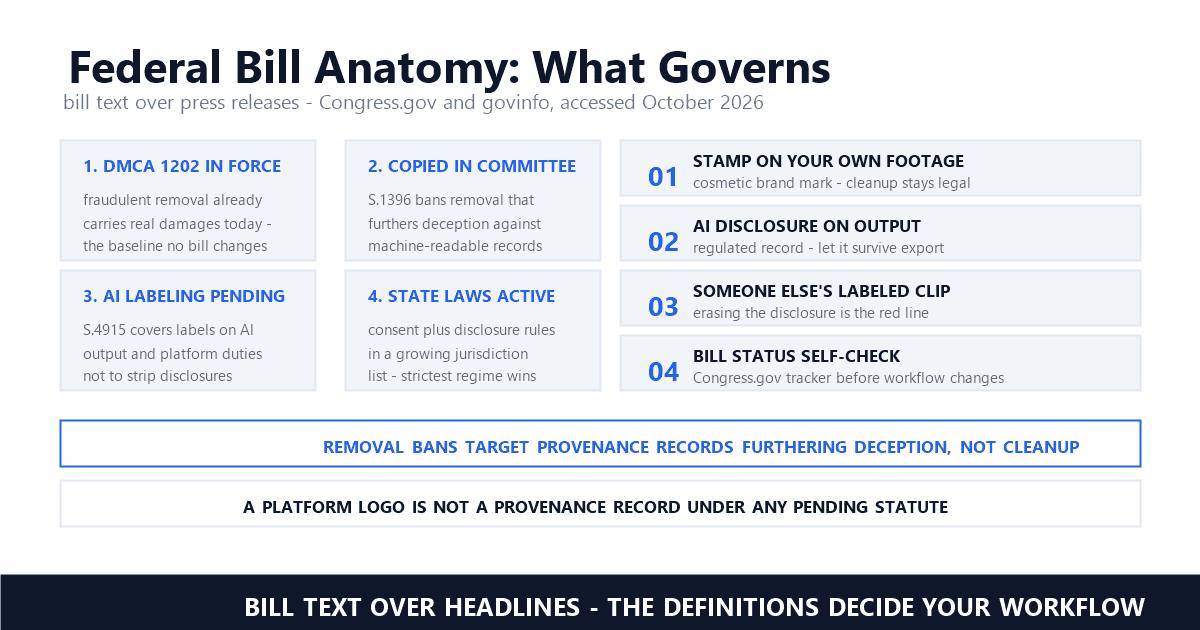
Vidu's phrasing is the clearest starting point because it comes from the vendor selling both sides of the line: "It should not be used to hide ownership, bypass licensing, or misrepresent someone else's work" — Vidu, Watermark Remover for Owned Media. The legal layers around that line are the ones we track across this series. In Europe, Article 50 of the AI Act requires machine-readable marking of synthetic content; in China, the labeling measures ban tools that maliciously remove or conceal such labels; and when a mark qualifies as copyright management information, 17 U.S.C. § 1202 attaches statutory penalties to stripping it. The four-question framework in our legality guide — whose mark, whose footage, which statute, which contract — resolves most real cases before the legal layers even load.
Our position as a removal product is the same one Vidu's tool page formalizes: we treat plan-gated marks as out of scope, because the vendor sells the clean file and the license is the product. Inpainting beats cropping and blurring on quality — mask size is the cost driver — and the licensed footage that crosses our queue comes from UGC handoffs and ad-platform compliance: creator-owned sources, authorized cleanup, receipts kept. The rule of thumb survives every platform we have covered: Veo, Seedance, Vidu — when the mark is the license, buy the license; when the footage is yours, clean it and keep the paperwork.
Vidu's two lines — a remover for the media you own, a ladder for the mark it adds — are unusual only in being written down. Most platforms leave creators to infer the difference from pricing tables and tool-page copy. Vidu's pages say it outright, and that text is worth more than any remover app: rights in, marks out, everything else through the plan you pay for.
Does the free Vidu plan add a watermark?
Yes. Vidu's pricing page lists "Download without watermark" and "Commercial use allowed" as features that appear from the Standard tier upward, while the free card offers ten references per month and neither line. Free output is watermarked and not licensed for commercial work — HokAI, FindAITools, and Vidu's own table all agree on that reading.
Which Vidu plan removes the watermark and grants commercial use?
Standard is the first tier with both: $8 per month billed yearly ($96 a year, or $10 month-to-month), 800 credits, roughly 200 videos. Premium at $28 and Ultimate at $79 add credit volume, priority channels, and off-peak throughput — the watermark row does not change above Standard.
Can third-party tools remove the Vidu watermark for free?
Third-party removers exist, but the candid ones disclose limits: Remover.work states its Vidu page uses a general logo-removal path and does not claim guaranteed coverage for every export. For free-plan clips the mark signals a non-commercial license, so even a visually clean file leaves the license problem intact — the compliant fix is regenerating under Standard.
Last updated: October 2026
Vidu — Vidu Pricing: Plans, Credits, and Commercial Use (Official) (accessed October 2026)
Vidu — Watermark Remover for Owned Media (accessed October 2026)
Vidu API Platform — Pricing — Vidu API (accessed October 2026)
Vidu API Platform — Terms of Use (accessed October 2026)
Remover.work — Vidu Watermark Remover (accessed October 2026)
HokAI — Vidu Review, Pricing and Verdict (accessed October 2026; page checked September 17, 2026)
ToolColumn — Vidu Pricing: Plans, Generation Credits & API Costs (accessed October 2026; verified August 24, 2026)
Mark Ma is the founder and lead engineer at UnMark, where he leads the development of AI-powered video watermark removal technology. With over a decade of experience in computer vision, deep learning, and video processing, he has built production systems that process millions of frames per month across TikTok, Instagram Reels, and Google Veo content. His technical work focuses on motion-compensated watermark detection, spatial-temporal inpainting, and quality-preserving reconstruction for short-form vertical video. Before UnMark, Mark shipped computer vision infrastructure at scale for content moderation and ad compliance platforms. He writes this blog to document the real engineering, testing, and regulatory reasoning behind UnMark's processing pipeline — every test result, frame analysis, and benchmark published here is reproduced from actual production data, not synthetic examples. His goal is to give creators, brands, and regulators a verifiable technical reference for AI video watermark removal in 2026.