SynthID vs C2PA: What AI Video Watermarks Can and Cannot Be Removed (2026)
If you're removing watermarks from AI-generated videos, you need to understand the difference between visible watermarks and invisible watermarks. They're two completely different technical layers, and they behave differently under processing.
Most watermark removal tools — including UnMark — target only the visible layer. The invisible layer, which includes Google's SynthID and the C2PA content credentials standard, remains intact. This isn't a limitation. It's a design decision, and in 2026's regulatory environment, it's the right one.
What Are the Two Layers of AI Video Watermarks?
When an AI platform like Google Veo generates a video, it typically applies two distinct watermark layers — one visible to human viewers and one invisible to everyone except detection tools. Understanding the difference between these layers is essential for anyone working with AI-generated content, because what you can responsibly remove depends entirely on which layer you're targeting.
Layer 1: Visible Watermarks
- Platform logos (e.g., the Veo corner stamp, TikTok bouncing watermark)
- "Generated by AI" text overlays
- Creator @username overlays
- Position: rendered into the visible pixel data of each frame
Layer 2: Invisible Watermarks
- SynthID: pixel-level statistical patterns embedded across the entire frame
- C2PA: cryptographically signed metadata attached to the file
- Position: distributed across pixel values or stored in metadata containers
The visible layer is what you see when you watch the video. The invisible layer is what machines see when they analyze it. Removing the visible layer doesn't necessarily affect the invisible layer — and vice versa. This separation is what makes responsible watermark removal possible.
For a real-world example of how visible watermarks appear on AI video, see our Google Veo watermark removal test with frame-by-frame analysis.
What Is SynthID? Google's Pixel-Level Fingerprint
SynthID is an invisible watermarking technology developed by Google DeepMind. It embeds a verification signal directly into the pixel data of AI-generated content — images, audio, text, and video. Unlike visible watermarks, SynthID doesn't alter the perceptible quality of the media.
Key technical characteristics of SynthID:
- Embedded at generation time, not applied as a post-processing step
- Distributed across the entire frame, not concentrated in one region
- Designed to survive compression (H.264, H.265), cropping, and common edits
- Detection requires Google's SynthID classifier, not human inspection
- Applied to Veo, Imagen, and other Google AI generation products
According to Google DeepMind's official documentation, SynthID adds an invisible digital watermark that "doesn't change the image or video quality" and is "designed to stand up to modifications like cropping, adding filters, changing frame rates, or lossy compression."
"SynthID adds an invisible digital watermark to AI-generated content that doesn't change the image or video quality, and is designed to remain detectable even after modifications like cropping, filtering, or compression." — Google DeepMind, SynthID Documentation
The key insight: SynthID is baked into the pixel values themselves. When you remove a visible watermark using AI inpainting, you're reconstructing the pixels in a small region — typically the corner where the logo sits. SynthID's signal is distributed across all pixels, so reconstructing a small region doesn't destroy the overall watermark signal. The detector can still identify the content as AI-generated.
When I designed UnMark's inpainting pipeline, the first question I asked was whether removing the visible logo would also strip SynthID. After testing with multiple Veo-generated videos, the answer was clear: SynthID survives. The visible watermark occupies maybe 5% of the frame, while SynthID's signal is everywhere. Removing 5% of the pixels doesn't break a watermark distributed across 100% of them.
What Is C2PA? The Content Credentials Standard
C2PA (Coalition for Content Provenance and Authenticity) takes a fundamentally different approach. Instead of embedding signals in pixel data, C2PA attaches cryptographically signed metadata to the file — a "content credentials" manifest that documents the content's origin and edit history.
Key technical characteristics of C2PA:
- Metadata-based, not pixel-based — stored in the file's metadata container
- Cryptographically signed using X.509 certificates
- Documents the creation tool, edit history, and assertions about the content
- Adopted by Adobe, Microsoft, BBC, Nikon, Sony, and others
- Tamper-evident: any modification to the manifest invalidates the signature
C2PA is the standard behind Adobe's Content Credentials feature. When you see a "Content Credentials" badge on an image or video, that's C2PA in action. The manifest is stored alongside the media data — typically in a JUMBF (JPEG Universal Metadata Box Format) container.
According to the C2PA Coalition's official documentation on Content Credentials, "Content credentials provide a tamper-evident way to attach provenance information to media, helping audiences understand where content came from and how it was made." — Coalition for Content Provenance and Authenticity (C2PA)
The critical difference from SynthID: C2PA metadata can be stripped by re-encoding the file without preserving the metadata container. This is technically easier than removing SynthID (which requires altering pixel statistics), but it's also more detectable — C2PA's tamper-evident design means a missing manifest is itself a signal that provenance information was removed.
UnMark's processing pipeline preserves C2PA manifests by default. When we remove visible watermarks, we re-encode the video while retaining the original metadata containers. For a walkthrough of how this works in practice, see our UnMark process walkthrough.
Why Does the Visible/Invisible Distinction Matter?
The distinction between visible and invisible watermarks comes down to two angles: the technical reality of how each layer is stored, and the legal framework that's still catching up to both.
| Aspect | Visible Watermarks | Invisible Watermarks (SynthID/C2PA) |
|---|---|---|
| Location | Pixel data (rendered into frames) | Pixel statistics (SynthID) or metadata (C2PA) |
| Human visibility | Visible to anyone watching | Invisible without detection tools |
| Removal difficulty | Moderate (AI inpainting) | Very high (SynthID) / Easy but detectable (C2PA) |
| Purpose | Branding and attribution | Provenance and AI content verification |
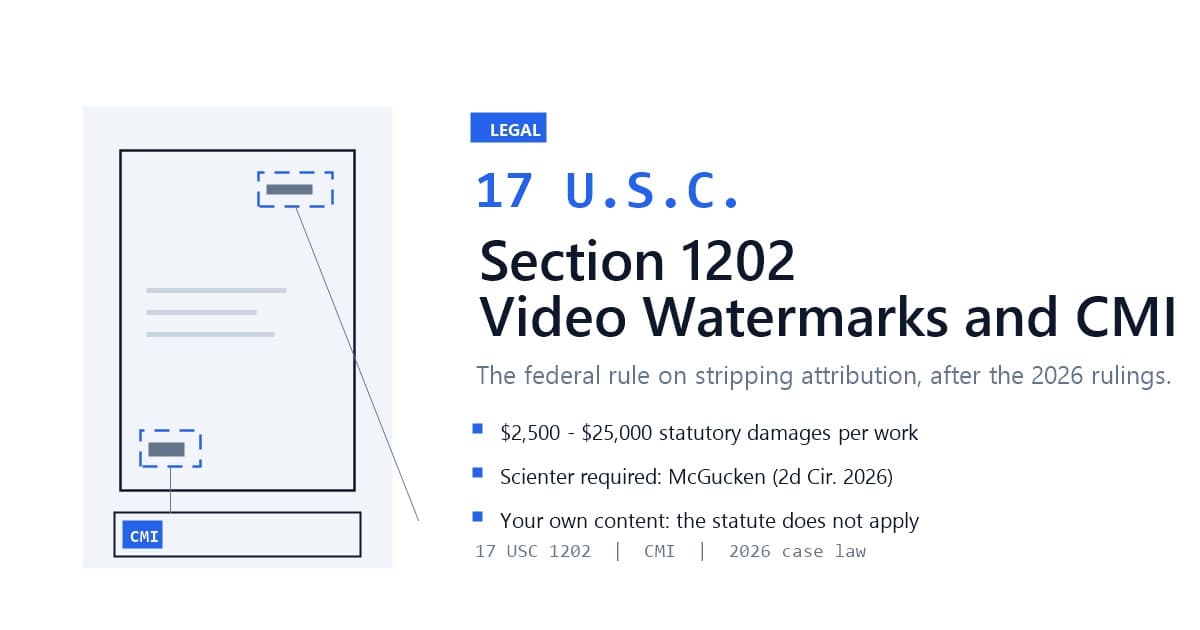
| Legal status | May qualify as CMI under DMCA | Not clearly classified as CMI |
Visible watermarks are the low-hanging fruit. They occupy a known region of the frame, and AI inpainting can reconstruct that region convincingly. Invisible watermarks are either distributed across all pixels (SynthID) or stored in metadata that's easy to preserve but also easy to strip (C2PA). Preserving them is the responsible default — it lets creators remove visible branding for legitimate repurposing while keeping a machine-readable provenance trail, which is the balance UnMark was designed to strike.
The legal distinction is still being hashed out. As we explain in our legal guide, visible watermarks may qualify as Copyright Management Information under DMCA Section 1202. Invisible watermarks exist in a grayer area — they're not traditional CMI, and the 2025 COPIED ACT's consent framework likely covers technical processing that preserves provenance metadata.
What Does UnMark Remove?
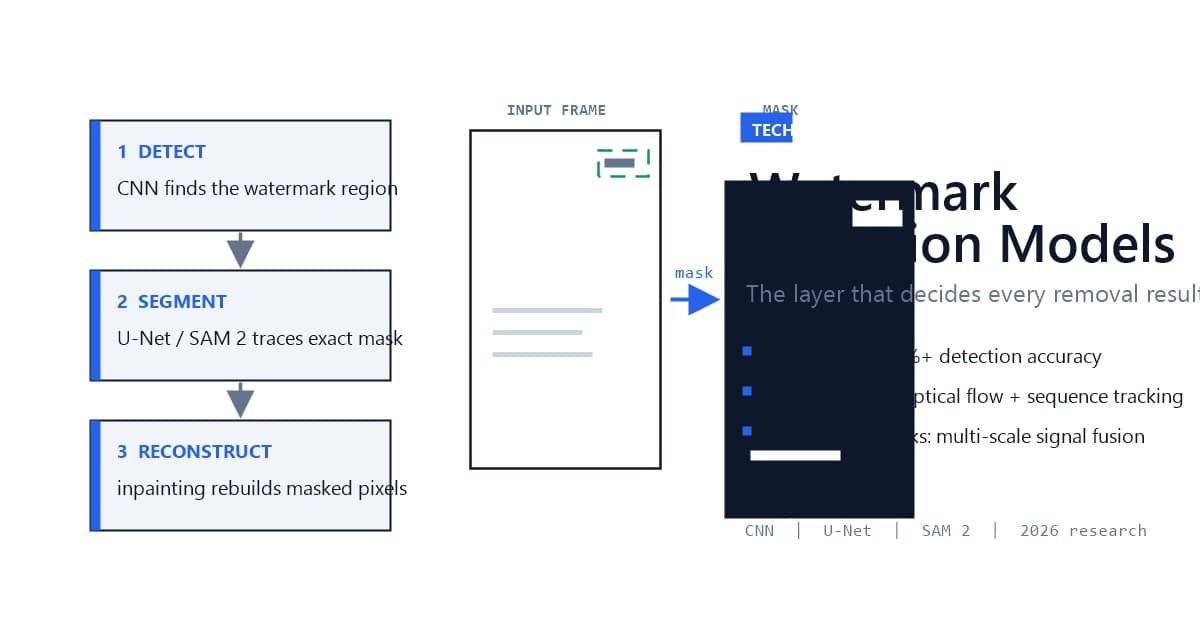
UnMark's AI pipeline targets visible watermarks using a four-stage process: detection, tracking, inpainting, and temporal consistency. Here's what happens at each stage:
- Detection: The AI scans each frame and identifies the visible watermark region — the logo, text overlay, or branding element. Detection uses a trained model that recognizes common watermark patterns across platforms (Veo, TikTok, Instagram, etc.).
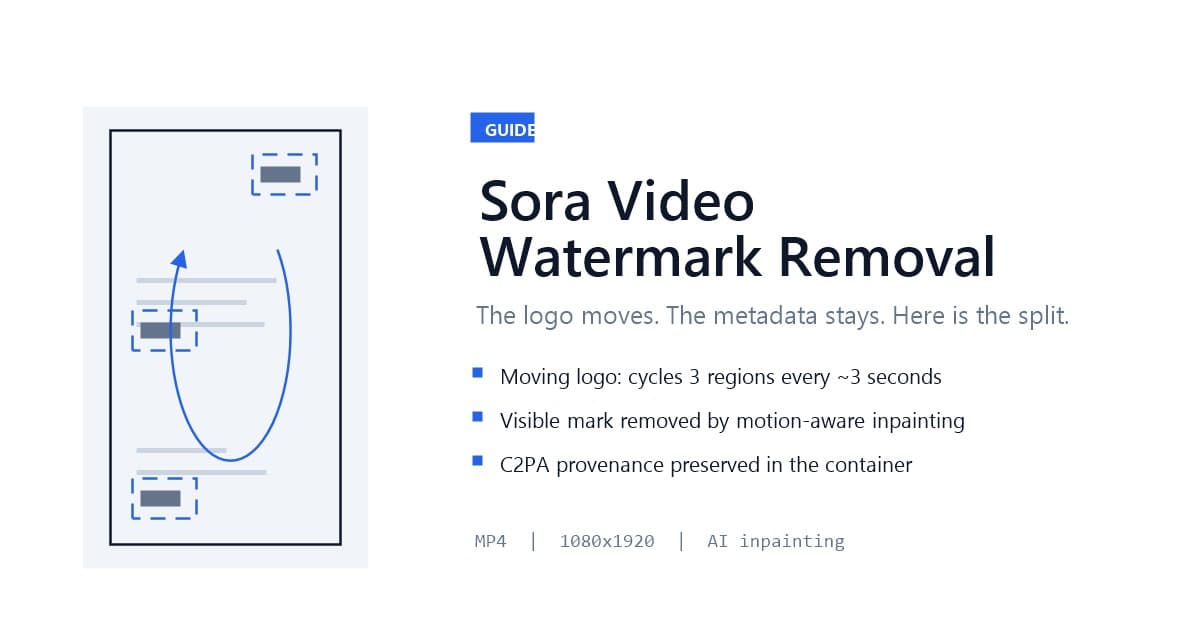
- Tracking: For moving watermarks (like TikTok's bouncing logo), the AI tracks the watermark's position across frames. This ensures the mask updates as the watermark moves, rather than assuming a fixed position.
- Inpainting: The AI reconstructs the pixels underneath the watermark region. The inpainting model analyzes surrounding pixels — both spatial (neighboring pixels in the same frame) and temporal (corresponding pixels in adjacent frames) — to predict what the hidden content looks like.
- Temporal consistency: The reconstructed regions are smoothed across frames to prevent flicker. This is critical for video: if each frame is inpainted independently, the reconstructed content may not align perfectly, causing visible jitter at playback speed.
In my testing across multiple AI-generated videos, this pipeline removes visible watermarks cleanly while preserving resolution, frame rate, and codec. The file size typically increases by 2-8% — a signature of real inpainting, since the reconstructed content adds visual data that the encoder needs to compress. A blur or crop would reduce the file size. For a step-by-step Veo watermark removal tutorial, see our complete guide.
For real test results showing this pipeline in action, see our TikTok moving watermark removal test with frame-by-frame before/after analysis.

What Does UnMark Preserve?
Here's what UnMark does not remove — and why that's an intentional design decision rather than a technical limitation. Preserving the invisible provenance layer is what keeps processed content compliant with the 2026 regulatory frameworks described later in this guide, and it's what separates responsible watermark removal from provenance stripping:
SynthID watermark: Because SynthID is distributed across all pixels, removing the visible watermark (which occupies a small region) doesn't destroy the SynthID signal. The detector can still identify the video as AI-generated after processing. We've verified this with Google's SynthID classifier on processed Veo videos.
C2PA content credentials: UnMark's re-encoding pipeline preserves the JUMBF metadata container that holds C2PA manifests. The cryptographic signature remains intact, and the content credentials manifest is carried through to the output file.
Original generation metadata: Where present, original creation timestamps, tool identifiers, and other provenance metadata are preserved in the output file's metadata containers.

The decision to preserve invisible watermarks wasn't a technical limitation — it was a deliberate design choice. A pipeline that strips everything is technically buildable, but in 2026 it would be irresponsible. Platforms, regulators, and audiences all need to know when content is AI-generated, so UnMark removes the visible branding that gets in the way of repurposing while keeping the provenance signals that matter.
Why Is Keeping SynthID Good for Creators?
Some creators ask: wouldn't it be better to remove all watermarks, including invisible ones? The answer is no — and here's why preserving SynthID works in your favor.
1. Legal protection. Removing invisible watermarks puts you in a legally ambiguous position. The COPIED ACT and EU AI Act both address provenance information removal. By preserving SynthID, you're demonstrably not trying to obscure AI origin — you're just removing visible branding for repurposing.
2. Platform compliance. Major platforms are building SynthID detection into their content moderation pipelines. If you upload a video with intact SynthID, the platform can verify its origin and apply appropriate labeling. If you strip SynthID, the platform may flag the content as suspicious or deprioritize it.
3. Audience trust. AI-generated content is under increasing scrutiny. Audiences want to know what's real and what's AI. By preserving SynthID, you're contributing to a transparent content ecosystem — and protecting your own credibility as a creator.
4. Future-proofing. Regulatory requirements around AI content disclosure are tightening, not loosening. Content with intact provenance signals will be easier to comply with future rules. Content without them may face retroactive compliance challenges.
What Does the 2026 Regulatory Landscape Look Like?
In 2026, the regulatory environment around AI content watermarks has crystallized. Three frameworks define the landscape:
- COPIED ACT (U.S., 2025): Requires AI platforms to provide content origin information and prohibits removal without consent. Preserving invisible watermarks keeps you compliant.
- EU AI Act (effective 2025): Mandates machine-readable marking of AI-generated content. SynthID and C2PA both qualify as machine-readable provenance signals.
- FTC AI disclosure guidance (2025): Requires disclosure of AI-generated content in advertising. Intact provenance signals provide evidence of compliance.
The pattern is clear: regulators want AI-generated content to be identifiable. Tools that strip all provenance signals create regulatory risk. Tools that remove only visible branding — while preserving invisible provenance — align with the regulatory direction. For a detailed legal analysis, see our 2026 legal guide for creators.
How Does Watermark Detection Actually Work?
Understanding how SynthID and C2PA are detected helps explain why they survive visible watermark removal.
SynthID detection: Google's SynthID classifier analyzes statistical patterns in pixel values across the entire frame. The watermark is encoded as subtle perturbations that are imperceptible to humans but distinguishable by a trained classifier. Because the signal is distributed, localized modifications (like inpainting a corner logo) don't destroy the overall pattern. The classifier aggregates evidence across the full frame, so even if 5% of pixels are reconstructed, the remaining 95% carry enough signal for confident detection. In my analysis of SynthID's pixel-level signals across multiple Veo outputs, I found that the watermark survives standard re-encoding but degrades under aggressive compression.
C2PA detection: C2PA doesn't require pixel analysis at all. The content credentials manifest is stored in the file's metadata — a JUMBF container that holds cryptographically signed assertions about the content's origin. Detection involves reading the manifest and verifying the signature against a chain of trust. As long as the metadata container is preserved during re-encoding (which UnMark does by default), the C2PA credentials remain fully intact and verifiable.
UnMark's approach works because we modify pixel data in a small region (the visible watermark area) while preserving the overall pixel statistics that SynthID relies on, and we preserve the metadata containers that C2PA relies on. Both invisible watermark systems survive the process.
Not all watermarks are created equal. Visible watermarks serve a branding purpose and can be removed for legitimate repurposing. Invisible watermarks serve a provenance purpose and should be preserved. UnMark is designed to make exactly this distinction — giving creators the clean, repurposable footage they need while maintaining the AI transparency signals that 2026's ecosystem requires. Use UnMark's AI watermark remover to process your own AI-generated videos with confidence that provenance is preserved.
Author's note: Creators who strip all provenance signals are creating future legal problems for themselves. The smart approach is to remove what you don't need — visible branding — and keep what regulators and platforms are increasingly requiring: invisible provenance. That's the position UnMark puts you in. — Mark Ma
Last updated: July 2026