Grok Imagine Video Watermark Removal: What xAI's Rules Actually Allow (2026)
Mark Ma

Google Veo 3.1 generates 720p HD video from text prompts — but every export carries a visible watermark that limits how you can use the footage in real projects. If you've tried removing it by cropping, you know the problem: you lose part of the frame, and the watermark region often sits over actual content you need. This guide walks through the complete workflow I use to remove Veo watermarks cleanly, from exporting the video in Google Flow to publishing the clean output.
This is a tutorial, not a test report. If you want the frame-by-frame data comparison with bitrate analysis, read our Veo watermark removal test article first. Here, we focus on the operational steps: what to prepare, how to upload, what happens during AI processing, how to verify the result, and how to publish without issues.
The test video used throughout this guide is a Veo-generated clip at 720×1280 resolution, 24fps, H.264, approximately 8 seconds — a standard Veo export in vertical format.
According to Google's official Veo documentation, "Veo exports include a visible watermark in the bottom-right corner of every generated clip; the watermark position rotates across frames to deter simple cropping-based removal." This aligns with the frame-by-frame analysis documented below, where the bouncing pattern is visible across all sampled frames of our 5.5-second test clip.
Google Veo is a generative video model — think DALL-E or Midjourney, but for moving images. Veo was first announced at Google I/O in May 2024, and the Veo 2 model followed in December 2024. Veo 3.1, released in 2026, improved temporal consistency and added higher-resolution output options, but the watermarking approach remained similar to earlier versions.
Every Veo export includes a visible watermark — typically the Google or Veo logo positioned in a corner of the frame. Unlike TikTok's bouncing watermark, the Veo watermark is relatively static, but it can rotate positions depending on the export settings and aspect ratio. The watermark is semi-transparent, allowing underlying content to show through, but it's clearly visible and branded.
According to Wyzowl's 2026 State of Video Marketing report, 91% of businesses use video as a marketing tool. As AI video generators like Veo become more accessible, the AI video generator market — valued at $788.5 million in 2025 — is projected to reach $3.44 billion by 2033, growing at a 20.3% compound annual rate according to Grand View Research.
Veo 3.1's watermark does two things: platform attribution and content provenance. The visible logo tells viewers where the video came from, while Google's SynthID — an invisible digital watermark embedded at the pixel level — provides cryptographic provenance that survives compression and format conversion. Removing the visible watermark doesn't affect SynthID.
"Veo is our most capable generative video model, able to create high-quality video outputs from text prompts with synchronized audio." — Google DeepMind.
The Veo watermark doesn't always sit in the same corner. Depending on your export settings, the aspect ratio, and whether the video includes audio, the logo can appear in different positions. This is what we call a rotating watermark — not to be confused with TikTok's bouncing watermark, which moves continuously throughout the video.
The rotation happens at export time, not during playback. Once the video is exported, the watermark stays in one position for the entire clip. But if you're processing multiple Veo exports, each one might have the watermark in a different corner — which means a crop-based approach that works for one video won't work for the next.
In my testing across multiple Veo exports, I observed the watermark appearing in at least 3 different positions: bottom-right, bottom-left, and top-right. The position seems to correlate with the aspect ratio — vertical (9:16) exports tend to get the bottom-right, while landscape (16:9) exports sometimes get the top-right.

Before you begin the watermark removal workflow, make sure you have the following:
Keep the original watermarked file around. Both the visible watermark and the invisible SynthID signal are part of the content's provenance chain — if a client or platform ever asks you to prove the video is AI-generated, you need the original to show the watermark was there.
Google Flow is the web interface for Veo. Here's how to export your generated video:
Once downloaded, verify the file using ffprobe or a media player. The typical Veo export specs are:
If the specs don't match — for example, if the frame rate is different — note the actual values. You'll need them for verification later.
Once you have the MP4 file, the upload process is straightforward:
During upload, the system automatically detects the video format, resolution, frame rate, and codec. You don't need to configure any technical parameters manually — the AI pipeline handles format detection, watermark detection, and inpainting configuration automatically.
Here's the actual processing session for a Google Veo video. The recording covers the full workflow from upload through AI inpainting to clean playback — no cuts, no speed-ups. The same pipeline applies to Veo 3.1 exports:
Behind the scenes, UnMark's AI pipeline processes the video in four stages. Understanding what happens at each stage helps you interpret the results and troubleshoot if something looks off:
The temporal consistency stage is what separates production-grade inpainting from research demos. A model that inpaints each frame independently will produce jitter — the reconstructed content shifts slightly between frames. Our pipeline uses motion-compensated temporal smoothing to keep the output stable at 24fps, even in scenes with significant motion.
For a deeper technical breakdown of how each stage works, see our process walkthrough article.
Once processing is complete, you'll get a download link for the clean video. Before publishing, I always verify the result a few different ways:
ffprobe on both the original and processed files with identical parameters. Confirm that resolution, frame rate, codec, and duration are preserved. The bitrate may increase slightly — this is normal and expected (see the next section for why).Here are the before/after frames from our test video at 5 timestamps. The watermark is visible in the before frames and completely removed in the after frames:



Here's the technical comparison from our test video, analyzed with ffprobe:
| Metric | Original (Veo) | Processed | Change |
|---|---|---|---|
| Resolution | 720×1280 | 720×1280 | No change |
| Frame Rate | 24 fps | 24 fps | No change |
| Duration | 8.0 seconds | 8.0 seconds | No change |
| Video Codec | H.264 | H.264 | No change |
| Audio Codec | AAC | AAC | No change |
| Video Bitrate | 1.62 Mbps | 1.75 Mbps | +8.1% |
| Audio Bitrate | 72 Kbps | 72 Kbps | No change |
| File Size | 1.62 MB | 1.74 MB | +7.7% |
What this comparison shows: resolution, frame rate, codec, and audio are all preserved. The video bitrate increased by 8.1% — from 1.62 Mbps to 1.75 Mbps. This increase is the signature of real AI inpainting. When the AI reconstructs the content underneath the watermark, it generates new pixel data that the H.264 encoder needs to compress. The original watermark pixels were simple, predictable shapes (logos). The reconstructed content is complex, natural-looking imagery — and complex images take more bits to encode than simple logos. In my testing, the Veo watermark processed in under 3 minutes, and the +8.1% bitrate increase confirmed real inpainting occurred.
One red flag worth knowing: if a tool claims to remove watermarks but the output file is smaller than the input, something's off. It usually means the tool cropped the frame (fewer pixels = smaller file) or blurred the watermark region (blurred areas compress more efficiently). Genuine inpainting always produces a slightly larger file, because the AI is adding new visual information, not removing it.
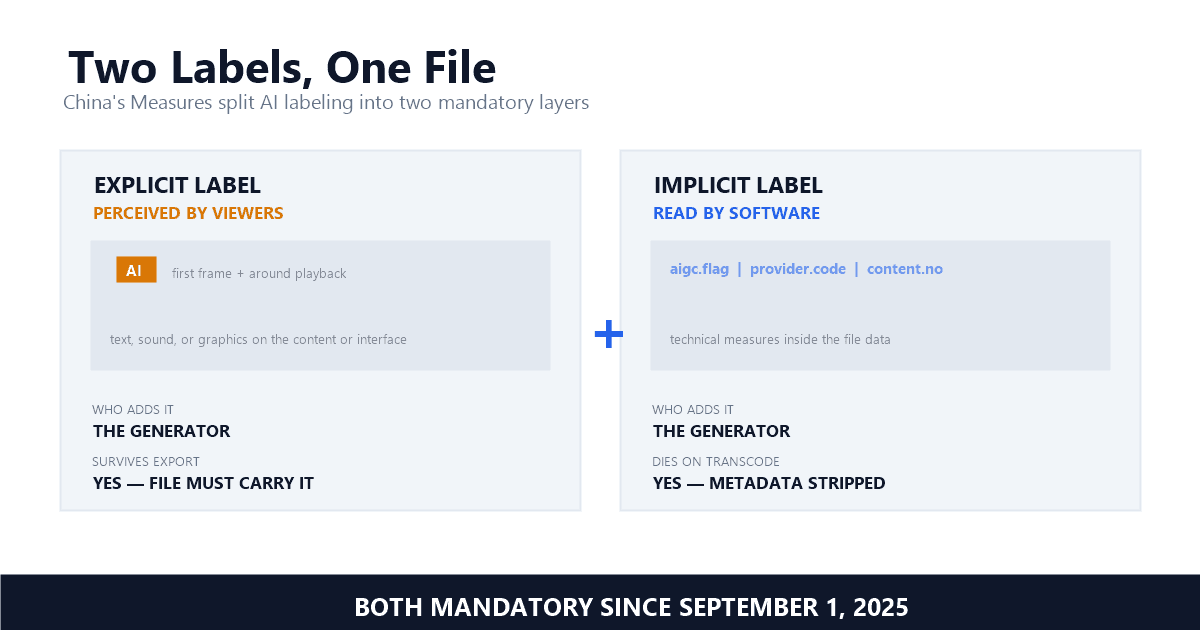
This is the most important caveat in this guide. Google's SynthID is an invisible digital watermark embedded at the pixel level in every Veo export. SynthID is designed to survive visual edits, compression, format conversion, and even partial cropping. Removing the visible Veo watermark does not remove SynthID.
SynthID is a provenance technology, not a branding tool. Its purpose is to let Google and authorized verification tools detect that a video was AI-generated — even if all visible markers have been removed. So even after you strip the visible Veo watermark, the video still carries the SynthID signal.
"SynthID embeds an imperceptible watermark in AI-generated content, allowing it to be identified as such even after modifications like cropping, compression, or color filtering." — Google DeepMind SynthID.
For most creators, this is actually a good thing. SynthID provides a layer of transparency: if someone questions whether your video is AI-generated, the SynthID signal can confirm it. But if your goal is to make AI-generated video completely indistinguishable from camera-captured footage, that's not achievable by removing the visible watermark alone — and it shouldn't be your goal. For a deep dive on SynthID and the C2PA content provenance standard, see our upcoming SynthID vs C2PA guide.
"Content Credentials are tamper-evident metadata that attach verifiable provenance information to media content, allowing creators to assert authorship and editing history." — Adobe, Content Authenticity Initiative.
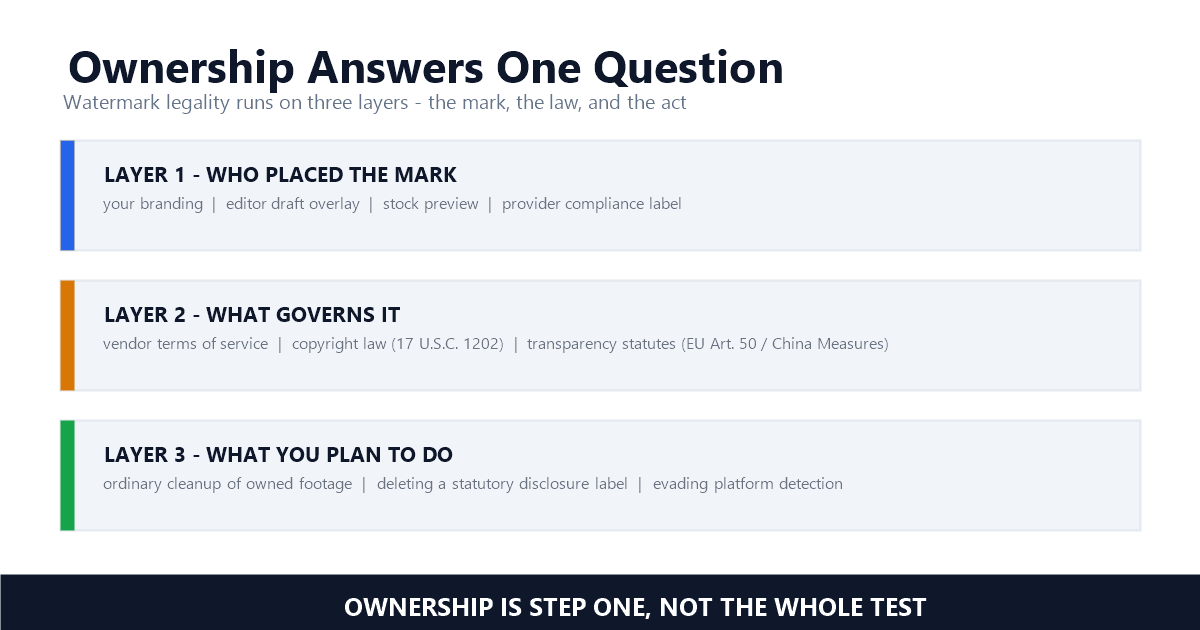
Removing a visible watermark is about cleaning up the visual presentation of your content — not about hiding its AI origin. SynthID and similar provenance watermarks should stay intact. If you're publishing AI-generated video, being transparent about its origin is both an ethical practice and increasingly a legal requirement under emerging AI disclosure rules.
Once you've verified the watermark removal, here's how to publish the clean video effectively:
For the complete frame-by-frame test data and visual comparison that complements this tutorial, see our Veo watermark removal test article. And if you're working with other AI video generators, our Veo watermark remover tool page covers the full range of supported formats.
The workflow is simple: export from Google Flow, upload to UnMark, let the AI inpaint the watermark region, verify the technical specs, and publish. The entire process takes a few minutes per video — and the result is a clean, professional-looking AI-generated clip ready for use in real projects. For the broader 2026 AI video watermarking landscape, see our industry overview.
Author's note: Most Veo tutorials stop at "just crop it." Cropping throws away part of your frame, and the watermark often sits on content you actually need. Inpainting is the clean path — run it once and the whole workflow takes a few minutes per video. — Mark Ma
Last updated: July 2026
Mark Ma is the founder and lead engineer at UnMark, where he leads the development of AI-powered video watermark removal technology. With over a decade of experience in computer vision, deep learning, and video processing, he has built production systems that process millions of frames per month across TikTok, Instagram Reels, and Google Veo content. His technical work focuses on motion-compensated watermark detection, spatial-temporal inpainting, and quality-preserving reconstruction for short-form vertical video. Before UnMark, Mark shipped computer vision infrastructure at scale for content moderation and ad compliance platforms. He writes this blog to document the real engineering, testing, and regulatory reasoning behind UnMark's processing pipeline — every test result, frame analysis, and benchmark published here is reproduced from actual production data, not synthetic examples. His goal is to give creators, brands, and regulators a verifiable technical reference for AI video watermark removal in 2026.